Wildlife advocates say education efforts lacking after monk seal video
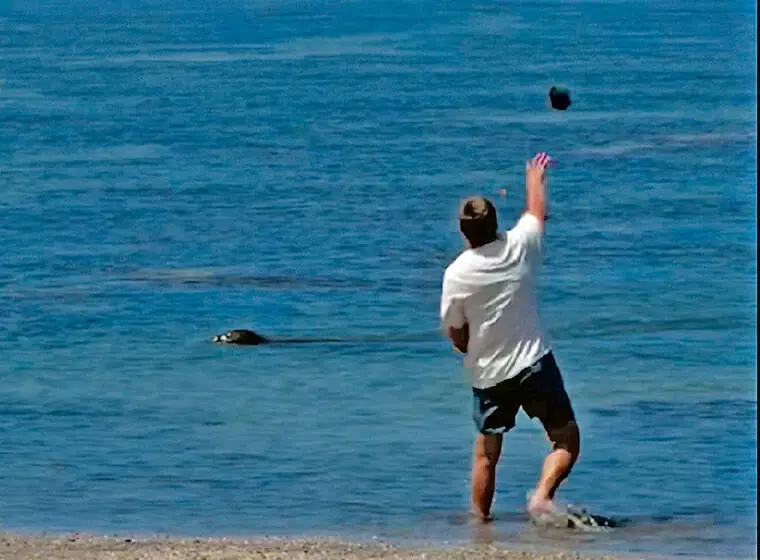
Video of a Washington man hurling a rock at a Hawaiian monk seal on Maui earlier this month has gone viral, drawing condemnation from all corners of the world. It also is raising questions about how well Hawaii is educating visitors about the endangered species.
Read more Caitlin Clark shines as Fever notch first home win of season over Storm
U.S. Sen. Brian Schatz, D-Hawaii, has called on the National Oceanic and Atmospheric Administration to strengthen its public education efforts.
“This alarming incident shows that we need to do more to educate the 10 million visitors who we welcome to Hawaii each year,” said Schatz in a letter to NOAA Administrator Neil Jacobs, “including continuing to ensure NOAA Fisheries, its Office of Law Enforcement, and the agency as a whole have the capacity and resources necessary to recover endangered species like the Hawaiian monk seal, conserve their habitats, and enforce their federal protections.” NOAA said it was aware of Schatz’s letter and would respond to it through appropriate channels.
The Maui visitor, who has since been identified as Igor Mykhaylovych Lytvynchuk, 38, of Covington, Wash., allegedly lobbed a coconut-sized rock toward the monk seal’s head as it was swimming in waters off Lahaina.
It was initially believed that the seal was a female known as Lani that frequents the Lahaina area. NOAA clarified Friday that the animal was an adult male identified as R404.
According to a criminal complaint, when witnesses confronted the man and told him they had contacted law enforcement, Lytvynchuk allegedly responded he was “rich enough to pay the fines” before walking away.
Federal officials on Tuesday charged him with harassing and attempting to harass an endangered Hawaiian monk seal, which are violations of the Endangered Species Act and Marine Mammal Protection Act. He was arrested by NOAA agents Wednesday near Seattle.
His defense attorney, Myles Breiner, says Lytvynchuk did not know the seal was endangered and did not intend to harm it. Lytvynchuk is expected to enter a not guilty plea May 27 in U.S. District Court in Honolulu.
If convicted, he faces up to a year in prison for each charge and fines of up to $70,000.
In the past, NOAA has fined visitors $500 each for touching or harassing resting monk seals. Offenders have included a Louisiana woman who touched a seal on a beach while honeymooning on Kauai, and a male tourist who snuck up behind a seal and touched it, prompting it to snap at him.
Many of offenders are caught after posting their exploits on social media.
Animal advocates say prosecution of these offenses are rare and that educational videos on respecting island wildlife should be shown on all flights to Hawaii.
Hawaiian Airlines spokesperson Alex Da Silva said that is already happening. In 2021, the airline launched its “Travel Pono” in-flight series highlighting employees who work with nonprofits, including a pilot who volunteers with Ke Kai Ola, The Marine Mammal Center’s dedicated monk seal hospital in Kailua-Kona.
The current “Travel Pono” video includes a segment that recommends keeping a safe distance from sea turtles and monk seals, among other tips such as not stepping on coral reefs.
“We were deeply disturbed by recent video of a visitor harassing a monk seal on Maui — an action that is not only illegal but profoundly disrespectful to Hawaii’s culture and wildlife,” said the airline in a statement. “As Hawaii’s airline, Hawaiian Airlines is committed to continuing to educate every guest to malama the places and communities they visit.”
The content is also highlighted in pretrip emails and social channels, Da Silva said.
The Hawai‘i Tourism Authority has put out its own messages about respecting wildlife in the islands, according to public affairs officer Jill Radke. The authority’s “Travel Pono” page at gohawaii.com recommends just that and includes a link to viewing guidelines.
HTA also has shared posts to social media of a monk seal mom and pup, saying, “Mahalo for keeping your distance.”
In past years, there have been public service announcements, such as “Malama Kauai’s Wildlife,” which explains monk seal distancing guidelines and what to do if encountering one of the animals in the ocean.
Radke said HTA works in close coordination with federal, state and county partners in drafting certain messages. This summer, there may be more messages on wildlife guidance from NOAA, as well as hurricane safety tips.
Read more Hawaii’s fight against Medicaid fraud plagued for over a decade
In 2022, HTA sent an email blast urging beachgoers to avoid Kaimana Beach in Waikiki while Rocky the Hawaiian monk seal was nursing her pup there. The message was in response to an incident in which Rocky injured a 60-year-old California woman who was swimming nearby, leaving her with several lacerations.
Radke said the majority of the millions of tourists who visit Hawaii annually respects its wildlife and culture.
“This is one visitor that very much does not represent the majority of visitors to Hawaii,” she said, referring to Lytvynchuk. “Most visitors to Hawaii love Hawaii for being Hawaii, for being unique, and they’re much more aligned with our values.”
Maui’s pending Destination Management Action Plan will include a pilot program recruiting community stewards to provide visitors with clear and timely information on ocean conditions, sensitive wildlife areas and safety concerns at local beaches.
Despite past and current efforts, marine animal advocates say education campaigns have not done enough.
KC Connors, moderator of the Facebook group ETA Hawaii — Enough Tourists Already, said there has been plenty of bad behavior by visitors in the past, but the rock-throwing incident is “the most aggressive one that we’ve seen,” and it certainly looked intentional.
The conflict between endangered wildlife and disrespectful visitors is a huge problem, Connors said, especially with diminishing beaches and overtourism. The group has posted examples of onlookers crowding around sea turtles and seals.
She formerly volunteered to hand out brochures to educate visitors about endangered monk seals at pupping sites, and said “a lot of the families were just lovely.” But there were others who would tell her they had paid for their vacation rentals and could do what they wanted.
HTA has run beautiful ads about Hawaii and the concept of malama aina (caring for the land), Connors said, but they are much too subtle.
“With Americans, you can’t be that subtle,” she explained. “You need to be more blunt.”
Subtle works for the Japanese market, Connors said, but for U.S. mainland visitors, the message needs to be straightforward and direct: touch a monk seal and you will be fined; touch a monk seal and you could go to prison.
Dana Jones, executive director of the Hawaiian Monk Seal Preservation Ohana, said the nonprofit began educating schoolchildren about monk seals 20 years ago after a local kid threw rocks at one in Ewa Beach. She believes it is making an impact.
“But we really do need to prosecute people when they break the law,” Jones said. “Tourists are going to sit up and say, ‘It’s going to cost me $10,000 extra if I do something stupid on the beach.’”
She agreed that state campaigns have been too gentle and should make it clear that offenders face huge fines for harassing wildlife and that no one is exempt from the law.
In a way, the viral rock-throwing video may prove to be a powerful PSA in it’s own right about respecting Hawaii’s wildlife. People have been sharing it far and wide, and many are learning that Hawaiian monk seals are the most endangered seal species in the world, with only about 1,600 left in the wild.
Connors believes people have just had enough.
“It’s a tipping point,” she said. “Again and again, Hawaii has bent over backwards to be kind to tourists, and this is a tipping point for us.”
To report wildlife violations, contact NOAA’s Office of Law Enforcement at 808-853-1964.
Read more BIIF flag football: Five Big Island teams knocked out at states