Hawaii poses unique challenges in removing unexploded military munitions
More than a century of military training has left untold numbers of undetonated bombs and other munitions across the Hawaiian Islands.
Read more Massive pack chasing Alex Smalley at PGA Championship
From military training in the years leading up to and throughout World War II, the Cold War and into the present, each service branch has used its own weapons ranging from bombs, grenades, rockets, mortars, cluster munitions, anti-tank rounds and other explosives that remain scattered around, and sometimes buried in, hillsides, jungles, valleys, reefs and beaches.
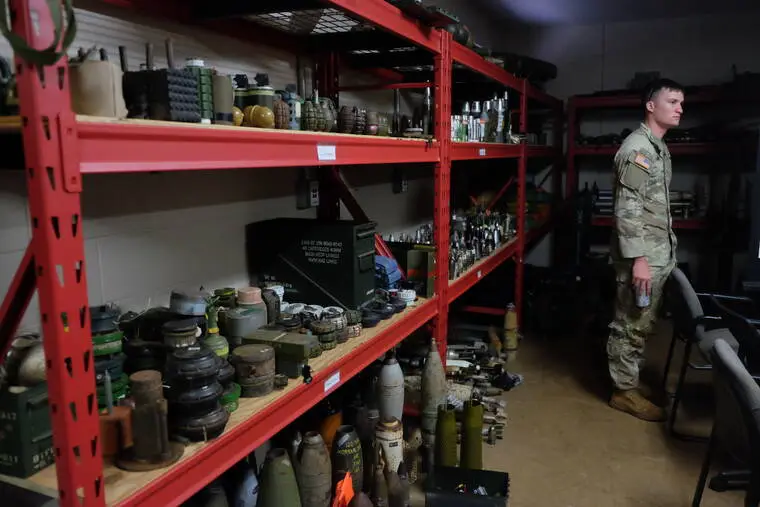
As a group of Army civilian employees received their annual training at Schofield Barracks last week for safely responding to unexploded ordnance, or UXO, they may encounter on the job, Spc. Austin Freeman showed them a shelf in his unit’s “team room” adorned with various munitions around a green sign that read “as seen in Hawaii.”
The training Tuesday consisted mostly of telling those going through not to touch anything that could be dangerous and to call the professionals if they find anything.
“We’d rather respond to a false alarm” than someone getting hurt, said Freeman, a member of an Army Explosive Ordnance Disposal team.
Everything on the shelf had been declared no longer dangerous by EOD teams. Some were old, rusted and degraded to the point that they barely looked like bombs at all. But explosive contents often remain deadly in muntions that, for whatever reason, failed to detonate properly when they were first used.
Freeman said that “a lot of times when something has been sitting out in Mother Nature forever and ever and ever — if you’ve ever seen some kinds of rusted metal, they let it go so far it starts to look like peeling tree bark.”
Other shelves in the team room included a wide range of other disabled munitions that serve as examples of the kinds of items EOD professionals could encounter from decades of Army training.
Beyond the unique mix of explosives in the islands, efforts to remove them are also complicated by unique factors in Hawaii’s geography, ecology, weather and history.
Now, as the military negotiates over the future of its leases on state lands — and as some military officials consider a land swap or other arrangement in which they may give up some federally owned land to focus on land they value more — the question of how to clear UXO has been a central discussion in negotiations.
• • •
Sgt. 1st class Gabriel Bell, an EOD soldier assigned to the 8th Military Police Brigade on Oahu, said he has responded to calls across the islands. Although the military munitions could have been fired or used decades ago, they don’t necessarily stay in place. Rains wash over hillsides and churn soil into mud, with any explosives present migrating around with the ground over the years.
Bell said the Kona-low storms in March moved munitions across the islands, including at Makua Valley on the Waianae Coast, a former military live-fire training area still used for drone and aircraft training. After the heavy rains, teams went through the valley “four or five times since the floods, and the rain has washed things down and off the mountains, and there’s a whole creek bed that we found stuff in because so much water has moved.”
Sgt. Wyatt Salmons recalled a close call with a piece of UXO that was covered with leaves and scattered among the rocks on a hillside.
“That was the worst thing to see,” he said. “One person passed it, an archaeologist passed it. I just looked down as it just so happened and thought, ‘That’s a weird rock,’ moved it and said, ‘That’s not a rock.’”
Once a piece of UXO is identified, there are several considerations on how to deal with it.
The safest way to remove them is to use a remote or timed explosive to detonate it in place where it was found. But in Hawaii, Bell said that “we’d rather not blow stuff up indiscriminately where it’s at, you know, even though it’s the safest for us.”
The UXO experts try to extract them, and if they believe the munitions can be moved safely, they are taken to Schofield Barracks in Central Oahu to be dismantled or destroyed.
Causing potential damage to ancient Hawaiian cultural sites and endangered species, or sparking wildfires, are ever-present concerns.
“We’ve had to wait overnight sitting on the UXO at the range just for fire conditions to get well,” Bell said.
At Makua, they must tread especially carefully. Soldiers recently found one next to an ancient Hawaiian archaeological site.
“There were petroglyphs on the rock, so we had to do some crafty stuff and add sandbags and stuff just to protect these things,” Bell recalled. “We really do take that into consideration. Archaeologists will document everything and that has to be reviewed by other archaeologists.”
• • •
Makua Valley is one of the most controversial of the military’s training grounds in the islands and holds particular significance for Hawaiian cultural practitioners.
Read more Aaron Rai emerges to win first major, first PGA for England since 1919
In Hawaiian, “makua” means “parent,” and the valley is considered the place where human life was first created, according to oral tradition.
The Army hasn’t fired a shot in Makua since 2004, when a lawsuit by Earthjustice on behalf of the activist group Malama Makua brought an end to live-fire training after wildfires burned brush and revealed ancient Hawaiian cultural sites within.
As part of the lawsuit, the group now does monthly “cultural access” visits to those sites under the supervision of Army personnel and contractors looking out for UXO.
The Army has said that it intends to vacate a parcel of state-owned land at Makua when its lease there ends in 2029, and military officials are considering giving up the federally owned portions of the training area as they seek to focus efforts on retaining land at the Pohakuloa Training Area on Hawaii island.
But cleaning up Makua is no small task. The valley was subjected to decades of live-fire training as ships at sea pounded it with canons and helicopters rained napalm and other munitions. The biggest challenge is the portion of the valley where the military used so-called improved conventional munitions, which includes cluster munitions.
Cluster munitions are filled with tiny explosives that scatter but rarely detonate on impact, at least initially. Once they spread out, the explosives create serious risks for anyone moving through the area.
Bell said that “back then we didn’t really know the permanent effects of that. It’s not till now where you see all these organizations going to Vietnam, still dealing with this stuff, and we’re realizing how much is still left there.”
Freeman said the devices had about a 30% detonation rate during first use, with the remainder still scattered. That’s enough of a problem alone for the UXO that are above ground. Once they get buried in the soil and move around, they present even more problems.
Uniformed military EOD teams in Hawaii largely lack the equipment to search for underground explosives, and long-term remediation work such as that falls to contractors.
• • •
Hawaii has a limited pool of on-island specialists with the proper certifications to go into the soil to clear explosives of any kind, let alone cluster munitions.
David Nishimura has spent over 20 years removing UXO and is co-owner of Hawaii-based Quality Metric Solutions. “Our whole goal is to try to employ as many local people as possible,” he said.
Nishimura, who has experience clearing sites in Hawaii and on the mainland, said the islands are full of unique challenges for his line of work.
Notably, he said, the false-positive rate in some areas can run as high as 80% due to the heavy content of basalt, iron and other metals in Hawaii’s unique volcanic soil. That makes it hard to find UXO with many of the currently available electromagnetic detection methods, significantly slowing the process.
It’s a long-standing problem, according to Andrew Alling, a Navy veteran turned researcher at the University of Hawaii who is working on an Army-funded project to develop new technology.
“There’s many reports going all the way back to Kahoolawe in the ‘90s,” said Alling, referring to the small island off Maui’s southwest coast that was used as a military bombing range from 1942 to 1990 before it was returned to the state in 1994.
“They brought all the fancy gear at the time and found the soil was really having weird effects on their equipment. The magnetic signatures were interfering.”
Nishimura said that while those technologies work well in finding explosives in deserts, swamps, tundras and other places used for military training, here in the islands, “hot rocks will ring louder than metal sometimes.”
• • •
The Army gave the UH team that includes Alling a grant to clear explosives from the military’s former Waikoloa Maneuver Area on Hawaii Island. The area was turned over to the state Department of Hawaiian Home Lands, but since then concerns about UXO in the soil have held up development on parcels for which prospective Native Hawaiian homesteaders had secured construction loans.
The UH researchers are looking at how to use smaller, more portable detection tools in conjunction with robotic drones and even AI tools to help isolate actual explosives from the “noise” in their readings.
Nishimura said he’s excited by the prospect of new technology that could help finally extract the potentially deadly munitions from the land. But he cautioned that even with new tech, it will require a skilled, local workforce and much time and effort to do the job right.
“What I’ve learned in my 20 years doing this is conservation and restoration is not a quick fix, it’s generational,” he said. “It is a generational war of attrition every day until you fix it. There’s no magic fix.”
Read more BIIF football: Gomes, Fronda sign with Utah Islanders