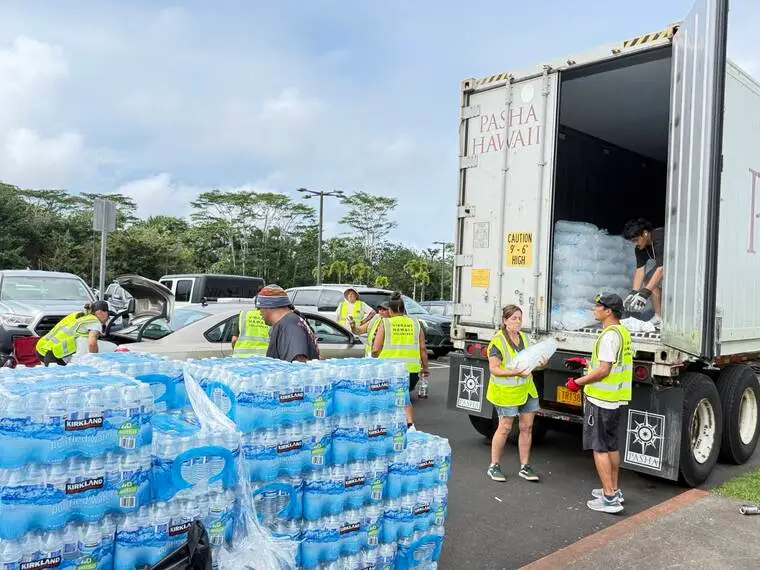
Big Isle nonprofits mobilize to provide, food, water, ice
Following Hurricane Lala’s hit on the Big Island over the weekend, local organizations have mobilized to get food and water to those impacted by the storm.
Read more ‘It’s going to look a whole lot different’: HPA football seeks redemption in 2026
Following Hurricane Lala’s hit on the Big Island over the weekend, local organizations have mobilized to get food and water to those impacted by the storm.
As of Wednesday, nonprofit Vibrant Hawaii reported that 1,076 households — representing 6,063 people — had submitted a request for assistance through the organization’s online portal.
“The biggest need that we’re seeing right now, based on this report, is assistance with food,” said Chief Resilience Officer Ashley Kierkiewicz.
In response, over the past several days, Vibrant Hawaii has organized over 20 “resilience hubs” islandwide to facilitate the distribution of over 3,860 cases of water, 7,010 hot meals, 2,348 bags of ice and 228 tarps, according to the organization’s website.
The hubs are staffed by community members who Kierkiewicz said have gone through extensive training to prepare for disasters such as Lala. The idea for the hub network arose following the 2018 Kilauea eruption.
“It’s been many years of training and community partnership and relationship through all kinds of things like food distributions, mobilization after the Kona lows, doing disaster exercises,” she said. “So, people are trained up.”
She said that having people who are part of each community take a leading role helps to ensure they are offering effective support.
“They know the vulnerable kupuna, they know the folks that are the single moms that might need a little extra food support,” she said. “So, because we are working in partnership with folks that are embedded in those communities, they’re able to ascertain what the needs are, and then from there, that helps to inform what kind of support we need to procure and get distributed.”
Vibrant Hawaii is also using data to determine distributions and coordinate with other organizations.
“We’re tracking everything that we are doing, and then if we know that folks are also providing kokua to communities like Ka‘u, we’re trying to understand what they’re giving, because we don’t want to duplicate … ,” she said. “If we are able to get our hands on resources, we have to be able to assess what has gone to which community.”
The Food Basket, another Hawaii Island nonprofit, has also ramped up distribution efforts in the days following the storm. On Monday, the organization opened up their two warehouses for extended hours for people to pick up food and water.
Read more Another storm is brewing southeast of the Big Isle
Executive Director Kristin Frost Albrecht said that 649 people in Kona and nearly 5,000 in Hilo came by to collect boxes of supplies.
Albrecht said The Food Basket staff also helped coordinate food drops in Pahala, Wood Valley and other parts of Ka‘u in the immediate aftermath of the storm. In the days since, she said teams have shifted focus to fill gaps in supporting other communities on the island which didn’t suffer the same catastrophic flooding, but are also in need of supplies.
“Ka‘u has a lot of attention — rightfully so — so, there’s lots of folks there,” she said. “So, we’re really concentrating on the other parts of the island that people have been out of power for a while and really need the help.”
This includes North Kohala, Hamakua and Fern Forest, where she said delivery drivers have been dropping off water, ice, food and daily ration packets from FEMA, which are nonperishable and provide a day’s worth of nutritional value.
Alongside disaster relief efforts, Albrecht said The Food Basket’s regular food assistance programs — which serve an estimated 60,000 people a month — have continued, as well as ongoing recovery efforts from the impacts of the Kona low storms earlier this year.
She said the organization will continue to distribute additional emergency food in coming weeks and work to support those impacted by Lala throughout the recovery process.
“We serve in every district, and so, just as we’ve done in past disasters, we’ll continue to reach out to the areas that have been most impacted to make sure people are getting what they need,” she said. “Our mission is to end hunger on this island and in the state, but during a disaster, we just really pivot to making sure people have their immediate needs met.”
While the focus for both organizations is currently on filling basic needs like food and water within communities, Kierkiewicz said additional needs will arise throughout the recovery process and encouraged people to keep this in mind when looking for ways to help and to check the organization’s website to see what is needed.
“This is a marathon, not a sprint, and there are so many requests to provide kokua, donations. A lot of folks are reaching out, wanting to provide immediate help,” she said. “We’re telling folks, give us a second to make an assessment … we’re in it for the long haul.”
More information and resources from Vibrant Hawaii — including the locations of resilience hubs — and The Food Basket can be found at www.vibranthawaii.org/ and www.hawaiifoodbasket.org/.
Read more Well-traveled CB Edmond finds comfort at UH
Email Grace Inez Adams at [email protected].

Related Posts

Remembering Hawaii’s 9/11 victims

World Manta Day returns today
