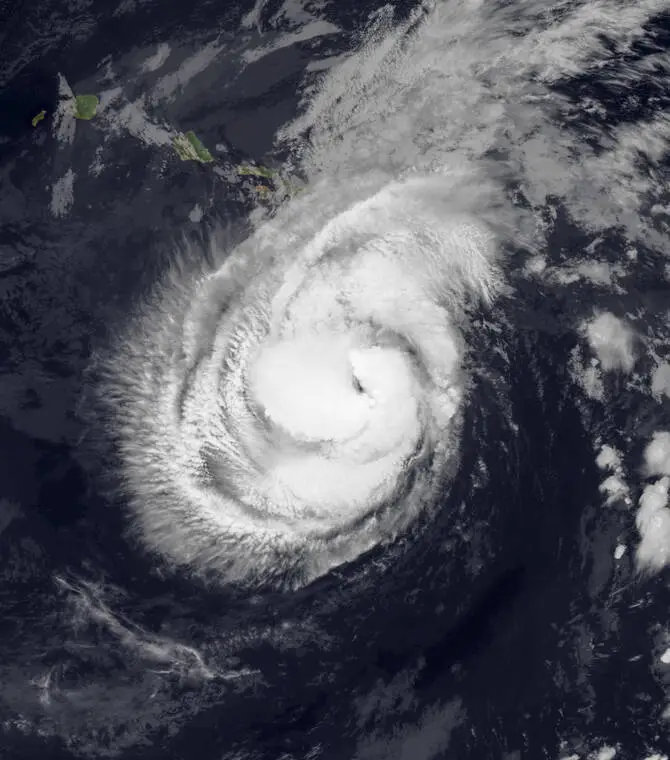
‘Very busy’ hurricane season forecast for Central Pacific
Be prepared for an unusually active and intense hurricane season.
Be prepared for an unusually active and intense hurricane season.
That was the message delivered Thursday by Gov. Josh Green, the National Weather Service, and state and county emergency managers.
Read more Permits granted to carry concealed guns up 54%
“We’re expecting a very busy hurricane season here in the Central Pacific — five to 13 cyclones. An average year for us is four to five,” NWS meteorologist John Bravender said during a press conference in Green’s office at the state capitol in Honolulu.
Bravender said a predicted El Nino — a weather phenomenon caused by warmer than normal equatorial waters in the Pacific — is a main driver of the forecast for robust cyclonic activity during hurricane season, which runs from June 1 through Nov. 30.
The National Oceanic and Atmospheric Association’s Climate Prediction Center last week forecast that an El Nino cycle had an 82% chance of occurring between May and July and a 96% chance of continuing through December to February.
El Nino doesn’t guarantee the development of tropical cyclones — which include hurricanes, tropical storms and tropical depressions — but does increase the odds of they’ll happen. And the the forecast of five to 13 cyclones in the waters around Hawaii isn’t a prediction of landfall by any of the potential storms, although that could occur.
Bravender attributed the wide range in the potential number of storms to uncertainty about “how quickly those warmer El Nino conditions develop over the summer and how they impact our hurricane season.”
He noted that most tropical cyclones migrate west to the Central Pacific basin — the borders of which are 140 degrees longitude in the east and the International Date Line in the west.
“Normally, we have one or two develop in the Central Pacific. Most move in from the east,” Bravender elaborated. “In 2015, half of them developed within our basin, so that could lead to less … time for us to prepare. That’s why you need to take this opportunity now.”
The prediction of increased hurricane activity also extends to the Eastern Pacific, with the potential for 15 to 22 named storms, which would also increase the possibility of more tropical cyclones approaching the islands.
Noting disastrous rainfall on the Big Island from Hurricane Lane in 2018 and the deadly 2023 Maui wildfire sparked by winds produced by Hurricane Dora, Green proclaimed that Hawaii residents have a “kuleana to be ready.”
“We’ve seen in recent years how quickly things can change in just a few hours … and preparation can never be understated,” Green said. “Our geography makes preparedness even more important, because we are the most isolated populated land mass on the planet here. And if we ever had a severe hurricane come and take out our harbor, we would be on our own for a while.”
Read more Dodgers’ Shohei Ohtani beats Padres with his bat, arm
Green thanked the Legislature for appropriating $175 million after two destructive Kona low storms in March, saying it’s “enough to get us through the hump until the federal dollars come in.”
”They also gave us $100 million in the budget, that I will sign in a couple of weeks as we head towards the deadline,” he said. “The $100 million is a flex account, so if there are a lot of storms, which we anticipated for this year, we will not have to go back into session.”
Army Maj. Gen. Stephen Logan, the state’s adjutant general and director of the Hawaii Emergency Management Agency, said the state’s and counties’ emergency management agencies recently held their annual disaster preparedness and hurricane response exercise, Makani Pahili — which translates to “strong wind” or “hurricane.”
Logan also urged residents to shore up their own preparedness.
“Plan for what is difficult while it is easy. Do what is great while it is small,” Logan said, a quote attributed to Chinese military strategist Sun Tzu, author of “The Art of War.”
“It starts with a plan,” echoed Talmadge Magno, the Hawaii County Civil Defense administrator. “We all need a plan. It takes quite an effort to put a plan together, but we all have that information, already, in our heads.”
“So, in your plan, you have to consider your vulnerabilities,” he continued. “Each person’s vulnerabilities are different — depending where you work, live or play — based upon the hazards that (Logan) pointed out. The surge, the dangerous waves, surf, the high winds and the rain. How do those hazards make you vulnerable in where you live, work and play?”
Magno said potential hazards for residents include evacuation routes being cut off by fallen trees or flooded roads.
All the speakers, Magno included, said residents should have a disaster kit with 14 days of nonperishable food, potable water, medications, pet food, flashlight, portable radio, batteries and other necessities. He advised those seeking more info to visit either county Civil Defense’s or HIEMA’s web pages for details.
“We have, on our websites, information that’ll help you put together a plan. Also, we have templates that you just fill in the blanks that’ll put the plan together for you,” Magno said.
Read more Thunder even the series with a Game 2 victory over Spurs
Email John Burnett at [email protected].