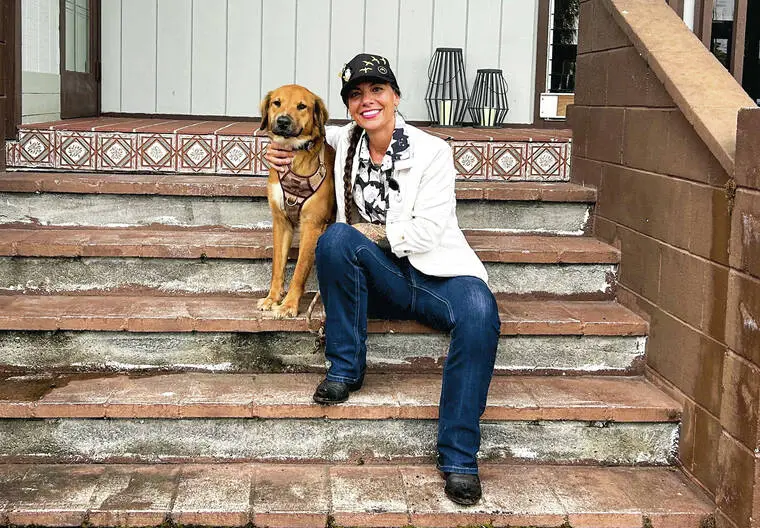
‘It takes a lot of compassion and grit’: DoDaro returns to lead Animal Control and Protection Agency
Three years after Regina DoDaro helped set up Hawaii County’s new Animal Control and Protection Agency, she returned last month to serve at the helm of the department as its administrator.
Read more Rams anxious for another gameday with ‘confident’ Giants on deck
Three years after Regina DoDaro helped set up Hawaii County’s new Animal Control and Protection Agency, she returned last month to serve at the helm of the department as its administrator.
In 2023, Hawaii County became the first in the state to establish a department dedicated to animal services. In other counties, animal control responsibilities are contracted out to non-profits, like the Humane Society. This was the case on Hawaii Island as well until 2021 when the county launched a two-year pilot program to incorporate animal control into the Hawaii Police Department, following which the County Council voted to create a separate dedicated agency.
DoDaro, who has a background in veterinary medicine and previously worked as director of operations for the Hawaii Island Humane Society, served as the animal control director during the HPD pilot program as well as the transition period to the new department.
Following that, she moved to Maui to support animal welfare groups after the Lahaina fire and took a position as director of field services and community outreach with the Maui Humane Society. She also spent time in Chicago, where she is from, helping to run a program designed to provide support for people with pets who are facing financial hardship or housing insecurity.
“That timeline really served me well in terms of lots of exposure to different styles of operating shelters — how animal control and shelter operations are really carried out under different perspectives,” she said, adding that it also allowed her to make connections she plans to leverage in her new role.
“That networking piece is really critical to us being able to provide as many resources as we can in our communities,” she said. “So I can reach out to the other islands and let them know I need assistance, they can do the same for me. And having the connections on the mainland allows us to work with other shelters to transfer animals for positive outcomes, such as adoption.”
While she valued these experiences, she said Hawaii Island, where she has spent 25 years of her life, always felt like home and she was eager to return when the ACPA administrator position became available.
Having been involved in the agency’s formation, DoDaro said she knew it was a significant undertaking, but one she was ready to take on.
“I am a self-described optimistic risk taker, and so returning to something that I knew would always be extremely challenging, for a myriad of reasons, was attractive to me because I was here during the inception and there’s nothing more that I want than to see this be successful,” she said.
ACPA is tasked with responding to an average of 70 to 100 calls every day about dangerous or endangered animals across the island, as well as caring for them and working to provide solutions for animals and people in compliance with legal requirements. It is a job that DoDaro says comes with many challenges, including public perception.
“We are largely a law enforcement agency, and we are tasked with lost and found animals,” she said. “However, the biggest misconception is that animals that end up in our care either do not receive medical support, that we don’t receive or accept cats or other species of animals, or all of the animals are euthanized. It couldn’t be further from the truth.”
She said every animal that comes to ACPA is evaluated and provided medical attention.
From there, she said, the agency works to reunite animals with owners, and if there is no owner or reunification is not possible, to connect with partner organizations to find homes for the animals whenever possible.
Legally, animal control organizations are required to hold untagged and unregistered animals for 48 hours and those with microchips or other identification for at least 10 days. However, DoDaro said ACPA treats the requirement as a minimum and works to support animals beyond that.
“I don’t hold to that time frame. If I have an ability to extend it within my fiscal responsibility and find a positive outcome, I’m going to do that,” she said.
Read more Fire Commission to interview six chief candidates
The county currently operates two shelters in the county — one in Kona and one in Orchidland, where the administrative offices and dispatch services are also located. The Kona shelter has a capacity of 100 animals and the Orchidland one can house up to 200, however this is currently reduced due to flooding issues in a portion of the facility.
While ACPA responds to calls about animals ranging from ducks to feral pigs and even fish, the shelters house primarily dogs that have been abandoned or surrendered. The department is also responsible for holding dogs that have been designated as dangerous while their cases are being processed.
DoDaro said both shelters are scheduled to undergo renovations in the near future.
There are also plans to acquire additional shelter facilities in Kohala and Ka‘u.
Following the renovations, she said she hopes to be able to open the shelters to the public to facilitate community events as well as direct adoptions. Currently, all adoptions are facilitated by partner organizations who visit the shelter to select animals which believe they can help find a home.
“Currently, that’s how we’re running it,” DoDaro said. “Simply because we don’t have the bandwidth to float people in and out. I would love to open that up, open the shelters up that way, but we also have to make the necessary repairs and renovations to ensure that everybody is safe.”
DoDaro is also working on building up the department’s staff. ACPA currently has 33 staff with 14 vacant positions, which she said the county is working to fill. In the meantime, she credits her current staff with bringing innovation, resourcefulness and care to the department to fill in the gaps.
“We are flying a plane that’s still under construction, and the airport is also under construction, but we’re doing it with a lot of grace and tenacity and a positive, optimistic outlook,” she said.
Since starting in her new position on Aug. 3, DoDaro said another priority of hers has been to increase public engagement and communication. This has included upping the number of dispatchers available to accept calls from one to three, the creation of an email account for non-emergency inquiries, and outreach and education efforts including a new mobile spay and neuter clinic.
“Spay and neuter is critical,” she said. “We have a severe pet overpopulation pretty much everywhere, but especially on this island, and it’s very difficult for people right now to be able to care for their animals. It’s expensive, we’re dealing with inflation, we have limited resources … so spay and neuter is a big one in our medical program.”
The mobile clinic will also provide services including microchipping and wellness checks for pets in partnership with other organizations.
Overall, DoDaro said she hopes to facilitate a communicative, transparent and compassionate ACPA.
“This is an incredibly challenging line of work, not just here on the islands, but anywhere, and it takes a lot of compassion and grit to do this work,” she said.
“Our team wants animals to have positive outcomes whenever possible, and I don’t think enough people realize that. Our goal really is to make a safer community and provide animals with homes whenever possible.”
For more information about Hawaii County ACPA visit https://tinyurl.com/53e5nace.
Read more NFL bars ex-LSU signees from joining teams this season
For ACPA services email [email protected] or call (808) 327-3558.
Email Grace Inez Adams at [email protected].