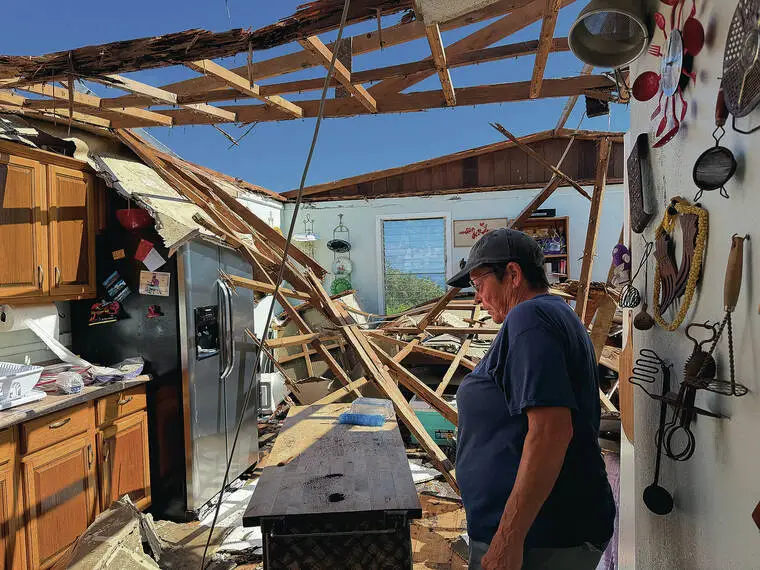
Storm damage to Hawaii infrastructure and schools costing hundreds of millions
A series of severe weather events this year brought more than $212 million in damage to public infrastructure across the state, according to preliminary figures from the Hawaii Emergency Management Agency.
Read more Olivia Miles breaks Caitlin Clark’s rookie scoring record as Lynx roll past Sun
That figure doesn’t include state Department of Education estimates of an additional $174.5 million in storm-related school repair, maintenance and recovery needs.
State officials caution the costs could escalate as damage assessments, documentation reviews, repair scoping and federal reimbursement determinations continue.
Hawaii experienced two back-to-back Kona-low storms between March 10 and 24 that brought heavy rain, damaging winds and widespread flooding. Then on May 22, a magnitude-6.0 earthquake struck the Kona side of Hawaii Island, triggering landslides and road closures.
Less than three months later, Tropical Storm Lala strengthened into a Category 1 hurricane as it passed near Big Island, with its heaviest impacts hitting the Ka‘u District the night of Aug. 15, causing catastrophic flooding in the area. Lala also brought flooding and damaging winds to Oahu and Maui.
Earlier this month, Hurricane Lowell, a Category 2 storm, passed near Niihau and Kauai the night of Sept. 7, its impacts stretching as far as Lanai. The string of disasters also proved deadly, with five fatalities reported from Lala and Lowell.
The Hawaii Emergency Management Agency’s preliminary estimates put public infrastructure damage from Kona-low storms at $44.8 million and $67 million from Hurricane Lala. Public infrastructure refers to publicly owned or operated assets such as roads, bridges, drainage systems, water infrastructure, government buildings, parks and other public facilities.
No monetary estimate has yet been determined for public infrastructure damage from the Kona earthquake.
Lowell targets Kauai
HIEMA estimated damage from Hurricane Lowell at $100.5 million, although preliminary assessments are still underway. Kauai County accounted for about $93.7 million of that amount, followed by Maui County at $6.4 million and Hawaii County at $430,000.
The Kauai estimate includes $45.4 million in damage to public utilities; $25.6 million to public buildings and equipment; $15.4 million to parks, recreational and other facilities; $5.5 million for debris removal; and $1.8 million to roads and bridges.
Damage to the Lihue Civic Building, which was severely damaged by fire on Sept. 9, was estimated at $24.75 million, according to HIEMA.
The agency also identified damage to two state harbors: $1.635 million at Port Allen Small Boat Harbor on Kauai and $3.1 million at Kaumalapau Harbor on Lanai.
A HIEMA damage assessment for residential property on Kauai remains pending. Kauai County officials said Friday that 880 damage assessments reports have been submitted with 18 homes destroyed and 100 homes with major damage.
Lala ravages
Hawaii Island
Hurricane Lala produced an estimated $67 million in public infrastructure damage, with Hawaii County accounting for the largest share at about $48.5 million.
Damage to public infrastructure on Maui County was estimated at $9.9 million, while on Oahu the figure was about $8.6 million.
HIEMA has identified 267 homes affected by Lala, including 29 destroyed, 82 with major damage, 102 with minor damage and 54 affected.
The agency has not yet determined how much of the damage from Lala will ultimately qualify for relief funds from the Federal Emergency Management Agency.
The Kona-low storms resulted in about $44.8 million in public infrastructure damage, according to preliminary data from HIEMA. Maui County accounted for about $19 million of that amount, with Hawaii County at $13.7 million and Oahu at $12.1 million.
The storms also impacted 463 homes statewide, including 17 destroyed, 210 with major damage, 128 with minor damage and 108 classified as affected.
Again, the amount that ultimately may be eligible for FEMA assistance has not yet been determined.
The Kona earthquake, meanwhile, caused damage to 313 homes in Hawaii County. HIEMA reported 18 destroyed, 92 with major damage, 188 with minor damage and 15 affected homes but has not yet established an estimate for monetary damage to public infrastructure.
Read more Worries persist in Hawaii despite Supreme Court’s mail-in ballot ruling
School disruptions
The recent weather events generated substantial repair and maintenance costs for public schools: about $162 million following the Kona lows and $12.5 million from Hurricane Lala. The estimates for Hurricane Lowell are still being developed.
DOE said those figures include anticipated costs for hazardous materials work, design and construction, repairs and maintenance, information technology infrastructure, equipment, classroom furniture and educational materials.
The department recorded about $3.2 million in expenditures related to the March storms as of last week. Spending associated with Lala and Lowell is still being compiled.
DOE separately estimated $142.8 million in additional repair and recovery costs tied to the three storm events. The figure is preliminary and could change as damage assessments, project scopes, insurance claims and potential reimbursements are finalized.
The department cautioned that the figures should not be added together to determine the total cost of the disasters because they represent different measures and may overlap.
The Kona-low storms generated 224 work orders at 54 schools, according to DOE. Hurricane Lala generated 153 work orders at 38 schools, while Lowell so far has generated 32 work orders at 17 schools.
DOE noted that a single school can have multiple work orders, depending on the number and type of repairs required.
The storms also forced campuses across the state to close for periods ranging from a single day to more than a week.
During the March storms, for example, Hokulani Elementary in Kaimuki and Konawaena Middle School and Ke Kula O Ehunuikaimalino, both in Kealakekua, were closed from March 23 through April 1. Noelani Elementary in Manoa was closed from March 23 through March 27.
Lala resulted in extended closures at several Hawaii Island schools. Ka‘u High and Pahala Elementary were closed from Aug. 18 through Aug. 28, while Naalehu Elementary remained closed through Aug. 25 before transitioning to at-home learning and eventually reopening at a temporary campus at Ka‘u Gym.
Lowell caused extended campus closures on Kauai, with all schools on the island closed Sept. 9 through Sept. 11, while Hanalei Elementary experienced additional closures that extended through Friday.
Support
for students
Schools adapted instruction based on the length of closures and conditions in each community. When possible, students received paper-based learning packets and other materials that did not require electricity or internet access.
DOE said that once schools reopened, teachers and staff monitored students’ academic progress and provided make-up learning, adjusted pacing and targeted support as needed. In some communities, the department also distributed shelf-stable meal boxes to students who would otherwise have received meals at school.
Officials said it is too early to determine the potential longer-term academic or social-emotional effects of this year’s disasters. Schools will continue to track students’ academic progress, well-being and behavior, and, if needed, connect youngsters and their families with counselors, social workers and other support services.
DOE said it is drawing on lessons from the 2023 Maui wildfires, when prolonged school closures required temporary learning sites, alternative campus arrangements, and transportation and additional academic and student support.
Neither HIEMA nor DOE could say how much of the damage will ultimately be covered by federal assistance.
HIEMA said FEMA eligibility determinations are still pending for the Kona-low storms, the Kona earthquake and Hurricane Lala.
DOE is also working with the state Department of Accounting and General Services and state and federal partners to identify insurance coverage, reimbursements and other potential funding sources.
“The amount of federal reimbursement that may ultimately be available, as well as the state’s ultimate share of recovery costs, has not yet been determined,” department officials said.
On the neighbor islands, DAGS crews have been handling smaller repair and maintenance work at schools on Hawaii Island and Kauai.
Read more Despite police enforcement efforts, some continue to drive recklessly on Saddle Road