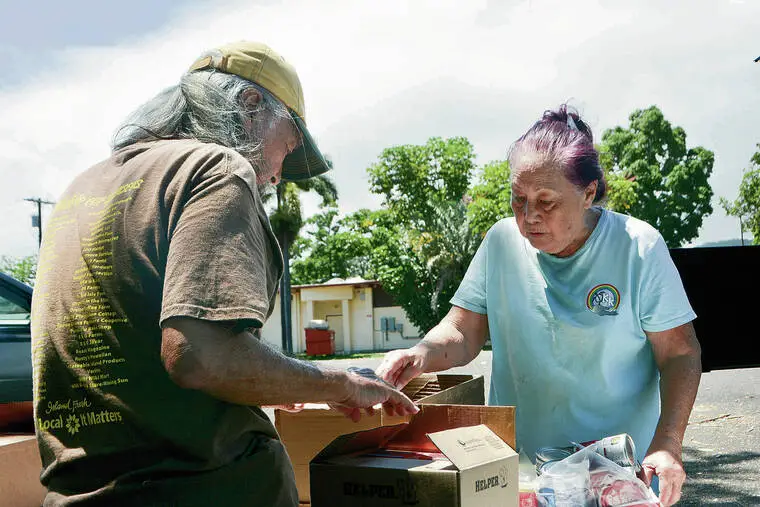
Pahala food drive illustrates continuing strain from Hurricane Lala
PAHALA — On Tuesday, residents of Pahala lined up for free groceries as the community continued to recover from Hurricane Lala — but for some, the food drive was about more than putting food on the table.
Read more Hearing set for man accused of killing Army combat vet in Puna
PAHALA — On Tuesday, residents of Pahala lined up for free groceries as the community continued to recover from Hurricane Lala — but for some, the food drive was about more than putting food on the table.
It was also a reflection of how repeated disasters, rising costs and prolonged recovery are changing the way people interact with one another.
O Ka‘u Kakou Market and The Food Basket hosted Tuesday’s drive, providing groceries to residents in a community where some families are still cleaning up storm damage and worrying about what could happen if another major storm arrives before they have recovered.
Longtime Pahala resident Corazon Barrios, 81, said floodwaters rushed underneath her home and into the living room during Lala, soaking the carpet.
Family members and friends helped clean up afterward, continuing a tradition of neighbors helping neighbors that she said has long been part of life in Pahala. But the storm also has changed some of what her household needs.
“We don’t have any more vegetables growing in the yard,” Barrios said. “All the Filipino vegetables, everything we grew, all no more, washed away already.”
She and her husband, Freddie Barrios, 78, have attended the food distributions occasionally in the past. Now, she expects they may need to come more often.
The food distribution normally takes place every fourth Tuesday at the Pahala Elementary School gym. But because the storm damaged Na‘alehu High School and displaced students who are now studying at the gym, O Ka‘u Kakou is operating from a lot alongside The Food Basket.
For organizers, the demand illustrates just how much the storm has strained the community.
June Domondon, treasurer of O Ka‘u Kakou, said the organization has seen a noticeable change in behavior since Lala.
“The people have gotten greedy,” Domondon said. “They take.”
The organization has had to tighten its rules for picking up food on behalf of other people. Residents must bring a letter if they are collecting groceries for someone else, she said, because organizers previously saw people picking up multiple times.
“Because if not, they double dip, and then the people who need it don’t get any,” Domondon said.
Domondon said O Ka‘u Kakou also has dealt with reports of people stealing from homes during the recovery. Her own family installed security cameras after experiencing concerns about theft.
She said she understands that desperation can change people’s behavior.
“They’re trying to survive, and it’s understandable,” Domondon said. “But they don’t think about the other people.”
The problems became especially apparent immediately after Lala, when electricity and water were out and residents across Ka‘u needed basic necessities.
At a distribution hub in Na‘alehu, Domondon said, the lines were nearly constant as O Ka‘u Kakou and other groups distributed water and other supplies to residents from Ocean View, Waiohinu, Na‘alehu, Pahala and Volcano.
“Before the storm, the lines had never been that long,” she said.
Domondon said reports of looting, theft and people taking advantage of the situation emerged after the storm. While she said such behavior is not excusable, she also said desperation can drive people to act differently when they are struggling to meet their basic needs.
For Jaime Penera, 57, who was raised in Pahala, recovery has meant helping friends while also trying to put his own life back together.
Penera previously worked in landscaping at a hotel, but health problems that required dialysis eventually forced him to leave the job. He recently stopped working, making the financial strain of the storm and the rising cost of everyday necessities even harder to manage.
At his own home, a couch and some furniture had to be replaced, along with clothing. Nothing was catastrophic, he said, but the losses still mattered.
“When you build your life, no matter how small or big, every loss counts,” Penera said.
Read more Curtis Murayama: 49ers, Hawaii fans have to wait to see Stribling prove his NFL worth
He said the free food has helped, particularly at a time when he is no longer bringing in the income he once did, and he expects demand for the food drive to increase.
“Hawaii — even before the storm, everything so expensive, food is very expensive,” Penera said.
The continued threat of storms — such as Tropical Storm Nolo, which formed southeast of the Big Island on Wednesday — adds another layer of anxiety.
Penera said he becomes worried whenever he hears news of another storm system, particularly because the ground remains saturated after repeated heavy rains.
There is also little time to recover between disasters, he said.
“There’s not enough time to clean up before we get hit again,” Penera said. “It’s very tiring. But when nature calls, you gotta be ready.”
For some residents, Tuesday’s food distribution offered immediate relief but also underscored a larger problem: Food assistance can help a family get through the week, but it cannot solve the affordability crisis that made the assistance necessary.
Residents said they are grateful for the food, while also describing how quickly it can disappear in a household.
One box of groceries can be gone within days, particularly for families, leaving them facing the same expenses again the following week.
The financial pressure also has affected how residents treat one another.
Some residents said they have encountered people entering homes during cleanup and taking belongings. In one instance, a person allegedly posed as someone helping with cleanup before taking items from a home.
Those experiences have created distrust.
Residents said people who have been taken advantage of can become less willing to share or help others, while those struggling to survive may become increasingly desperate.
The result, they said, is a community caught between two competing instincts: the long-standing expectation that neighbors help neighbors, and the fear that helping someone else could leave a family without enough for itself.
Domondon said O Ka‘u Kakou has tried to fill as many gaps as it can through donations, but the organization’s resources are limited, making it necessary to distribute assistance as evenly as possible among those in need.
She said some residents ask for more supplies than the organization can provide, adding to the strain on volunteers who are already trying to meet growing demand.
“We’re trying to serve everybody,” she said.
More volunteers would help, Domondon said, as the number of requests continues to grow.
With additional storms approaching, she said the frustration is building.
“There’s so much stuff added now that we have to take care of and do,” Domondon said. “These demands are getting bigger.”
The requests range from water and food to emergencies beyond what a volunteer organization is equipped to handle. Domondon recalled one instance in which a woman called O Ka‘u Kakou after falling, despite the organization not providing medical services. Still, Domondon said, people often turn to the group because they know it will try to help.
That willingness to help has been one of the community’s strengths during the disasters. But residents and organizers say recovery cannot depend entirely on volunteer groups and individual acts of generosity.
Government services need to arrive quickly, supplies need to be sufficient and residents need enough economic security that a box of groceries does not become the difference between having enough food and going without.
For Pahala, the storms have damaged homes, disrupted schools and strained infrastructure. But residents say another, less visible form of damage may be occurring at the same time: the erosion of trust between people who once depended on one another.
The concern is not that the community has stopped caring. Rather, residents worry that repeated disasters and financial pressure are making it increasingly difficult for people to care for others without first worrying about whether they have enough for themselves.
For a community accustomed to helping its neighbors, that may be one of the most difficult parts of recovery.