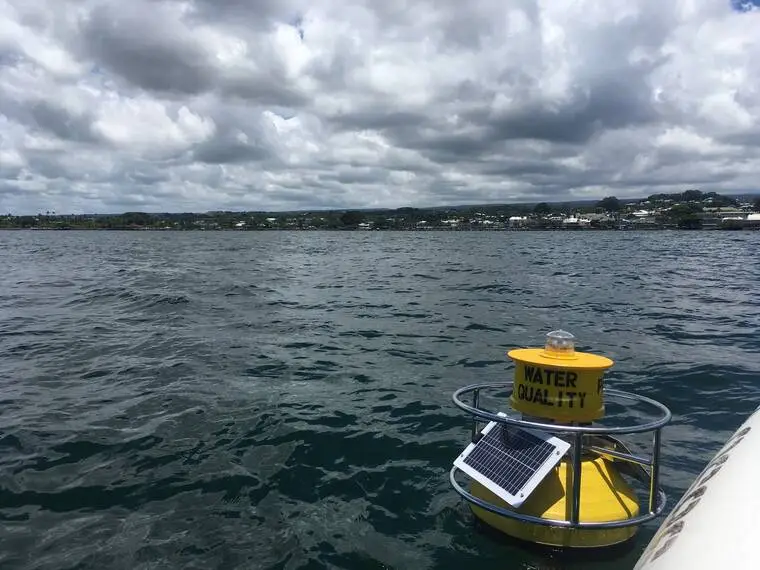
Management plan in the works for Hilo Bay watershed
Efforts are underway to develop a watershed management plan for Hilo Bay, which has a long history of poor water quality, high bacteria levels and brown water advisories.
Read more Nick Kurtz comes through again as A’s take set from Angels
Efforts are underway to develop a watershed management plan for Hilo Bay, which has a long history of poor water quality, high bacteria levels and brown water advisories.
The project, which is being funded by a $2 million grant awarded to Hawaii County in 2024 from the National Fish and Wildlife Foundation, will lay out a roadmap for addressing the issues that have plagued the bay for decades.
The plan will be refined over the next year and is scheduled to be finalized by fall 2027.
University of Hawaii at Hilo professor and researcher Tracy Wiegner said it is a step that is long overdue and will open doors for the county to get the funding necessary to make progress on better managing and protecting the watershed which drains into Hilo Bay.
“I think it’s great that they got that grant to do the watershed plan. We’ve needed it since I moved here in 2004. They’ve been wanting to do that,” she said. “We need it in order to qualify for federal funding to implement watershed management activities to improve water quality, so we haven’t been able to apply for those funds, because we don’t have a watershed management plan in place.”
Wiegner has been involved in extensive research on Hilo Bay and its watershed. While she said more research is needed, there are several primary factors that contribute to the poor water quality. Those factors include sediment draining into the bay, likely from soil erosion along the Wailuku River, and sewage from the many cesspools on the island seeping into groundwater and then into the bay.
“Fecal indicator bacteria levels are high, and this is likely from all of the on-site sewage disposal systems in Hilo,” she said. “Most homes have cesspools, which are just holes in the ground, so all of the waste from your home — from your sink to your shower, to your toilet, to your washing machine — all enters into the groundwater, which then eventually discharges at the shoreline.”
There are an estimated 50,000 cesspools in Hawaii County, all of which are under a state mandated to be closed by 2050.
Read more PHOTOS: ‘Riders recap year at annual athletics ceremony
Stephen Colbert is another researcher at UH Hilo who has worked with Wiegner on studying the water quality of Hilo Bay and its watershed.
He said that while it is not the only watershed harmed by sewage and other pollutants, its vast size poses additional challenges to addressing them.
“The Hilo Bay watershed is huge,” he said. “To just kind of put it in perspective, it’s like half the size of Oahu, and there’s no way that any one entity — whether it’s the county, the state, or private land owners — there’s no one entity that could fix all of that (or) could do all the things that are needed to improve the water quality of Hilo Bay.”
However, he said the watershed management plan will be a useful tool in working toward a healthier watershed.
“What I hope to see coming out of this is Hilo Bayfront becoming more of a place where people want to go and spend time, and for those that already do go there and spend time in the water, that the water quality is improved, so there’s less concern with going in the water,” he said.
As part of the development of the plan, the county is hosting a community listening fair this weekend for those who want to learn about the project and provide feedback.
The event will take place from 10 a.m. to 4 p.m. Saturday at the Aupuni Center Conference Room at 101 Pauahi St., Suite 1, Hilo.
Read more Knicks ride third-period explosion to 2-0 lead over Cavaliers
To learn more, visit www.rd.hawaiicounty.gov/economic-development/hilo-bay.
Email Grace Inez Adams at [email protected].