Why did Steph Curry, Kawhi Leonard sign two-year deals? Explaining the over-38 rule
Kevin Durant. James Harden. Steph Curry. Kawhi Leonard.
Of all the basketball players born between 1988 and 1991, they are undoubtedly the four greatest. Individually, three of the four have won regular-season MVP, while three of the four have won Finals MVP. Overall, they might be the four best players of the 2010s, save for … well, you know.
Read more Stephen Tsai: Ex-Hawaii coach Craig Stutzmann wouldn’t change his ‘Rocky’ journey
Even now, roughly a decade after their respective peaks, all four have made an All-Star team in the last two seasons, and all four have a plausible case as their teams’ No. 1 option when it matters.
And now, they have something else in common, too, something that has become increasingly common in the NBA in recent years: The non-max “over-38” veteran extension. Curry became the latest player impacted by the rule when he agreed to sign an extension Friday night.
With the NBA collective bargaining agreement’s so-called over-38 rule limiting the number of years veterans such as these four can receive in an extension, the focus has shifted from Get That Bag to other areas — such as what other professional objectives might be achieved if the player left a bit of money on the table.
First, a primer: The over-38 rule limits teams to offering two-year contract extensions to any player who would turn 38 during the extension. Obviously, that impacts 38-year-old Curry, but it also includes players like the just-turned-35-year-old Leonard, because he would turn 38 during any extension longer than two years.
As a result, these four players have ended up with four remarkably similar deals to continue their careers. Technically, Harden’s deal isn’t an extension, but the over-38 rule drove much of the logic behind his eventual path to re-upping in Cleveland, on terms not too different from the others. Durant went first in the 2025 offseason, while Leonard and Curry just agreed to terms on their deals in the last few days.
One particular detail you’ll note: All four deals have player options in the final seasons, even though these players would be pushing 40 and seemingly unlikely to chase a big payday elsewhere in free agency. From the team side, this is likely a feature rather than a bug.
Being able to opt out of their deals gives the teams two forms of flexibility when dealing with the player: First, if the player loses effectiveness, the team and star can still negotiate to “land the plane softly” by having the player opt out of his deal and sign for lower annual money at a longer term. (Harden, in fact, already did a variant of this in his deal with Cleveland that we’ll discuss in a minute.)
For example, if Curry is showing his age in 2028 and the Warriors want to use some of his $60 million salary toward other upgrades instead, they could have him opt out and re-sign for a lower number that pays out for more years (a maximum of three due to the over-38 rule). Think of it as a bit like the stretch provision, except it keeps the player on the roster. In fact, the over-38 rule exists to prevent more brazen implementations of this same strategy.
Second, even if the player is still worth the money at that point, it gives him the chance to make a similar choice to the one these four vets made in the last 12 months, not to mention the one made by younger players such as Victor Wembanyama and Jalen Brunson: re-signing for a lesser amount to enable roster moves that otherwise would be difficult or impossible.
That’s the shorthand version of why we’re seeing these extensions. Let’s break it down a bit and talk about each of the four individually. Some subtle variations in contracts and team situations add specificity to each case.
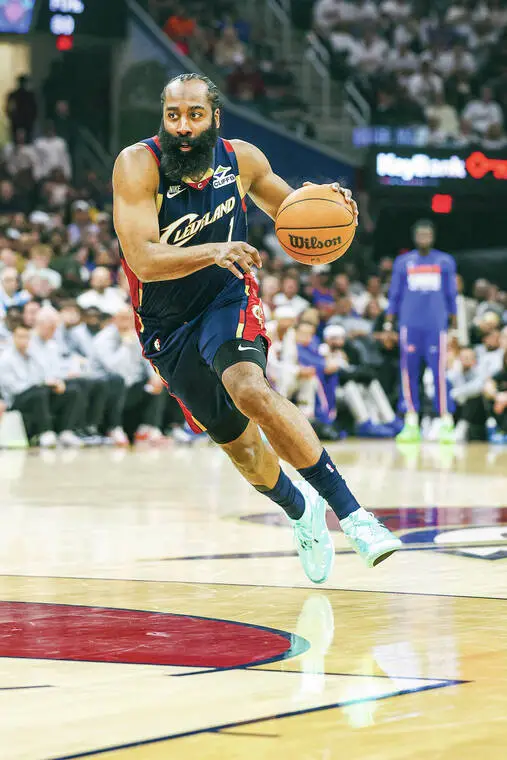
James Harden
(re-signed with Cleveland for three years, $97 million)
Harden’s deal is the most intricate of the four, as he basically engineered his departure from the Clippers last trade deadline so he could get to his next payday in Cleveland. The plot twist here is that Harden’s contract was already set to pay him $42 million for 2026-27. He opted out of that so he could re-sign for … $29.9 million.
Huh?
Yes, the original deal had only $13 million guaranteed, but it’s not like the Cavs were gonna cut him. No, the real method behind the madness is that Harden’s free agency bought the Cavs time this summer, and they needed that time to determine the most they could pay Harden and still make the other roster-building moves they needed to stay in contention.
Cleveland’s big offseason stroke, the sign-and-trade deal for Peyton Watson, didn’t happen until late August, and it only happened because the Cavs and Harden agreed to delay signing a new contract. They knew roughly what the amount would be, but it wasn’t until the Watson deal got to the finish line that they had enough clarity to know the exact limit: $97 million over three years. That figure combines the most they could give him annually while staying below the second-apron hard cap imposed by the Watson deal and the longest contract (three years) allowed under the over-38 rule.
The $97 million deal has another significance: It matches what he would have made if he stayed at $42 million in 2026-27 and tacked on another year with an 8 percent raise, the maximum-allowable bump. The only difference is that his money is spread over three years rather than two. But if he’s still cooking defenders entering his age-39 season in 2028, the player option for 2028-29 is an opportunity to make up the difference.
In the meantime, the money he left on the table has a very clear impact on his team’s chances this season, because it enabled the Watson acquisition.
Kevin Durant
(signed two-year, $90 million extension)
Durant’s extension, agreed to a year ago in Houston, feels forgotten, but it portended some of the moves we’ve seen more recently. When the Phoenix Suns traded Durant to Houston, he was eligible to sign a two-year extension before last season and did so, but with a significant haircut: Durant took $90 million over two years instead of the maximum $120 million.
Read more Nolo dropped less rain than Lala before spinning away
That difference kicked in this offseason and gave the Rockets an additional $15 million in operational wiggle room. That short-term benefit let Houston sign Marcus Smart while staying below the first apron and keeping their trade flexibility — massive for any star-hunting moves the Rockets might pursue with their tantalizing combo of draft assets and expiring money.
The deal should let Houston just barely skirt the tax this season (at the moment I have them limboing under the tax line by an incredible $14,077), which is equally desirable from a team perspective. It sets the Rockets up to navigate a much more expensive roster a year from now when Amen Thompson’s $207 million extension kicks in and Fred VanVleet becomes a free agent. The Rockets could be into the tax in both 2027-28 and 2028-29 without paying the repeater penalty if they stay under the tax this season.
Some of that money, of course, is likely earmarked for Durant, since he can opt out of his $46 million contract for 2027-28 after this season. (The contract cannot be extended before then.) One presumes he will opt out no matter how this season goes, just to provide his team the best chance to win over the next three years by mimicking what Harden did this past summer. If he inks a three-year deal, he’ll be hooping well past his 41st birthday.
Kawhi Leonard
(signed two-year, $115 million extension)
Leonard is the youngest of these four players, but he’s also been by far the most injury-prone, which makes paying him $115 million for the two seasons after this one not exactly risk-free. Leonard is also notable for taking the smallest haircut of the four, signing for $10 million less than his max contract over the next two seasons.
That’s partly because Leonard’s peak version remains the most impactful of the group. He was arguably one of the league’s five best players last season. But a $56 million commitment to Leonard sets up Toronto to be one of the league’s most expensive teams next season. For instance, if the Raps trade RJ Barrett’s expiring deal for another core piece and re-sign bench sparkplug Jamal Shead, they are likely to land at or above the second apron in 2028-29. (That is, unless they can find a taker for Jakob Poeltl’s $27.3 million cap hit. Please? Hello? Anyone???)
Leonard won’t be able to extend the deal again before his player option season in 2028-29. Thus, as with Durant, he’s likely to opt out almost regardless of how he performs — with the general parameters likely understood by the two sides ahead of time, but the particulars possibly waiting until later in the summer when the Raptors have more facts about the rest of the roster, similar to Harden this past summer.
Steph Curry
(signed two-year, $116 million extension)
Finally, there’s Curry, the most recent addition to the list and also the most intriguing one. This wasn’t a simple calculation on his part or the team’s. Curry, in particular, could have gone in many directions here, most notably waiting until after the season to sign a three-year deal instead of the two-year extension he signed. Unlike the other players above, none of whom are on their first team, Curry also had some added leverage as a franchise legend. More than anyone else, he has turned the Warriors from a tortured franchise into a money-printing factory.
As with the other players, he won’t be able to extend this deal again before his opt-out in 2028. In two years, he’s likely looking at a negotiated opt-out where the two sides figure out the best financial path to end his career in a Golden State jersey. In the meantime, I’ll note that being under contract for next year (and not a free agent) gives Curry an out for a trade if things go horribly wrong, without having to go the LeBron James route and take a minimum deal in free agency.
That scenario, by all indications, is highly unlikely. More salient: With Curry’s number hard-wired, and his return next season certain, the Warriors front office can use his presence as a recruiting magnet, and work on collecting the pieces for the rest of their 2027-28 cap puzzle.
It’s an uncertain picture. Jimmy Butler and Draymond Green will be unrestricted free agents (unless Butler also extends his deal). Al Horford, De’Anthony Melton and Kristaps Porzingis have player options, and Brandin Podziemski will be a restricted free agent.
There’s a sliver of a chance, then, that Golden State could pursue a cap-room play built around Podziemski’s team-friendly $17 million cap hold. (Podz could also sign an extension between now and Oct. 19.) That would entail the others opting out, Butler leaving and Green re-upping for the room exception, leaving the Warriors $60 million to wave around in free agency for a Nikola Jokic moonshot.
But this isn’t 2016 in the Hamptons. Elite players rarely become truly available in unrestricted free agency anymore. More likely, the Warriors can operate as an above-the-cap team and use their expiring contracts and draft assets to bring in an elite player, ideally one who is younger than 50 or so given the age of the rest of the roster. (Even their rookie is old!)
In that event, the “discount” Curry took — roughly $10 million less than his max in each of the two seasons — is all about the tax aprons and the Warriors’ ability to add talent over the next 12 months while navigating them. This has nothing to do with the tax, as Golden State owner Joe Lacob has already shown he’ll shoot money out a firehose to win.
But just staying under the first apron could be huge. Allowing salary aggregation and friendlier salary-matching terms in trades, being able to use the nontaxpayer midlevel exception and biannual exception to add talent and being able to complete sign-and-trades are likely important elements for any Warriors 2027-28 plan that doesn’t involve wielding cap room. Those avenues disappear for teams over the apron.
The fascinating part is that we don’t yet know which pathway the Warriors will choose, something likely to be determined more by who becomes available to them. The 2026-27 season almost feels like an afterthought for a phenomenally old roster (the 36-year-old Green could be the second-youngest starter!) that will be missing Butler most of the year. Much like the three players above, however, Curry’s deal is the latest of the “over-38” deals to increase teams’ future flexibility and ability to contend in coming years.
Read more BIIF football: No. 12 Warriors, No. 13 Wildcats rematch this week; plus other upcoming rematches
This article originally appeared in The Athletic.
© 2026 The New York Times Company