Kauhale builders admit ‘mistakes were made’ as audit looms
The impending release of a highly anticipated critical audit of the state’s kauhale homeless housing initiative has prompted a rebuke of HomeAid Hawai‘i over its billing practices and led the nonprofit to launch its own financial reviews resulting in its CEO repaying $17,982 for expenses considered his “personal responsibility.”
Read more ‘We had extra motivation this week’: Wildcats get revenge, tiebreaker with win over Warriors
While the state has taken steps to correct billing deficiencies from HomeAid, and the nonprofit is admitting missteps, both acknowledge their actions came in the wake of an April 20 memo from State Auditor Les Kondo warning of the need for “immediate attention” to address “improper use of public funds.”
“We are concerned that significant deficiencies in internal control in the State Office of Homelessness and Housing Solutions’ (SOHHS) implementation of the kauhale initiative create an ongoing and substantial risk of improper use of public funds,” Kondo said in his memo.
At the time, he made it clear that the focus of the audit was SOHHS oversight of the kauhale program and not on HomeAid.
HomeAid’s operating budget of just $207,407 in 2015 shot up exponentially to $142.9 million in 2024 on the heels of explosive growth from state contracts to expand kauhale projects and build emergency housing for survivors of the Aug. 8, 2023, Maui wildfires.
Jun Yang, the state’s homeless coordinator, said in a statement that his office “takes the audit very seriously. Despite the 10 month delay, SOHHS has taken steps to develop monitors and contract management practices. On August 7, 2026, after an internal administrative review, SOHHS sent a letter to HomeAid that detailed deficiencies with billing of invoices. HomeAid undertook a corrective action plan and made efforts to resolve issues with billing.”
In the August letter addressed to HomeAid’s CEO Kimo Carvalho, Yang cited “recurring, systemic non-compliance issues regarding the submission of payment invoices. Specifically, HomeAid Hawaii has routinely failed to adhere to mandatory state financial submission procedures.”
Yang cited “deficiencies” including:
• Failure to provide original receipts, vendor proof of purchase, “or certified underlying documentation required to verify expenditure authenticity.”
• Invoices that included line items “previously submitted, processed, or reimbursed under prior payment requests.”
• Payment requests “for unallowable expenses or activities outside the contractually authorized scope.”
• Invoices that have included “billing statements, invoices, and payment demands from third-party vendors, contractors, or affiliated entities that hold no direct contractual relationship or approved subcontract status with the State of Hawai‘i.”
Yang told Carvalho in the letter that “effective immediately, all pending and future invoice submissions from HomeAid Hawaii will undergo heightened administrative oversight. Any invoice containing any of the non-compliant practices outlined above will be rejected without processing and returned for full remediation prior to payment authorization.”
In order to comply with state requirements, Yang instructed HomeAid to take corrective steps within 15 days that include submitting a written Corrective Action Plan detailing internal “fiscal controls and review processes HomeAid Hawaii will implement to eliminate invoice errors.”
HomeAid also must “designate a primary financial compliance point-of-contact responsible for conducting pre-submission audits of all state billing packages,” Yang wrote, and schedule “a mandatory compliance briefing with our office’s fiscal team to review baseline accounting requirements and verification standards.”
Scaling up quickly
In the meantime, Carvalho said he has repaid the nonprofit $17,982 for expenses connected to the kauhale initiative following HomeAid’s internal reviews of finances during its period of explosive growth that included being tapped by Gov. Josh Green to quickly build emergency housing for Maui wildfire survivors.
The kauhale concept was inspired by a 2019 trip that Green, as lieutenant governor, took to Texas to see a tiny-home community built by HomeAid Austin that housed 200 homeless people and resulted in a 60% reduction in drug use while retaining 82% of the residents.
Working with HomeAid Hawai‘i, Green opened the state’s first kauhale in December 2019 in Kalaeloa and moved to expand the concept after he was elected governor in 2022, using a series of executive orders initially opposed by some environmental groups, historic preservationists and others Green had considered allies but who were alarmed that the executive orders would allow established procedures to be ignored.
This year, Green expects to see a total of 33 kauhale opened around the state through HomeAid.
In a statement Friday to the Honolulu Star-Advertiser, Green said, “We welcome accountability and will continue strengthening the program, but we will not lose sight of what matters most: kauhale are working, it is changing lives, and we are going to keep building on that progress because the people of our state deserve a real solution to this generational problem.”
Members of HomeAid’s board of directors acknowledge that accounting mistakes were made as the organization rapidly scaled up to build kauhale, but they said any missteps were addressed in audits it implemented on its own.
Read more PGV aims to boost output with new wells
Carvalho said he made five trips to vet modular housing construction companies to build 450 tiny homes for fire survivors on Maui, including three trips to Korea and China that should not have been billed to the state as kauhale homeless housing spending because they were unrelated to island homelessness.
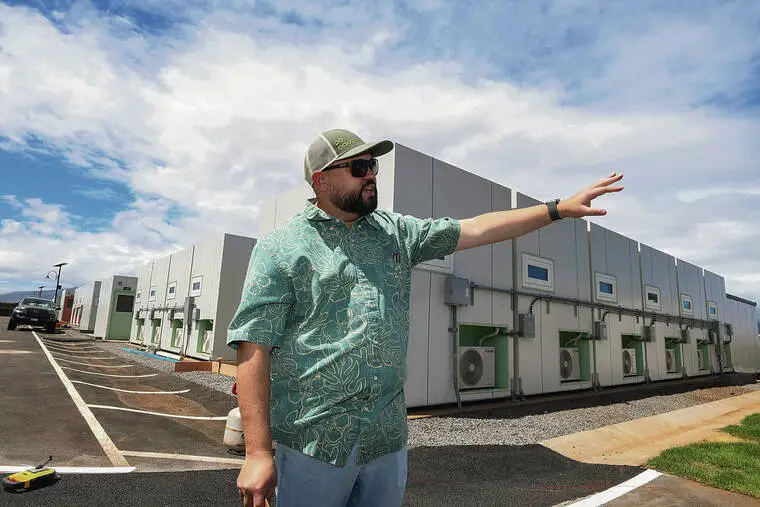
Almost simultaneously, HomeAid was working to build a 64-unit kauhale for Maui’s homeless located near Kahului Airport.
“The truth is, with the wildfires we really had to scale up fast, beyond our capacity,” Carvalho said. “But we were passionate and we did what we were asked to do.”
‘Mistakes
were made’
Carvalho bluntly told the Star-Advertiser that “mistakes were made” but have since been corrected and addressed with new procedures and practices, such as better financial oversight and clearer conflict of interest policies.
He said the mistakes came at a time “when all of a sudden we had to start shelling out a lot more money from our wallets and having to worry about our personal credit cards while being very careful about what bills I submitted.”
Carvalho said that during two 3-1/2-hour interviews with Kondo and the auditor’s staff, Kondo wanted to discuss one embarrassing discrepancy in particular: an inappropriate Las Vegas Hilton Resorts hotel minibar charge from October 2024 of $54.19 for an “intimacy kit” that Carvalho said was improperly submitted to the state for reimbursement, even though he said he never opened the kit or even knew the bill had been submitted by his executive assistant.
“I understand the intimacy kit concern, and when I learned of it, I took immediate responsibility, corrected it, and reimbursed HomeAid and the state,” Carvalho said. He said he assumes the intimacy kit included condoms and other sexual aids that he insists he never saw or used.
Carvalho said he believes he was charged for the kit when he inadvertently moved it around in the room’s minibar and triggered a sensor while moving around bottles of liquor looking for coffee ahead of a virtual meeting he was about to participate in.
Conflict of interest questions arose during HomeAid’s own audits over three kauhale landscaping projects totaling $152,897 paid to Dotson Gardens LLC, which was owned by Carvalho’s then-husband, Chris Dotson.
A separate contract worth $112,780 was paid to Washington-based Mob TechNet Solutions, owned by Dotson’s stepbrother.
Carvalho said Dotson Gardens provided landscaping at cost for three separate kauhale communities, while Mob TechNet Solutions equipped HomeAid with laptops, printers, an email system and other IT hardware and software at discounted prices because the nonprofit lacked even basic technology at the time.
HomeAid’s audits found no criminal wrongdoing, according to Jeff Prostor, president of HomeAid Hawai‘i’s board of directors, and Ralph Mesick, the board’s executive committee treasurer.
Mesick works as senior executive vice president and chief risk officer at Central Pacific Bank but emphasized he was speaking to the Star-Advertiser as an unpaid volunteer HomeAid board member and not as a representative of Central Pacific Bank.
He said Carvalho awarded the contracts after getting approval from the board’s chair at the time in the form of email exchanges, but that the full board did not review the arrangements.
In the end, Mesick said, the board’s executive committee found that the contracts provided HomeAid and the kauhale project with “pricing benefits” with “no direct payment to (Carvalho).”
HomeAid oversight
Following his April letter to the Legislature, Kondo told the Star-Advertiser, “We’re auditing the state Office of Homelessness and Housing Solutions. We are not auditing HomeAid Hawai‘i.”
But five months have passed, and Carvalho said he considered his interviews with Kondo and his staff more like an “interrogation” than a conversation about the workings and cost savings and benefits of the kauhale program.
HomeAid’s tiny-home community concept relies on a combination of government-owned land and labor and materials donated by HomeAid Hawai‘i that bring costs far below traditional affordable housing projects. The initiative offers “deeply affordable” rental prices for people earning 30% below Honolulu’s area median income compared to traditional “affordable” housing projects for those earning 60% or more above the AMI.
The impending state audit and greater controls demanded by the state and internally from HomeAid Hawai‘i could have long-range benefits for both Hawaii and other HomeAid chapters around the country, Carvalho said.