Maunakea board opts to take no position on controversial amendment
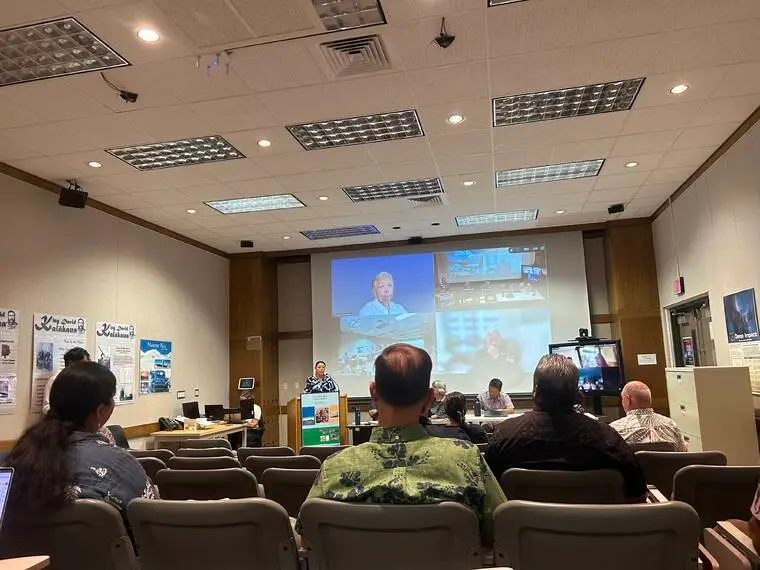
The Maunakea Stewardship and Oversight Board and members of the public weighed in Thursday on a proposal by the University of Hawaii to make changes to its management plan for the summit region of the mauna.
Read more Warriors fall to San Jose State 20-16 after late comeback falls short
The Maunakea Stewardship and Oversight Board and members of the public weighed in Thursday on a proposal by the University of Hawaii to make changes to its management plan for the summit region of the mauna.
The changes include an amendment that would allow for decommissioned observatory sites to be reused for future astronomy facilities, which is prohibited under UH’s current plan. The UH Board of Regents will discuss whether to approve the changes at a meeting next month.
The proposal comes as UH, which has managed the summit region since 1968, prepares to hand over responsibility to MKSOA in 2029.
MKSOA was created by the state Legislature in 2022 by Act 255, following years of tension over the presence of observatories on the mountain — which holds significant cultural value to Native Hawaiians and scientific value to astronomers — with the goal of bringing stakeholders together to create a comprehensive management plan for the mountain.
In the meantime, the UH plan is set to remain in place, and following the passage of state House Bill 2592 in May, if MKSOA fails to meet certain deadlines, management will revert back to the university.
During a MKSOA Board meeting Thursday, Chair John Komeiji emphasized that the board was only serving in an advisory capacity with regard to the potential amendment, and the decision is ultimately up to the UH Board of Regents.
“We’re giving input, but the actual decision is made by the University of Hawaii Regents, and that is not the meeting today,” he said.
He said the board had received written testimony on the topic from about 80 people, split relatively evenly in support and against.
The proposed amendment was first presented to the MKSOA board for input last month by Gregory Chun, the executive director of the UH Hilo Center for Maunakea Stewardship. He said the primary goal was to more closely align the university’s plan with Act 255. The board voted to defer the topic to its October meeting to allow more time to review the changes.
MKSOA Board Vice Chair Noe Noe Wong-Wilson questioned the motive for the change and the need for such an amendment ahead of the impending transition, which prohibits the university from extending, renewing or issuing new leases for observatories in the meantime.
“Even if they choose to change their plan, I don’t think they can do anything,” she said at Thursday’s meeting. “I think it’s either to show somebody something — I don’t know what — or, in the awful circumstance that 2028, 2029 comes along, and we, Maunakea Stewardship and Oversight Authority, aren’t able to meet our legal obligations, and it reverts back to the university… .”
She also said she felt like the amendment created unnecessary confusion and alarm in the community by causing concern that the change could facilitate the construction of the Thirty Meter Telescope, a proposed new observatory that was put on hold following large protests in 2019. Recently, TMT management has said it would explore utilizing a decommissioned site instead of its originally intended location.
“Our concern is that we maintain open communication and trust with our community, and that is our focus in creating our plans, and this is a distraction, it’s unnecessary … ,” Wong-Wilson said. “Now, we find ourselves in the uncomfortable place of having to deal with a, you know, kind of imaginary situation that has a real impact on the community that stood up to protect Maunakea.”
MKSOA board member Lanakila Mangauil echoed this concern.
“Looking at a lot of the testimonies and the vibe in the community, is that this is a special favor action as a favor to particular constructions,” he said. “And, as for myself, you know, I think that this is a distraction as well … .”
Read more More than $6M approved for Hilo veterans cemetery
With regard to the substance of the amendment, he said he felt like there needed to be a broader discussion in the future about the environmental impacts of reusing decommissioned sites versus previously undisturbed land. Under the terms of the observatories leases, there is a requirement that the sites be returned to a natural state when decommissioned. Suggesting that it would be less damaging to reuse these sites, Mangauil said, puts into question whether it is actually possible to restore that land.
“So, if we are somehow equating previously used lands as somehow separate than natural landscape, then is it contradicting the idea that it has been returned to a natural state and the ability for lands to be returned to natural state after these large construction projects or developments?” he asked. “There’s a confliction that happens, I think, that needs to be addressed … .”
Several members of the public spoke at the meeting in-person and via Zoom, both for and against the amendment.
“When is the land, the aina, ever gonna go back?” asked Tara Rojas, a community member who said she was against the amendment. “Whenever something is given or taken, who wants to ever let it go? UH has 50 years of mismanagement, and they were allowed to keep it that long, and they kind of still want to keep it. That’s not right. The aina should go back and be allowed to heal.”
Leinani Lozi, another community member, who also works with one of the observatories on Maunakea, spoke in favor of the amendment and said she felt it was possible for astronomy and caring for the land to go hand in hand.
“As a kanaka maoli wahine and kamaaina, I strongly believe that Maunakea is a sacred site, and the human practice of observing the cosmos and answering questions like, ‘Where do we come from?’ and ‘Are we alone?’ is a sacred science … ,” she said. “In order for astronomy on Maunakea to be truly grounded in our values, specifically that of aloha aina, and to continue to be world-leading in astronomical research, the reuse of already developed sites is necessary.”
Community member and Windward Planning Commissioner JoNelle Fukushima also provided testimony.
“TMT’s willingness to explore a previously disturbed footprint deserves fresh assessment, not automatic approval, but not automatic rejection either,” she said. “Prioritize reuse, require cultural and environmental review, water safeguards, restoration and transparency.”
The MKSOA Board ultimately decided Thursday not to take a stance on the amendment and instead opted to pass along the testimony that was received to the Board of Regents, along with a recording of comments made during the meeting.
Komeji said that while he personally was supportive of the amendment, he was frustrated with the way the public feedback process was handled by the university.
“UH, it’s your rules that you’re trying to change. You should have a direct way to listen to the people instead of deflecting it to us at MKSOA,” he said. “I don’t understand the thinking behind that.”
The UH Board of Regents Facilities and Long Range Planning Committee will discuss the amendment at its upcoming Nov. 5 meeting.
The amendment can be viewed at mkmp.konveio.com. Public feedback will be accepted online until Oct. 14.
Read more BIIF cross country: Ka Makani, ‘Riders shine in Waimea meet
Email Grace Inez Adams at [email protected]