Hawaii public schools see some gains in attendance, math and graduation rates
Hawaii public schools are continuing to recover from pandemic-era learning disruptions, with student attendance and mathematics proficiency improving in the latest school year. But statewide academic performance remains below the goals set for 2029.
Read more Dream sweep Liberty, advance to first WNBA Finals since 2013
The state Department of Education released its 2025-26 Strive HI results, showing improvements in regular attendance, mathematics proficiency and graduation rates.
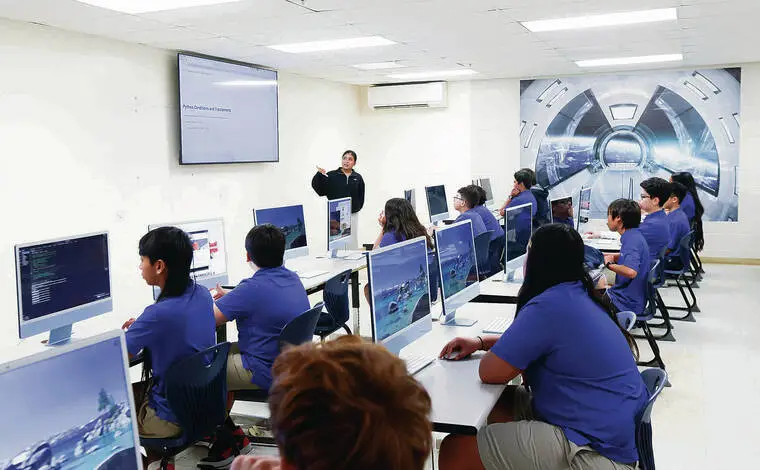
Public charter school Kulia Academy in Kalihi, which served students in grades 6 and 7 during the 2025-26 school year, recorded math and English language arts proficiency rates well above the statewide averages. The results, released this year, reflect student performance during the previous school year. The growing school has since added eighth grade as its inaugural classes advance, while continuing to enroll new sixth graders.
At Kulia, 87% of students were proficient in mathematics and 84% were proficient in language arts during the 2025-26 school year. The school had 153 students enrolled.
Statewide, 42% of students at DOE schools were proficient in math and 53% were proficient in language arts, according to the department’s Strive HI data.
Kulia’s results also improved from the previous school year. Math proficiency increased from 75% in 2024-25 to 87% in 2025-26, while language arts proficiency rose from 80% to 84%.
The school also reported a 93% regular attendance rate, compared with 77% statewide. The DOE defines regular attendance as presence at least 90% of instructional days.
Kulia Executive Director Andy Gokce attributes some of the school’s performance to its academic model, which gives students substantially more time in core subjects than a typical middle school schedule.
The school year is about a month longer than at other schools, Gokce said. Kulia began its 2026-27 school year July 6, and the school also held a monthlong summer program the previous year.
Students attend school from 8 a.m. to 4 p.m., with two hours of English and two hours of math each day, according to Gokce.
At many other schools, students may have math and English every other day for about 75 minutes. At Kulia, students receive roughly 118 to 120 minutes of each subject every day.
Gokce said the additional instructional time works out to about 3.4 times as much math and English instruction compared with a traditional schedule.
“Teachers have more time to work with the students,” Gokce said. “They know the students better because they don’t have 150 students that they have to track.”
The school monitors students’ progress throughout the year through diagnostic and benchmark testing. Students take a diagnostic assessment in July, another benchmark assessment before Thanksgiving and another assessment at the end of the school year.
That allows the school to track students’ growth and see whether they are progressing toward their academic goals, Gokce said.
The intensive schedule initially raised questions about whether students would be able to handle the workload.
Gokce said the school has not received significant complaints from students or parents that the academic schedule is too demanding. Some students have wanted more time for after-school activities such as club soccer, he said, but the school also offers extracurricular activities.
Mililani Ike Elementary had more than 90% of students meet or exceed standards in language arts, math and science. Lokelani Intermediate was the only school statewide to improve by at least 5 percentage points across every measured key performance indicator over four years.
Read more Strengthening El Nino could add fuel to Hawaii’s hurricane season
At Waiakea High School on Hawaii island, a teacher-led effort to make math more engaging coincided with gains in student achievement. Math proficiency rose 8 percentage points in 2025-2026, while language arts proficiency increased 10 points.
The effort began about five years ago, as teachers drew inspiration from Peter Liljedahl’s Building Thinking Classrooms in Mathematics to shift from lecture-based lessons to collaborative problem-solving. Students work in randomly assigned groups of three, often at whiteboards, to solve problems and explain their reasoning.
Principal Kelcy Koga has encouraged teachers to experiment with instructional approaches. While the test-score gains are encouraging, he said the broader goal is to prepare students for college, careers and life after high school.
Waiakea supports that goal through five career academies, which every student joins, and a four-year senior project that begins with planning in freshman year and culminates in a completed project during senior year.
Across Hawaii’s public schools, regular attendance increased to 76.8% in 2025-26, up from 66.1% in 2021-22.
The DOE said attendance remains a key focus because students benefit from instruction, peer interaction and support when they are in school. Regular attendance is also closely associated with academic proficiency and on-time graduation.
The improvement in attendance comes as academic performance continues to recover from pandemic-related disruptions.
Statewide language arts proficiency was 53.2% in 2025-26, compared with 54.1% before the pandemic in 2018-19. Math proficiency was 42.5%, compared with 43.1% before the pandemic.
The DOE said proficiency rates are approaching pre-pandemic levels, but the pace of improvement will need to accelerate for the state to meet its 2029 goals.
The state is aiming for 65% of students to demonstrate proficiency in language arts and 50% in mathematics by 2029.
Although most of the students at Kulia included in this year’s Strive HI report were seventh graders, Gokce said many students are already taking high school-level courses.
The school’s current eighth graders are nearly finished with honors Algebra II, a course typically taken by high school juniors, and are moving toward precalculus. They are also working on AP English, he said.
Some seventh graders are taking Algebra I and geometry, courses typically associated with later grades.
That means students can be working on advanced high school coursework while still taking the middle school-level state assessment, Gokce said.
The preliminary four-year graduation rate for the class of 2026 was 87%, unchanged from the previous year. The rate rose from 85% in 2022 to 86% in 2023 and 2024 before reaching 87% in 2025. The state’s 2029 target is 90%.
The DOE also found that regular attendance was linked to stronger academic outcomes. Among students who attended regularly, 94% graduated on time, compared with 87% statewide. Regular attendees also had higher proficiency rates in language arts, math and science.
Read more Trump approves major disaster aid for Hawaii after Lala, Lowell