‘Seek-and-destroy’ nematodes key to fighting invasive beetle
The Queensland Longhorn Beetle has wreaked havoc on Hawaii Island farmers, but it turns out there’s a microscopic solution available on the coasts: nematodes.
Read more Sabalenka, Osaka bring style to Paris but Medvedev comes undone
Entomopathogenic nematodes, to be exact. Essentially, they are tiny, smooth worms that eat and kill bugs alive.
“These nematodes, this particular species, are hunters,” Roxana Myers, a research plant pathologist who specializes in nematodes at the United States Department of Agriculture, told the Honolulu Star- Advertiser.
According to the University of California, Riverside, a few thousand different species of nematodes have been identified, though researchers believe the actual number is in the millions. Many nematodes are parasitic and their diet of choice varies by species. Some prefer plants, others prefer bacteria, some have animal or human hosts and there are even some cannibals who eat other nematodes.
“All of these are beneficial nematodes,” Myers explained. “They help with soil decomposition and improving soil health. They’re all very important to the ecosystem.”
Nematodes have been used to fight pests on the mainland, but importing them to the islands wasn’t feasible given the state’s strict regulations on nondomestic animals and microorganism imports. Finding them locally erases that issue, Myers said.
Local nematodes also aren’t subject to state or federal regulations like pesticides or bio-control, she added, and it’s safe for people, plants, animals and the whole ecosystem.
Myers began looking into using nematodes against Hawaii’s invasive insects in Hawaii in 2014. At the time, a 1991 research paper was the sole resource for where bug-killing nematode populations might reside on the Hawaiian islands. Her and a colleague set out on a quest to find them, and luckily the tiny worms were still residing in the same locations on Oahu, Hawaii Island, Maui, Molokai and Kauai.
Since 2014, Myers said, nematodes have successfully killed 40 different types of invasive insects in laboratory settings. She noted that while it’s a great result, it doesn’t account for other variables that can happen in the field. For example, she said, these nematodes are susceptible to sunlight and are best used in soil or, in the Queensland Longhorn Beetle’s case, inside a tree trunk.
The Queensland Longhorn Beetle was first identified on the Big Island in 2018, when a cacao farmer reported it to the Big Island Invasive Species Committee, committee program manager Franny Brewer said. It was concerning, she said, because it didn’t appear that the beetle discriminated against what plants it consumed. It was found killing all kinds of trees, including citrus, kukui, cacao and ulu.
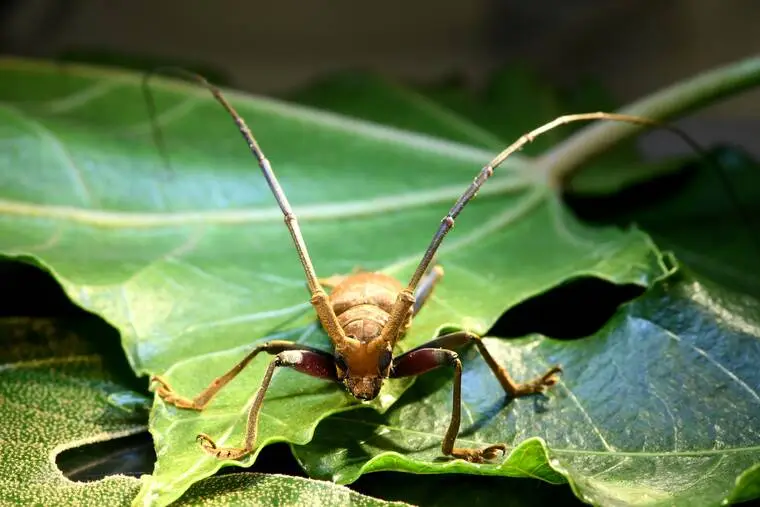
The beetle originates from Australia, where it’s not considered invasive. Its body, covered in a dark-brown velvety coating, is 3/4 to nearly 2 inches long, but its antennae stretch up to twice its body’s size. The beetle’s population is currently concentrated in Puna and the Hilo-Pahoa-Mountain View area.
“Usually an insect will have this really narrow kind of attack range, sometimes even one species,” she said. “But this thing was hitting very different plants, which is pretty unusual and also pretty bad.”
The beetle’s cream-colored larvae, which is typically between 1-1/2 inches to 2-1/2 inches long, tunnels into wood, typically in trees, where it resides for six to 12 months. It weakens the trees and disrupts its ability to transport nutrients and water to the point of potentially killing the tree completely.
There is no known treatment for an adult beetle infestation. The beetle’s most damaging stage is as a larvae, which is extremely difficult given it’s protected by the tree it’s burrowed in. That’s where nematodes come in.
After success against the sweet potato weevil, Myers began testing nematodes against Queensland Longhorn Beetle in 2020. She started with injecting infested logs with nematodes, which showed great success. The “seek-and-destroy” nematodes appeared to follow the larvae’s own tunnel within the tree to hunt and kill them.
Field tests yielded similar success. Once-infested trees recovered within four months, Myers said, with new branches and healed bark.
Read more Hawaii AG, others push back on Vance, call his roundtable ‘a political stunt’
The treatment gets more effective with each kill, Myers said. As nematodes eat their larvae host, they reproduce by the thousands.
Dana Shapiro, CEO of the Hawaii Ulu Cooperative, said that while it’s exciting to have such an effective treatment that is chemical-free, applying the treatment can be tedious and time-consuming for farmers who already have their plates full with other tasks.
“There’s no sort of on-the-ground partner at this time helping farmers with those time-intensive tasks that are a critical part of it working,” Shapiro said. “It’s just one more thing that honestly is reducing the economic viability of farming. Even with the treatment, without having support applying it or research that’s going to make it easier to apply, a lot of people just don’t have time to do it.”
Injecting nematodes isn’t the only time-intensive part of the treatment process, said Emma Stierhoff, ecological research and outreach technician for the University of Hawaii’s Liko Na Pilina project, an ecological restoration initiative.
Stierhoff has become a sort of nematode mother, raising nematodes in a lab to ensure the freshest treatments are available for farmers in need. She said the process takes at least two weeks.
She also raises galleria moths, whose larvae is the nematodes’ food for reproduction. One moth larvae can produce up to 100,000 nematodes, she said. If she has six cadaver larvae being fed to nematodes at once, she said, that typically yields around 20 treatments within two weeks.
Raising the moths is also more difficult than the nematodes themselves, she added. The moth’s life cycle is over a month, and the lab tries to keep several at different life stages to ensure there’s a constant supply. Mites or other organisms can kill a colony of moths, which means the lab will have to start completely over.
Nematodes also could be reared with meal worms, Stierhoff said, but not as many nematodes are reproduced so it’s not ideal.
House Bill 2139 aimed to fund University of Hawaii research on effective treatment methods for the Queensland Longhorn Beetle, but it was deferred by the Senate Committee on Ways and Means last month.
Myers, Brewer, Shapiro and Stierhoff agree that more research on the beetle and support from farmers is critical to manage its hold on the islands. Ideally, they said, a team is needed that is dedicated to applying the treatment for farmers at little-to-no cost.
More research also needs to be done on how to rear nematodes faster and other methods that could be used against the beetle, they said.
Myers believes nematodes potentially could be used against several invasive pests to the islands, but there would need to be a way to bring the treatment to scale. She said they are lethal against most species tested in the lab, are safe for native species and are nontoxic to humans.
She said she hasn’t tested it against a Coconut Rhinoceros Beetle larvae, but believes it could be effective. The grubs are much larger than Queensland Longhorn Beetle larvae, she added, so several more nematodes likely would be needed.
For now, she’s begun field trials against two-lined spittlebug, an invasive pest that is wreaking havoc of Hawaii Island’s cattle farmers.
Read more Celtics’ Joe Mazzulla wins NBA Coach of the Year after calling award ‘stupid’