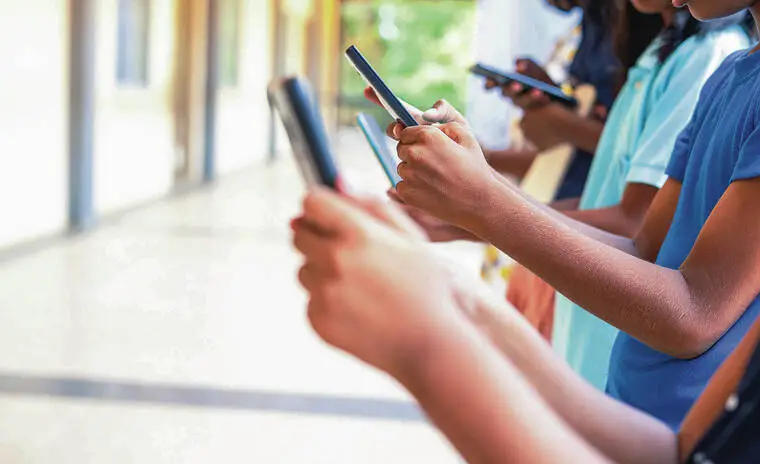
New cellphone limits coming for Hawaii students
Hawaii parents will begin receiving notices from their children’s schools about a new statewide cellphone policy that will restrict when students can use their phones on campus beginning this fall.
Read more Dodgers’ revamped batting order pummels Rockies 15-6
Hawaii parents will begin receiving notices from their children’s schools about a new statewide cellphone policy that will restrict when students can use their phones on campus beginning this fall.
Under the Board of Education policy adopted Feb. 12, elementary and middle school students will be prohibited from using cellphones during school hours, while high school students will be prohibited from using them during instructional time.
The policy was adopted the same day House Bill 2562, a broader school cellphone measure, was deferred.
HB 2563 would have required the board to establish a “phone-and-related devices-free, bell-to-bell policy” beginning with the 2027-28 school year and would have included cellphones, smartwatches, earbuds, AirPods, Bluetooth-connected headphones and smart glasses.
Rep. Justin Woodson (D, Kahului-Puunene), chair of the House Education Committee, said HB 2563 followed years of concern over how phones were affecting students in school.
“The data that was coming out around cellphone usage in schools showed a direct negative correlation between cellphone usage and student outcomes ultimately,” Woodson said.
The BOE policy applies only to cellphones, leaving questions about whether students may turn to other devices once the restrictions take effect.
“They’re going to figure it out like they always do,” said Sarah “Mili” Milianta-Laffin, a seventh and eighth grade elective teacher at ‘Ilima Intermediate School in Ewa Beach. “… I think that it’s not going to be a one-and-done policy. It’s going to have to be revisited.”
Milianta-Laffin was on leave this legislative session to lobby legislators on behalf of the Hawaii State Teachers Association.
But the teachers themselves offered legislators little guidance as they debated HB 2563.
In April 2025, 100 teacher delegates to the teachers union’s annual convention were split over whether to allow, limit or outright ban cellphones, said Milianta-Laffin, who represented HSTA’S Leeward chapter at the convention held at McKinley High School.
Before the BOE decided its cellphone policy, many Hawaii public schools already had adopted their own rules.
“Having a Board of Education policy helps to have a uniform policy that puts everyone on the same page,” said Teri Ushijima, assistant superintendent for the Department of Education’s Office of Curriculum and Instructional Design.
Exceptions will be allowed during emergencies or perceived threats to safety, when authorized by a teacher or administrator for instructional purposes, when required for a student’s health needs as determined by a licensed physician or when included in a student’s Individualized Education Program.
“We are having the schools communicate at the start of the school year how parents can reach their students if they need to during the school day,” Ushijima said.
For teachers, the new policy is a welcome attempt to reduce a persistent classroom distraction, but also raises concerns about how the rules will be enforced.
“I think cellphone addiction is real,” Milianta-Laffin said. “We see it in our students every day and it is changing the way that students are learning.”
Read more Shohei Ohtani carries Dodgers past Rockies
In classrooms, Milianta-Laffin said phones are often used for TikTok, Snapchat, messaging or even FaceTiming students in other classrooms.
“As a teacher, it kind of becomes whack-a-mole when you’re trying to get one kid’s phone handled and then another kid gets a phone out,” she said. “I cannot be more engaging than a child’s TikTok algorithm.”
The policy’s success, Milianta-Laffin said, will depend on whether teachers receive clear rules, consistent consequences and support from administrators when students push back.
“We’ve never intended to be the phone police,” she said. “We want to talk about the instruction. We want to push the kids’ learning. We want to celebrate learning.”
At Hilo Intermediate School, eighth grade social studies teacher Aaron Kubo said his campus has already gone further than the BOE policy by using Yondr pouches since the start of the 2025-26 school year.
Students lock their phones in the pouches at the beginning of the school day and have them unlocked at the end of the day by staff using a magnet.
The pouches built on a cellphone restriction policy that had been in place at the school for more than a decade.
“This is more of an iteration of it,” Kubo said.
At first, some students tried to work around the system by trying to break into the pouches or find ways to keep access to their phones.
“Kids are very ingenious, they’re very smart,” Kubo said.
Once the system became part of the school day, Kubo said he noticed fewer students leaving class without reason and fewer behavior issues tied to phones.
“There was much, much less kids roaming around,” he said. “There was much, much less of the fighting on campus and there was much more engagement.”
Still, a cellphone policy only works if adults on campus enforce it the same way and families understand the reason behind it.
“Any ambiguity, any kind of issues, any special treatments, then it falls apart,” Kubo said. “So that consistency and follow-through needs to be consistent and clear.”
The first year of implementation is expected to bring adjustments for students, teachers and families as schools develop campus-level rules.
“If we’re locking it down, everybody’s got to be on the same team,” Milianta-Laffin said.
The DOE plans to review the policy as schools begin using it and make changes if needed.
For Kubo, the policy is also about helping students practice self-control before they leave middle school and face more independence.
“I want them to understand that this is actually meant for them to actually try to focus on whatever it may be that they want to do in the future,” he said.
Read more BIIF golf: Saito, Nakagawa named Players of the Year