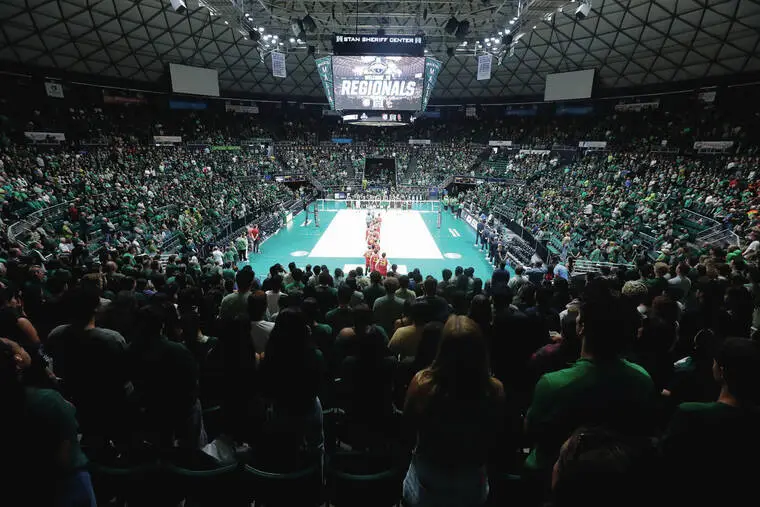
Hawaii volleyball special: Boosters appreciate being appreciated by the Warriors
Long after the arena is nearly empty, the aroma of fried rice has replaced that of garlic fries.
Read more Judge: Closed-door House committee meetings were illegal
Long after the arena is nearly empty, the aroma of fried rice has replaced that of garlic fries.
Sometimes we have too much food,” Tammy Namihira says. “We try to feed the arena crew, too.”
If the players had a post-match autograph session, it might be a very long time between meals. Their pregame meal was around 3 p.m., and by the time they finally sit down, many are running on fumes
But Namihira and other behind-the-scenes heroes help make University of Hawaii men’s volleyball what it is, coordinating a postgame meal system run almost entirely by boosters and volunteers. They also provide snacks for them on those extra-long nights.
Every season, she sends an email to the 60-or-so boosters asking who can host a postgame meal.
She organizes the schedule. Namihira’s core group of six fills in the nights nobody claims.
“I coordinate,” she says. “I don’t really cook.”
But she does make some great homemade desserts: pumpkin crunch, apple crisp, haupia.
This is about much more than feeding athletes.
“For me, doing volleyball keeps us going,” says Namihira, an empty-nester who still works fulltime for the city and county of Honolulu. “It’s all about the team and trying to help the team any way we can.”
That spirit contributes to why the men’s volleyball team under coach Charlie Wade has now won three national championships in the last six seasons.
The Rainbow Warriors recruit worldwide, but many of them end up calling Hawaii home.
“I don’t know what it is when Charlie goes around the world,” Namihira says. “But he finds players who really fit in well. They need to fit a certain mold. They need to have a team mentality.”
She has seen enough to recognize the difference.
“You look at some guys on other teams and you know they wouldn’t have fit,” she says. “No. 1, they do have to buy into the culture. And they’re so far from home. It is gratifying when they come back and they say they’re home. It’s heartwarming.”
The players learn the local ways from local teammates, and from the fans, too — especially when it comes to food.
“These guys, they really love white rice, fried rice, poke,” Namihira says, laughing again. “Better than me.”
Newcomers are surprised, and grateful.
“They came in and, ‘Oh, we get fed,’” she says. “They’re very appreciative. They don’t take things for granted.”
For players spending most of February on the road, the postgame meals became emotional comfort as much as nourishment.
“They missed the rice and the poke,” she says.
Namihira has been connected to UH volleyball for decades.
“Whenever I could watch them, going back to the Klum Gym days,” she says. “And when I didn’t go, I watched on TV.”
She became especially invested during the Yuval Katz era in the 1990s and held season tickets before stepping away while raising her two children.
Namihira eventually returned to the program about 10 years ago, becoming a season-ticket holder again and later taking on greater responsibilities with the boosters.
Read more Shohei Ohtani shines on mound, at plate as Dodgers blank D-backs
The work includes helping organize fundraising events and the annual banquet after senior night. Most of it happens quietly, behind the scenes.
Nobody does it for recognition. The reward comes when players realize somebody waited around two extra hours just to make sure they had a hot meal.
“You folks don’t have to wait for us,” players tell them.
That’s why they do it — because it is not expected, but is appreciated.
Noe Mokiau is a fifth grade teacher at Maili Elementary School.
In her classroom, the volleyball team — and the attitude of gratitude — is part of the curriculum. Her students research hometowns, statistics and personal backgrounds before writing letters of gratitude to each player.
“It’s a reciprocal thing,” Mokiau says. “They can all see the impact they’ve had on each other.”
The project naturally includes geography. Mokiau points to a globe in her classroom and shows students where the players come from.
“They trip out that they choose our little islands,” she says.
For children growing up on the Waianae Coast, that especially matters.
“A relatable topic, but global,” she says. “I call it West Side World Changers, and tell them, ‘You guys can change the world no matter where you are from.’”
Volleyball becomes the entry point into larger lessons about literacy, research and possibility. The students produced well researched and written letters the Mokiau delivered to the players during the team banquet.
One student who wrote to setter Tread Rosenthal later attended the NCAA regional match against USC and got to meet him in person.
Moments like that reinforce why Mokiau became a teacher.
“I loved school, and had a teacher who pushed me.”
That first-grade teacher — Kelly Kotoshirodo, known affectionately as “Miss K” — changed her life.
Now Mokiau tries to do the same for her students.
“All my hard lessons, I try to incorporate in class,” she says. “Try to do hard things.”
Despite coming from a volleyball-and-football family, Mokiau gravitated to track and field at Kamehameha, where she was a two-time state champion in the shot put, and a key to the first girls team championship in the sport at her alma mater.
She first started attending volleyball matches regularly after graduating in 2009, often making the long drive from Waianae whenever she could convince friends to join her.
She became a season-ticket holder in 2019.
Now she and her friends are among the most visible fans in the arena, wearing rainbow-colored face paint, cheering loud and proud.
“We want to be the next generation of aunties,” she says.
They also hosted a postgame meal this year.
“It was so much fun,” she says. “We’re going to do it twice next season.”
Namihira is the organizer, Mokiao the educator/entertainer.
That makes Dexter and Linda Liu the chefs of Namihira’s core group.
Dexter handles much of the cooking, and his fried rice is now world famous, thanks to the volleyball team.
“Cook the lup cheong first,” he says. “Get the oil out.”
He also includes char siu.
Linda laughs while describing how the meals have evolved into gatherings that include not just players, but parents visiting from thousands of miles away.
“We feed the parents when they come, too,” she says, “so they know what their kids are eating.”
Linda describes her husband as “an excellent cook,” but some would say her job is the most important: Linda makes the Spam musubi that are part of the snack pack when the players can’t eat a meal right after a match.
She echoes what Namihira says about the players’ gratitude. Asking any of these folks to name a favorite player is like asking a parent to name a favorite child.
“Doing this with Tammy, we’ve gotten to know them all. They’re all great guys,” Linda Liu says. “Doing this gives us an opportunity to know them a little bit better. You see how appreciative they are. That’s one of the things that keeps us doing this. The first thing they do, no matter how hungry they are, is they come behind the table and hug us. We realize the guys who don’t play in the matches are just as important as the starters. Without their commitment there is no team. They could be starters on other teams, but they stay here.”