Hawaii’s primary election unlikely to stir voter enthusiasm, turnout
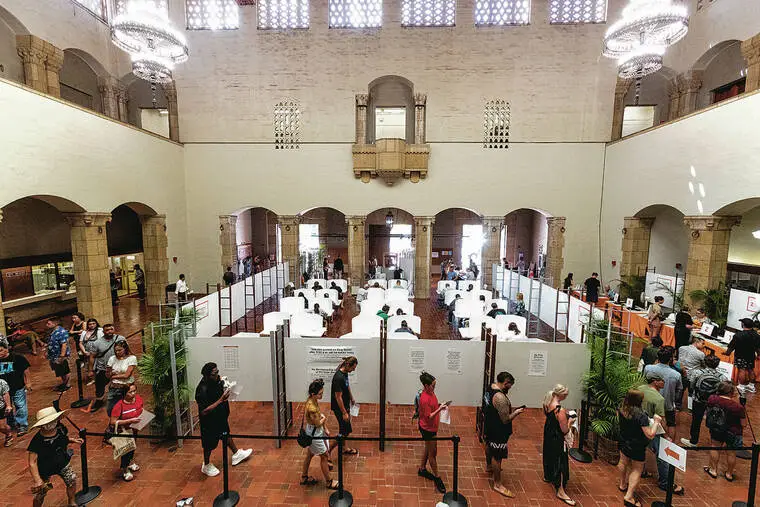
There is little expectation that voters will turn out in droves for the upcoming Aug. 8 party primaries following the 2024 presidential election year, when only 32.3% of all of Hawaii’s registered voters bothered to vote in the primary, a record low since widespread mail-in voting began in 2020.
Read more Victor Wembanyama, Spurs steal Game 3 in must-win game vs. Knicks
The 2022 primary generated only 39.8% of registered voters in a race that ultimately gave Hawaii voters a choice in the following November general election race between then-Lt. Gov. Josh Green and former Lt. Gov. Duke Aiona following a bitter Democratic primary that included former first lady Vicky Cayetano and former U.S. Rep. Kai Kahele.
The turnout in the last two primary elections suggests that residents across the islands remain motivated to register to vote, but most do not bother to actually cast their ballots.
“Some people feel their vote doesn’t count, which of course is not true,” said Judith Wong, president of the League of Women Voters of Hawaii. “But that’s how some people feel — that things are going to happen no matter what I do, whether I vote or I don’t vote.”
With just under four out of 10 Hawaii voters bothering to vote in the last two Hawaii primary elections, Wong said that those who don’t vote are abdicating their voting power to those who do.
“I’m certainly not saying it is correct to think your vote doesn’t count,” she said. “But if you don’t vote, you are actually strengthening the vote of other people. So basically, the people who aren’t voting are actually sort of giving away their votes to people who care enough to vote.”
Voter enthusiasm across the state has jumped when the stakes are high.
The anemic August 2024 turnout of 32.3% in the primary race soared to 60.7% in the subsequent November 2024 general election that saw then-former President Donald Trump and Vice President Kamala Harris battling to become president.
Before, in the November 2008 general election, a whopping 66% of registered Hawaii voters turned out when Hawaii-born Barack Obama beat Republican Sen. John McCain.
But this year’s August midterm primary and general election races offer few reasons for Hawaii voters to get excited.
“That concerns me as a Republican and it should concern all of us as citizens,” said Shirlene Ostrov, chair of Hawaii’s Republican Party. “It goes to show that people don’t think that their votes make a difference.”
Makai Freitas, the new chair of the Hawaii Democratic Party and an incoming University of Hawaii regent, said Hawaii voters need to engage in the electoral process because “we’re in a pivotal time in our lives, across the world and especially here in Hawaii. You’ve got to get out there and make a difference.”
Freitas grew up in a union family and now works as the head of government affairs for the Hawaii Longshore Division of the International Longshore and Warehouse Union.
He wants voters to respect the sacrifices of prior generations of union members who were beaten and killed fighting for their right to vote to be represented by labor unions.
Not voting, Freitas said, is a slap in the face to the sacrifices of those who came before.
“If you’re frustrated, if you’re not happy, that’s fine, that’s acceptable, that’s normal,” Freitas said.
But the response of registered voters, he said, should be to “Get out there and make a difference. People fought for the right for us to vote. And it’s disrespectful to all those people who came before us during the Democratic Revolution of 1954.”
Hawaii’s voter apathy comes as Trump last year issued an executive order aimed at limiting voter rights, followed by another executive order in March that would give the U.S. Postal Service the power to refuse to deliver mail-in ballots cast by anyone not on a new national voting data base that Trump is trying to create in the middle of this year’s election cycle.
Read more $6M in renovations planned for UH Hilo theater
His executive orders remain the subject of court challenges.
And in April, the majority of conservative U.S. Supreme Court justices overturned Louisiana’s congressional map by eliminating a majority-Black voting district.
“We’re in a state nationally, locally, statewide right now where we have an administration that’s actively attacking civil liberties, taking away people’s rights and voting rights,” said Amelia Sofos, the 20-year-old, deputy director of political affairs for the College Democrats of America, chair of the College Democrats of Hawaii and president of the College Democrats at the University of Hawaii-Manoa.
Many of Hawaii’s young Democrats, Sofos said, “want radical social change right now, but there’s not a candidate that’s going to check all of their boxes. (In Hawaii), we’re not going to have a Zohran Mamdani. We’re not going to have a Bernie Sanders or an Alexandria Ocasio-Cortez running all the time.
“So we have to make these compromises and a lot of times young folks are just really tired of making compromises,” Sofos said. “And so it can lead to this kind of sense of disillusionment with electoral politics and voting in general.”
Rocklin Youngstrom, the 22-year-old president of the Hawaii Young Republicans, said Hawaii’s history of low voter participation “concerns me as a Republican and it should concern all of us as citizens.
“This election should give voters a chance to hear from candidates who they think are focused on accountability and restoring trust in government when the highest levels of our government are caught up in corruption and not having accountability,” she said.
Lt. Gov. Sylvia Luke was looking at the likelihood of a relatively easy reelection during the Democratic Party primary in August that usually leads to the eventual winner if there’s no strong Republican candidate.
But that was before Luke dropped out of the race and went on indefinite unpaid leave in April after receiving a target letter from the attorney general’s office that she was a subject of the AG’s ongoing investigation into potential bribery and political corruptions allegations.
Like young Hawaii Democrats, young Republicans are trying to get like-minded people their age to register to vote for perhaps the first time.
Youngstrom is putting her words into action by making her first run for political office in the August Republican Party primary against fellow Republican Daniel Michael Gabriel.
The winner will move on to the November general election showdown against incumbent Democratic state Rep. Amy Perruso (D, Wahiawa-Whitmore Village-Mokuleia), who’s running unopposed in the Democratic primary.
For the 2026 primary and general elections, Hawaii likely will continue to see low voter turnout, said political analyst Neal Milner.
“We’re likely to be a low turnout state and, in the primary, we’re likely to see even a lower turnout than in the general election,” Milner said. “There isn’t a presidential election. There’s nobody running for (U.S.) Senate. There is a gubernatorial election, but it’s a foregone conclusion. So there’s little to get voters excited. We know politics has become very nationalized and we know that interest in local politics has diminished.”
Camron Hurt, state director of Common Cause Hawaii, said the responsibility for Hawaii’s apathetic voting record also lies with the candidates themselves.
As Obama showed, Hawaii voters will get energized around candidates who draw their attention, enthusiasm and their votes.
“People turn out if they’re excited about a candidate or passionate about an issue,” Hurt said. “The other part of it really come from the candidates making people excited.”
Read more Chanting ‘USA! USA!,’ thousands welcome US men’s soccer team to SoCal ahead of World Cup