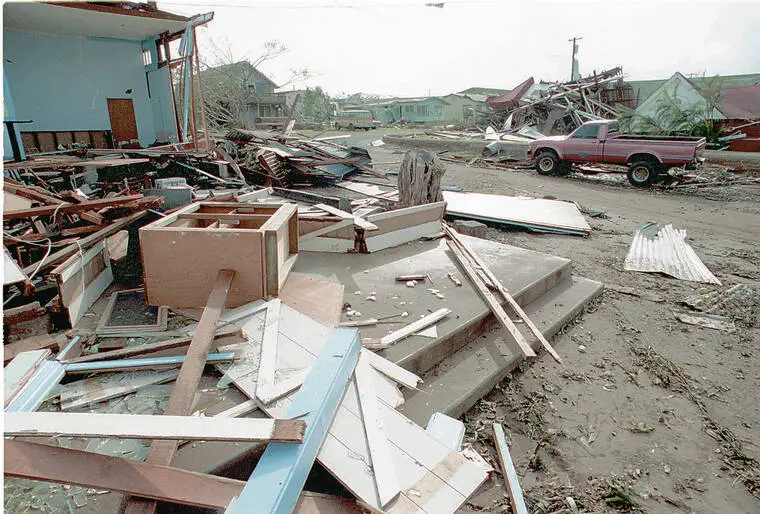
Hawaii shelters inadequate against hurricanes
With a potential El Nino cycle increasing hurricane threats to the Hawaiian Islands, state and county officials warn that most existing shelters are insufficient to protect residents beyond a Category 1 storm.
Read more Shai Gilgeous-Alexander, Thunder eke out sweep-sealing win over Lakers
None of the county and state emergency management agencies contacted by the Honolulu Star-Advertiser confirmed whether available shelters could withstand beyond a Category 1 storm, which can generate sustained winds of 74 to 94 miles per hour and is the weakest of the five storm categories on the Saffir-Simpson Hurricane Wind Scale used by the National Weather Service.
All the agencies contacted said shelters should be a last resort and urged residents to retrofit their homes or seek refuge at another resident’s retrofitted home.
Hawaii Emergency Management Agency information specialist Patrick Daley said three state buildings have completed or are undergoing hurricane retrofitting under a state program that uses federal and state capital improvement plan funds, but he did not specify which storm category they are meant to withstand.
Those are located in the Waialua High School gym on Oahu, the Molokai High School gym and the band room at Laupahoehoe Community Public Charter School, formerly Laupahoehoe High and Elementary School, on Hawaii island.
HIEMA Administrator James Barros said in an email that hurricane shelters throughout the state “are not at the levels of readiness that we require.”
“We recognize that effective sheltering is a critical part of overall emergency preparedness and strengthening that capability remains a priority,” Barros said.
Areas deemed “hurricane refuge sites” may not have the services of a shelter but can give residents a safer place “to ride out the storm,” he noted, adding the agency will continue to improve shelter readiness and partner with refuge sites to strengthen the state’s preparedness.
On Oahu, Honolulu Department of Emergency Management Director Dr. Randal Collins said that of the island’s 25 hurricane refuge areas, 20 are retrofitted to withstand Category 1 winds.
Maui Emergency Management Agency Administrator Amos Lonokailua-Hewett said Maui County shelters are built to Hawaii’s high-wind building standards but are not designed to be storm-proof in extreme hurricane conditions.
Kauai Emergency Management Agency Administrator Elton Ushio said its shelters are assessed by best available refuge area standards rather than hurricane winds, while Hawaii County Civil Defense Agency Administrator Talmadge Magno said the island has more than a dozen potential shelter sites but did not specify the storm strength they are meant to withstand.
Hawaii’s hurricane season runs from June through November. During 2025, according to data from the National Hurricane and Central Pacific Hurricane centers, three of the four tropical cyclones that occurred in the Central Pacific reached hurricane status. Two became major hurricanes rated as Category 3 or higher.
It was considered an “El Nino neutral” cycle, meaning sea surface temperatures remained close to average across the equatorial Pacific, according to the World Meteorological Organization.
Devastating damage occurs once a hurricane reaches Category 3 with sustained winds of 111 to 129 miles per hour, according to the National Weather Service. Category 4 storms, which have winds of 130 to 156 miles per hour, and Category 5 storms, with winds above 157, cause catastrophic damage.
Hurricanes have made landfall in Hawaii only twice in recorded history: Hurricane Dot in 1959 and Hurricane Iniki in 1992, both on Kauai. The latter was a Category 4 storm that killed seven people, injured more than 100 and caused $1.8 billion in damage, according to the National Disaster Survey report.
Read more Waimea man killed on Kawaihae Road while changing a tire
Iniki inspired changes in building codes, and most counties enacted local requirements to ensure new builds would have hurricane safety measures. The state didn’t have a uniform building code until 2012, and its most current version requires new construction to withstand projected “ultimate wind speeds,” which range depending on an area’s topographical risk.
On Oahu, for example, most of new builds must be able to withstand a Category 4 storm or higher, according to the map. The current code also requires all new state and county high-occupancy buildings to be designed to withstand at least a Category 3 storm.
State and county officials urge those living in homes built before 1993 to check whether their house was retrofitted to withstand hurricane winds and to take action if not. That action can include installing hurricane-proof windows and hurricane clips for roofing, or making a plan to seek refuge at a safer home.
Most experts agree it’s not a matter of if a hurricane will hit the state, but when.
Hawaii State Climatologist Pao-Shin Chu said hurricanes have typically remained south of the island chain because of the warmer water near the equator. With climate change, he said, northern waters are now warmer, which can attract big storms closer to Hawaii.
Chu is concerned about the state’s shelter situation, especially because of how isolated Hawaii is.
“It’s all just a matter of time,” he said, noting that Hurricane Lane in 2018 put everyone on Oahu on edge as the Category 5 storm headed straight for the island before veering sharply and decreasing in strength within 120 miles of making landfall.
“Everybody was in a high degree of anxiety. We don’t know what to do and there’s no place to go … . Mother Nature really saved us.”
Chu said that a hurricane hitting the islands would bring devastating damage, with the potential for any wooden structures to be completely destroyed.
Kioni Dudley, a hurricane safety community activist in Kapolei, has pushed for hurricane safety bills in the Legislature that would provide homeowners with incentives to retrofit their homes and require certain state buildings to be able to withstand Category 5 storms in the event shelters are needed, but both died in this year’s session.
Dudley said he is increasingly concerned about the upcoming El Nino cycle pushing a strong storm to the islands this year. It’s too late for systemic change, he said, so in the meantime people should come up with a safety plan that includes seeking refuge in a concrete building or structure with better protection against storms.
It doesn’t make sense to wait for a storm to hit to take action, Dudley said, and state leaders “need to realize that your actions will either save or lose thousands of lives.”
State and county emergency leaders agree all residents should have a two-week supply of necessities in the event of any natural disaster, especially hurricanes, which could knock out power and damage ports and supply chains. Emergency supplies should include shelf-stable and high-protein foods, 14 gallons of water per person, medicine, first aid, an alternative source of power and a radio with extra batteries in case phones, cellular connection or Wi-Fi become unavailable. Pets will need two weeks of food and water.
The University of Hawaii Sea Grant program offers a free handbook to help homeowners prepare for natural disasters on its website. The handbook also covers several retrofit measures to protect homes from hurricanes.
Read more UH volleyball wins national championship