Lead removal project paves way for $78M rehabilitation of Hakalau bridge
Work to remove lead contamination from the ground beneath the Hakalau Stream Bridge started on June 4, according to the state Department of Transportation.
Read more Freddie Freeman posts 2,500th hit in 10-run 7th; Dodgers drub Pirates
Work to remove lead contamination from the ground beneath the Hakalau Stream Bridge started on June 4, according to the state Department of Transportation.
According to the DOT, traffic flow on the bridge — which is about 13 miles north of Hilo on Mamalahoa Highway (Route 19) — is not being affected by the lead remediation work below. Scheduled work will run daily, Monday to Friday, from 7 a.m. to 3:30 p.m.
DOT said it will update the public when there are expected impacts to traffic.
Alpha Inc., an excavation contractor from Kahului, Maui, was awarded the contract on a bid of $10.3 million.
The scope of work includes testing, removal and disposal of lead-contaminated soil. The lead remediation project is expected to be completed by Thursday, Aug. 27, and will be followed by structural rehabilitation of the bridge, opened to automobile traffic in 1953.
“This bridge was constructed and then reconstructed during emergency situations,” state Transportation Director Ed Sniffen said in a recently released half-hour documentary, “Hakalau — Bridges Across Time.” The video was commissioned by DOT and produced and directed by Oahu filmmaker Na‘alehu Anthony.
Read more Dream’s Angel Reese finding range going into battle with Liberty
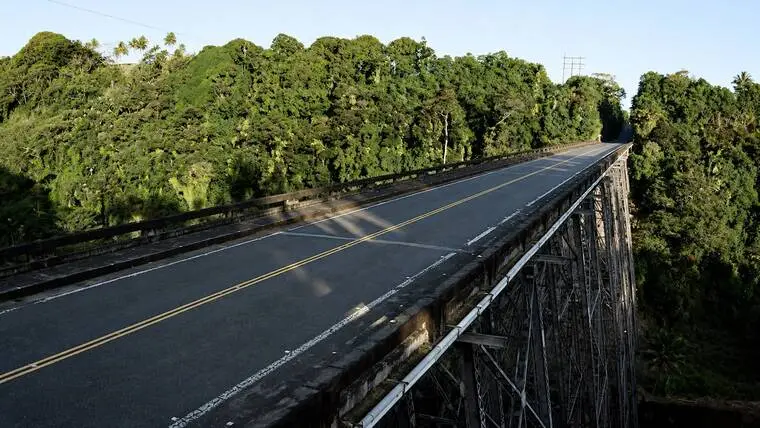
The two-lane highway bridge, a steel trestle-and-girder structure listed on the Hawaii Register of Historic Places as part of the “Steel Trestle Bridges on the Hamakua Coast,” was originally built in 1911 by the Hilo Railroad Co. for trains.
It is 775 feet long and sits 261 feet above the Hakalau Stream bed. After the April Fool’s Day tsunami in 1946 that severely damaged the railroad, causing it to close, the trestle was retrofitted and integrated into Mamalahoa Highway, with decks widened to accommodate cars and trucks.
“This thing is still here today, with trucks going over 114 years later and still standing strong,” Rob Lee, a DOT project manager, said in the documentary. “And it’s amazing that the technology, the materials that was used. … It’s just awesome to see history holding up this long. And we can still use it to go back and forth, just like they did in 1953.
“That’s what stands out to me, the longevity and the size of the structure. Quite amazing, the technology and the knowledge they had back then.”
The total rehabilitation project for the bridge has an estimated price tag of $78 million, according to a 2024 environmental assessment.
Read more Tyler Callihan’s first career homers deliver Pirates win over Dodgers
The documentary can be viewed on YouTube at youtu.be/jXI-tshQdqg.
Email John Burnett at [email protected].