Two-day resilience conference kicks off in Hilo
Vibrant Hawaii is holding what it claims as the first resilience conference in the state.
Read more Knicks erase 29-point deficit to stun Spurs, move within one win of first title since 1973
Vibrant Hawaii is holding what it claims as the first resilience conference in the state.
The conference, Friday and today at the University of Hawaii at Hilo, is described on the nonprofit organization’s website as “a two-day, in-person training designed to strengthen local capacity for disaster preparedness, response and recovery.”
Janice Ikeda, Vibrant Hawaii CEO, opened the conference Friday with an address to an audience of conferees that half-filled the University of Hawaii at Hilo Performing Arts Center — which has a seating capacity of 550. Most are from Hawaii Island, but other islands, especially Oahu, also were were represented.
According to Ikeda, the guiding principle of the conference is the “law of the splintered paddle,” a foundational human rights decree by Kamehameha I in 1797 which is codified in Article 9, Section 10 of the state Constitution. As Hawaii’s first official law, it established that noncombatants, the elderly, women and children must be allowed to travel safely without fear of harm or violence.
Ikeda called the law “of Hawaii and for Hawaii,” while the state Constitution describes it as “a unique and living symbol of the state’s concern for public safety.”
“It reminds us that in moments of danger or disruption, our collective responsibility is to ensure that those in distress can find safety, dignity and care …,” Ikeda said. “It reminds us that Hawaii already has the wisdom and human capacity for community-centered public safety. Our job is to train it, coordinate it and trust it.”
With the Federal Emergency Management Agency’s deadline to apply for individual assistance for those adversely affected by the two Kona low storms in March looming on Sunday, Ikeda laid out a sobering rationale for increased local response to disasters and emergencies by everyday citizens.
“We are on an island that is on the end of a very long supply chain,” Ikeda said. “We are in a period of increasing disaster frequencies. We overly value and rely on resources we cannot control. Year after year, FEMA has entered hurricane season with its disaster relief fund in the red zone, below the threshold the agency uses to insure it can respond to at least one major catastrophic event.
“This past April, ahead of (the) 2026 hurricane season, FEMA has officially triggered what it calls immediate needs funding — an unprecedented action. FEMA now has to choose between long-term recovery and responding to new disasters. It cannot do both.”
Read more Local sports briefs: Riders seeking new football head coach
With hurricane season in Hawaii just underway and running through November, Ikeda noted the federal government’s disaster relief organization was found by federal auditors to be chronically understaffed and inadequate to respond properly to a major storm.
“At the start of last hurricane season, the Government Accountability Office found that only 12% of FEMA’s incident management workforce was able to respond,” Ikeda said. “We overlook and often undervalue resources available to us, most especially our human resources.
“Right now, when a disaster hits, we look for master coordination to be stood up by someone with the right training. But what everybody outside of Hawaii calls ‘mass care,’ we just call it ‘pa‘ina,’ right?” she added, invoking a Hawaiian word meaning “party.” “Baby lu‘au, graduation party, wedding. Every aunty who has ever organized a baby lu‘au has already run a mass-care event — volunteer coordination … facility-use agreements, managing the budget, clean-up, security … the ability to identify strengths and give you a role. … We all know that aunty that has the expertise to coordinate donations, manage volunteers, feed hundreds of people … . Right now, we treat disaster case management like it’s a specialized skill that only kicks in after a declared emergency.
“The thing we are trying to build is a decentralized and coordinated system with the community at the center, the governing of the community in genuine partnership, how it is described … in our language and our law.”
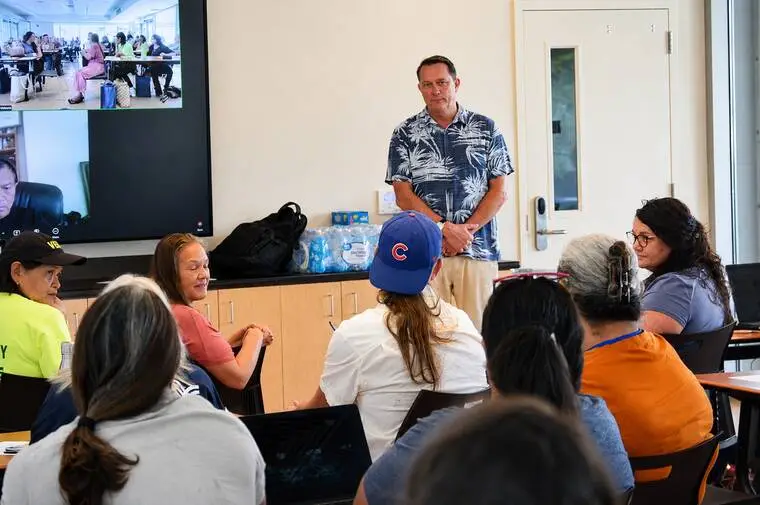
After Ikeda’s opening remarks, conferees attended specialized breakout sessions on the subjects of mental health, volunteers and donations, shelter support, medical response, food security and long-term recovery.
During the volunteers and donations breakout session, Maurice Messina, Vibrant Hawaii’s chief operating officer, noted the community response in West Hawaii following March’s destructive Kona low storms.
“At Konawaena High School, when the Kona low really affected that school, it shut down their cafeteria — and that cafeteria was serving about 700 kids,” Messina said. “When the community members reached out and said, ‘we need help here,’ we started organizing a food drive, a food distribution at the Honaunau Rodeo Arena. It was the sports teams, the kids who played the biggest part of getting those donations out to the community members.
“And there are so many organizations that I hear about going, ‘We’re aging out, we’re aging out. Where are we going to get our replacements from?’”
Pointing to some high school-age attendees in the room, Messina intoned, ‘They’re right there.’”
Read more UH basketball coach Ganot ‘fired up’ with influx of talented recruits
Email John Burnett at [email protected].