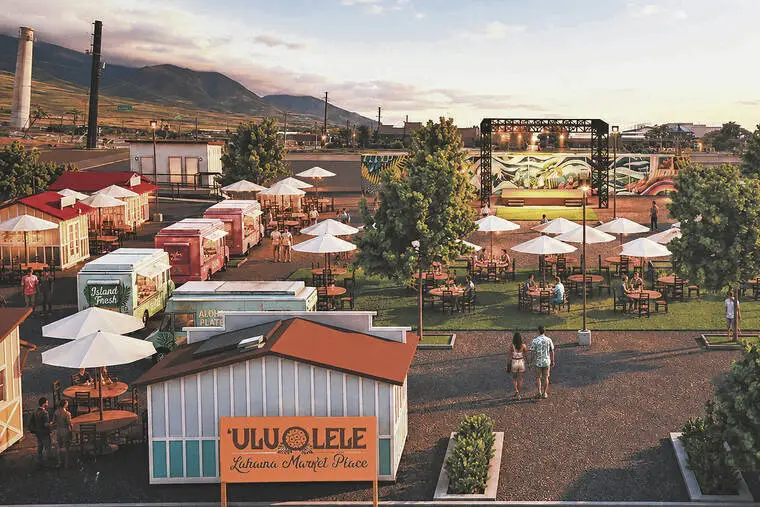
First storefronts returning to Lahaina’s Front Street
Front Street’s commercial core remains largely empty almost three years after the Aug. 8, 2023, wildfire, but Maui County and the Hawaiian Council on Thursday unveiled an $8 million pilot marketplace that will return the first storefronts to what was once one of Hawaii’s busiest economic corridors.
Read more Portugal survive late drama to beat Croatia and reach World Cup last 16
The ‘Ulu o Lele Marketplace, opening in September on the former Outlets of Maui site, marks the first major commercial reinvestment in a district where recovery has lagged behind the residential rebuild. More than 1,200 homes are in construction or permitting, but Front Street’s return has been slowed by complex approvals, reduced building footprints and disagreements over how historic Lahaina should be rebuilt.
Wednesday’s blessing of the Front Street Railing and Walkway Project signaled additional movement. New county permitting data showed five commercial permits issued, two nearing approval, and more than a dozen properties in consultation — evidence that Lahaina’s commercial core is finally entering a sustained recovery phase. The Lahaina Small Boat Harbor, closed for 28 months, also has begun its slow return, with seven operators back in service and companies like Atlantis Submarines resuming tours as the waterfront rebuilds.
Maui Mayor Richard Bissen said there is a lot of historic value to Lahaina’s Front Street, and “the revenue and income generated from that location was important to the entire state of Hawaii.”
Bissen added that the impact is much more personal and “important for our people of Lahaina … the business owners, and the shops that are there. So it’s absolutely essential for our economic activity, for employment, for our community, especially those that reside in Lahaina and work in those shops.”
He said the desire for its return is universal. “I think we all want to see it come back.” And its cultural weight, Bissen added, is global. “Anyone you meet around the world will tell you a story about a honeymoon or a wedding or a family trip that they took there.”
Marketplace details
‘Ulu o Lele — meaning “Growth of Lele,” a nod to Lahaina’s traditional name — will offer 17 retail units and eight food truck spaces between 144 and 240 square feet, creating an interim home for local businesses, nonprofits, cultural practitioners, farmers and community programs while permanent redevelopment continues. The project stems from the Maui Business Recovery and Resilience Assessment, a community-driven plan funded by Hawai‘i Community Foundation to stabilize West Maui’s economy.
The Hawaiian Council’s Kako‘o Maui initiative so far has invested $35 million in wildfire recovery, including $12 million in charitable donations. It has supported nearly 1,000 people through housing programs, delivered 66 interim homes, provided $2 million in predevelopment grants that helped rebuild more than 100 houses, served 9,000 residents through its distribution center, and offered workforce training to nearly 900 individuals.
Hawaiian Council CEO Kuhio Lewis said last year’s needs assessment made clear that economic recovery was the community’s most urgent gap and that many businesses already had been lost.
“It’s a small and a beginning effort to bring energy, to bring hope, to help families and businesses to start feeling a degree of normalcy in Lahaina,” he said.
Priority will go to businesses directly impacted by the fires, with tenants rotating to maximize participation. Subsidized rents will range from $800 to $1,500. The project is funded through Kako‘o Maui disaster recovery dollars and a major contribution from Hawai‘i Community Foundation.
Hawai‘i Community Foundation President and CEO Terry George said the foundation supported the marketplace with a $4 million Maui Strong Fund grant, calling it “a powerful example of community-driven recovery in action.”
A request for proposals will be released soon, with a Lahaina advisory committee selecting tenants. Lewis said the Council will act as facilitator and leave “the decision making to the people of Lahaina.”
Community member and small-business owner Courtney Lazo, born and raised in Lahaina, said the location on the edge of Front Street offers a gentle path back for residents who have not yet been able to return to Front Street. “It allows our people to kind of inch their way back into our town … baby steps,” she said.
Lazo said the project gives residents still struggling through the long recovery a chance to stay rooted in Lahaina.
Read more Lucas Glover, 46, builds 2-shot edge at John Deere Classic
“That’s ultimately what we want … people to remain here … be able to afford to stay here, and feel like they are truly part of this community, especially in the commercial district,” she said. “And being able to set roots, and have the new mom‑and‑pop shops set up that can carry on for generations.”
Green shoots
and gaps
Aug. 8 will mark three years since the wildfire destroyed Lahaina’s historic core — the nation’s deadliest fire in more than a century. All commercial and residential lots have now been cleared, and more than 500 homes are under construction with another 700 in permitting. But Front Street’s recovery has been slower, especially for the 10 commercial properties on the makai side which have faced more onerous permitting, especially those that lost over-water leases, shrinking buildable footprints. The county has launched a buyout program for owners unable to rebuild, converting purchased parcels into public access and open space.
Deputy Managing Director Erin Wade said Wednesday that five commercial properties have received permits, two more are close to issuance and more than a dozen are in consultation.
Wade said 612 Front St. — the former Six Fathoms building — was a six‑tenant structure that is being rebuilt as a near replica of what burned. 632 Front St., long remembered as the old Burger King and most recently Pai‘a Fish Market, is returning with the same look and feel, she said.
In the 700 block, 714 Front St. and 724 Front St. are also coming back almost identical to their original construction. The most complex project because it is a historic restoration, 744 Front St. — known locally as Fleetwood’s — is “on the verge” of securing its final permits, Wade said.
She said there is “great momentum that is happening” on Front Street, “and while it might be behind the scenes at the moment, all of these projects are moving forward and in keeping with what the community’s hopes and expectations were.”
Many are following updated design guidelines that preserve Lahaina’s historic character while allowing fire-resistant materials such as fiber cement siding and standing seam metal roofs, Wade said.
Activating Lahaina
Lahaina’s more than 150-year-old banyan tree is recovering, and view planes to the ocean are wider. But many landmarks are gone, and Lahaina Harbor — once near capacity — was forced to close for 28 months due to structural damage and hazardous water conditions.
DLNR data shows 48 companies were displaced; 12 relocated to Ma‘alaea, and seven have returned since the harbor reopened Dec. 15.
Atlantis Submarines’ return in June marked a symbolic milestone. The company lost nearly all of its Maui assets in the fire, but CEO Ronald Williams said in a statement, “We never had any thought of giving up and have always felt that being able to restart the submarine tours at Lahaina Harbor would be viewed as another sign of hope that life is coming back to this iconic community.”
Atlantis has resumed operations with a submarine towed from Oahu and 15 returning employees The increase in harbor activity also has highlighted how uneven Lahaina’s recovery remains. Toni Marie Davis, executive director of the Activities &Attractions Association of Hawaii, said early operators felt like they had “won the lottery,” only to find visitors hesitant to walk through a still-scarred landscape.
“They actually didn’t come in droves … it dampened their joy,” she said.
Lewis said the Council will focus on long-term economic revitalization and activating ‘Ulu o Lele to ensure “the right energy” in the space. As a prime contractor for the Hawai‘i Tourism Authority, the Council is exploring shuttles and other supports for marketplace businesses. The site will include a stage for entertainment and cultural storytelling.
“It’s intended to be something that tells the story of the people of Lahaina in a positive way,” he said.
Bissen said more commercial activity will follow as infrastructure work continues. “Where do I think we’ll be in three years? I think with the momentum we’re starting, we’ll have many more commercial businesses up and built and running,” he said.
Read more Visually-impaired runner Murdoch to race Kona Marathon through nonprofit

Related Posts

Remembering Hawaii’s 9/11 victims

World Manta Day returns today
