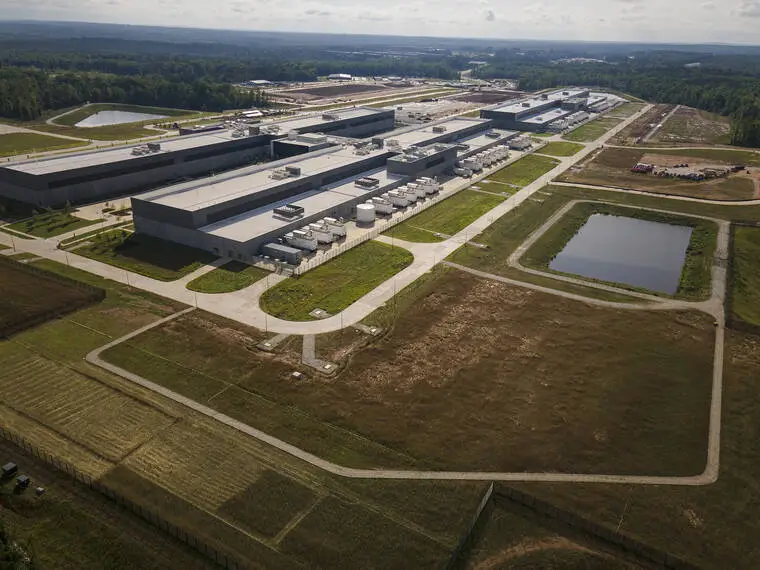
Legislation targets data centers in Hawaii County
A Hawaii County Council Committee on Tuesday unanimously approved forwarding a bill banning industrial-scale data centers on the island after hearing testimony from nearly a dozen supporters.
Read more First American woman rows solo from California to Hawaii
A Hawaii County Council Committee on Tuesday unanimously approved forwarding a bill banning industrial-scale data centers on the island after hearing testimony from nearly a dozen supporters.
The Policy Committee on Planning, Land Use and Economic Development voted 8-0 to send Bill 170 to the planning director and dual planning commissions for review. Hilo Councilman Dennis Onishi was absent and excused.
The measure amends county zoning code in an attempt to define data centers — commonly understood to be large, climate-controlled facilities housing networked computers and servers that function as the technological backbone for artificial intelligence systems. They are distinguished from standard “data processing facilities” in the bill, which are defined as establishments “primarily involved in the compiling, storage and maintenance of documents, records and other types of information in digital form utilizing a mainframe computer.”
These latter facilities are currently allowed in Hawaii County on lands zoned industrial-commercial mixed-use (MCX). The bill intends to separate industrial-scale data centers from these smaller installations so that data center developers cannot exploit this zoning loophole to bypass county restrictions.
According to the bill’s text, drawing this distinction will “prevent data centers from being considered a permitted use due to their similarities with data processing facilities.”
Data centers are defined in the proposed legislation as “a facility used for the industrial-scale operation of computer systems and associated equipment for the processing, computing, transmission or dissemination of digital data, and that requires supporting infrastructure beyond that typically accessory or incidental to office, commercial or public institutional uses.”
Within the past few years, public perception of these facilities has shifted from mild indifference to vocal — and at times hostile — opposition. Critics often warn that data centers’ high water and electricity usage will drive up residential utility costs while diminishing quality of life with eyesores and noise pollution caused by the constant humming of ranks of cooling fans. Some proponents, however, argue that job creation and new tax revenue streams could offset these drawbacks.
During Tuesday’s meeting, a string of testifiers spoke in person and via Zoom, largely praising the council for proactively heading off an issue that has caused significant social upheaval on the mainland.
Among them was Kailua-Kona resident Noelle Lindenman, who contended that an industry infamous for straining electricity and water reserves doesn’t belong in an isolated setting with limited natural and utility resources.
“Our island’s water and energy resources cannot support hyper-scale data centers,” Lindenman said. “Please pass the strongest version of this bill.”
Pepeekeo resident Charmaine Banther explained to the committee that an average data center “uses 60 megawatts of electricity” and “5 million gallons of water” per day.
Attempting to put these numbers into perspective, she claimed such immense daily utility needs represent “one-third of Hilo’s electricity” and the water usage of “50,000 people — more than the population of Hilo.”
“As we’ve seen in recent years, our resources are not unlimited,” Banther said. “Last year’s drought showed us how fragile our system is. Are we prepared to take a data center over providing water for our people, the schools, the farmers? Is (it) more important to be able to get a quick AI answer than to support our community? I don’t think so, and I don’t think most of our community would say so either.”
Hilo resident Cory Harden recounted a long list of mainland data center horror stories, like tech companies forcing local officials to sign nondisclosure agreements, residential families unable to sleep due to the roar of gas turbines running in their neighborhood generating electricity to power servers, and air pollution caused by large diesel generators.
“In some areas, electric utilities are crossing through people’s properties with the new transmissions lines needed to supply energy to data centers, with some homeowners even finding massive high voltage poles going up in the middle of their lawns just yards from their houses,” she said, claiming to be quoting Consumer Reports.
Read more Cobolli and Paolini keep bubbling into Wimbledon quarter-finals, Britain’s Fery stays afloat
Pahoa resident Tanya Yamanaka Aynessazian said she attended a tax conference in Detroit, Mich., last month where she met people living in rural communities who’ve “already experienced the repercussions of data centers.” She said local officials in these places have done little to rectify such issues, and in some cases have enabled them.
“Their county councils and city councils have already sold them out, even giving tax breaks to the people and corporations who are building these, and their water is already running dry,” Aynessazian said.
She begged council members to do “absolutely everything (they) can do to stop data centers from ever becoming rooted,” warning that without guardrails, this new technology would eventually “take over in a way that we probably can’t understand.”
“It’s on your watch,” she said. “It’s on all of our watch, and this is going to be something that our kids are going to be yelling at us about in the future — and our grandkids — if we’re not really careful about what we’re doing.”
After testimony wrapped up, the bill’s author — Hamakua Councilwoman Heather Kimball — briefly touched on the handful of benefits data centers offer before rattling off a list of negatives, including their “effect on electricity prices for residents, the use of water, the noise.”
“All of those things have led me to a position where I don’t think they belong here in Hawaii County,” Kimball said.
She said she often hears comments from detractors claiming that data centers are “never going to happen here anyway (because) land is expensive, energy is expensive.”
“The industry has a stated goal of data centers in every state — 3,000 across the nation,” she responded. “It’s not something that we shouldn’t anticipate happening.”
Kona Councilwoman Rebecca Villegas praised the bill, saying she had watched enough science fiction horror films to know where the AI boom could eventually lead.
“I don’t know about you guys, but I’ve seen enough movies — even from decades ago — about artificial intelligence and it turning and all the different things,” Villegas said.
She reasoned that trading Hawaii Island’s resource sustainability for technological convenience and ease is a reckless bargain that could come with grave unforeseen consequences.
“I have probably 90,000 photos on my cellphone. I am a photo taker — I share with other people,” she said. “I would gladly give that up if it meant that we continue to be able to abide within the capacity of our island’s natural resources.”
Planning Director Jeff Darrow told the council he was “not aware of any data center coming before the Planning Department requesting a permit.” Nevertheless, Darrow said the widespread use of AI technology on the island shouldn’t force residents to simply live with its side-effects.
“I think we’re all affected by data centers in the sense of our everyday use of our phones, our photographs … our use of Chat GPT, and AI, and whatnot,” he said. “I think it is very much a part of everyone’s lives right now, but that doesn’t mean that we have to just allow it all over our county.”
Read more Portugal superstar Cristiano Ronaldo closes out World Cup chapter
Email Stefan Verbano at [email protected].

Related Posts

Remembering Hawaii’s 9/11 victims

World Manta Day returns today
