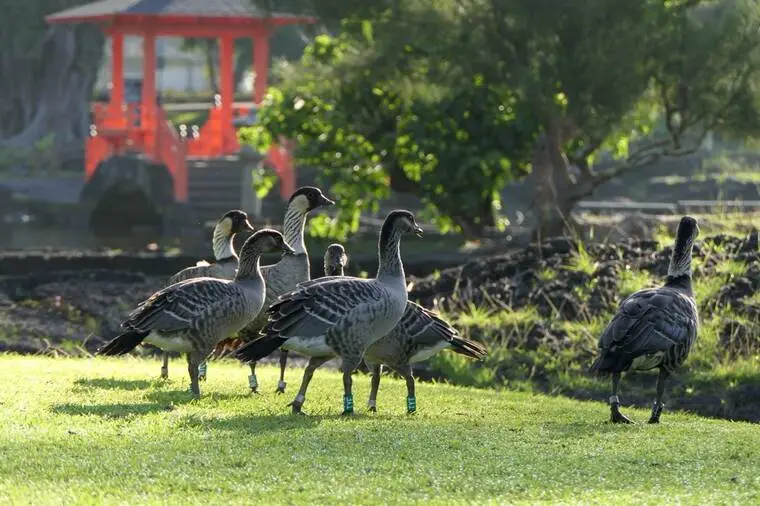
Nene goslings take flight after surviving in Hilo park
For the first time in recent years, three nene goslings successfully hatched in Lili‘uokalani Gardens — and survived.
Read more Roundup: William Contreras, Brewers jump all over Dodgers
For the first time in recent years, three nene goslings successfully hatched in Lili‘uokalani Gardens — and survived.
The state Department of Land and Natural Resources and the nonprofit Nene Research and Conservation have been closely monitoring the birds and reported they were banded and appeared healthy when they grew their flight feathers and took off from the park several weeks ago.
Jordan Lerma of Nene Research and Conservation said he is hopeful this will be the start of more successful nene nesting seasons at the park, which has a long history of tragedy for the birds.
Nene have been hit and killed by cars, had their nests trampled by dogs, and gotten sick from toxoplasmosis, a disease spread by feral cats — which people have fed in the park for years despite warnings from DLNR about how harmful it is to nene and other wildlife.
The goslings’ mother has had an especially tough couple of years.
“This is the female that previously nested at Wailoa, and her gosling from Wailoa got stolen by a lady,” Lerma said. “And then the next year, she tried at Lili‘uokalani Park. She hatched one gosling, and that gosling only made it about a month before it died from toxo(plasmosis). Then the next year, she laid three eggs, and they got trampled by dogs. So, she’s kind of had a really rough story.”
This year, however, he said things finally seemed to align.
“She chose a different spot in the park. It’s kind of like an island that connects to the other main areas with a bridge, so we were able to put barriers on the bridge to warn folks, and it was about 150 yards away from the cat colony,” Lerma said.
He also credits the passage of County Council Bill 51 last year, which banned the feeding of feral cats on county land, and community members stepping up to help protect the nest.
Read more Ousted Hawaii baseball team begins preparing for next season
“This year, the community has kind of been rallying around her,” Lerma said. “Once she showed up in the park people, the community, were very motivated to make sure that she was successful this year.”
She also had a little extra security from two male nene birds who Raymond McGuire, a wildlife biologist with DLNR’s Division of Forestry and Wildlife, said seemed to take her in after her mate was struck by a car last year. It’s an arrangement that McGuire said is unusual, but seems to be working to the female nene’s benefit.
“For whatever reason, they’re just awesome nene,” he said. “Two guardians, in this area, is probably ideal because there’s just so many things.”
With all of the potential hazards at Lili‘uokalani, he said he has often been asked why DLNR doesn’t just relocate nesting nene to safer locations. However, he said this would not necessarily guarantee, or even aid, the survival of this unique native species, which is federally classified as threatened.
“The truth is, in order for the nene to survive, we have to coexist with them, and if we continue to move their nests, then we never adapt to each other,” he said. “It’s not until we can really coexist that we can actually have a good population.”
Lerma echoed that sentiment.
“When Captain Cook first arrived, they estimated the nene population for Hawaii Island was greater than 25,000, so that’s five times more than the current statewide population,” he said. “What we want to see is getting back to that. It’s getting to a point where native species and community can coexist. … I hope to scale what we’ve done in Lili‘uokalani so that everyone in Hilo recognizes these birds and their importance in our ecosystem.”
Read more Management plan in the works for Hilo Bay watershed
Email Grace Inez Adams at [email protected].