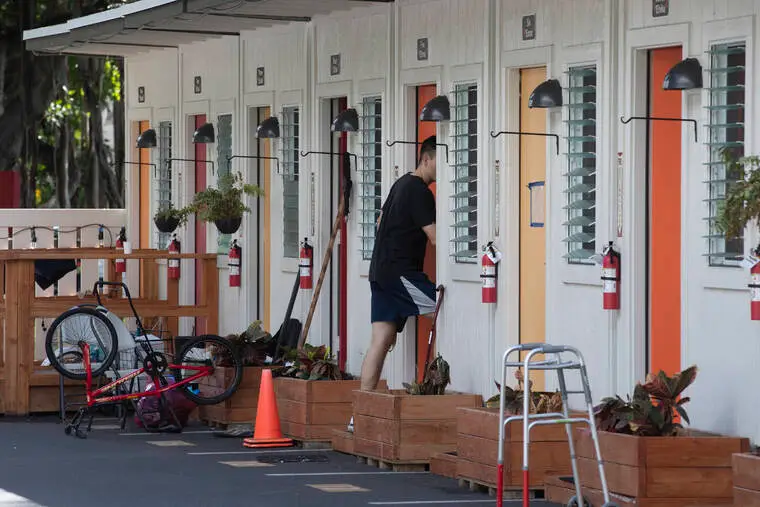
State audit blasts spending on Green’s kauhale initiative
More than $13.7 million in state payments for Gov. Josh Green’s signature kauhale homeless initiative were “unauthorized, unsupported or questionable,” according to the highly critical, long-awaited state audit of Hawaii’s oversight of kauhale construction.
Read more ‘They made their day’: Vulcans, Special Olympics Hawaii host Hilo regional games
More than $13.7 million in state payments for Gov. Josh Green’s signature kauhale homeless initiative were “unauthorized, unsupported or questionable,” according to the highly critical, long-awaited state audit of Hawaii’s oversight of kauhale construction.
According to the report released Wednesday by state Auditor Les Kondo, neither the Statewide Office on Homelessness and Housing Solutions nor nonprofit kauhale builder HomeAid Hawaii were prepared for the rapid pace of construction of tiny home communities across the state.
After the scathing audit was released, Green in a press release said the office that oversees construction of the kauhale initiative has accepted all 11 recommendations in the report, but disputes that most of $6.1 million identified in the audit represented “unauthorized payments.”
State Homeless Coordinator Jun Yang said in the response from the state included in the audit that SOHHS has “aggressively taken steps to recover public funds for expenses that were deemed improper” in the audit.
They include more than $16,000 in unauthorized mainland and international travel that included first-class airfares; $300,000 in office and administrative expenses; and approximately $170,000 for work performed by subcontractors and consultants for nonprofit kauhale builder HomeAid Hawaii that were not directly related to Green’s kauhale initiative.
“Our kauhale are delivering results across Hawaii with nearly 900 beds so far, providing stable housing and human services to more than 2,900 of our formerly houseless neighbors, including medically fragile and older adults, families with children, people with behavioral health needs and survivors of domestic violence,” Green said in a statement following the audit’s release. “We welcome accountability and will continue strengthening the program, but we will not lose sight of what matters most: kauhale are working, they are changing lives — and we are going to keep building on that progress because the people of our state deserve a real solution to this generational problem.”
The homeless housing initiative is on pace to have 33 kauhale opened by the end of the year, moving clients into tiny-home communities where they receive a long list of social and medical services.
Green has made his kauhale response to homelessness one of the pillars of his reelection campaign, and the audit comes less than a month before the Nov. 3 general election voting deadline in which Green is widely expected to win re-election to his second term.
HomeAid officials told the Honolulu Star-Advertiser last week that their operating budget of just $207,407 in 2015 shot up exponentially to $142.9 million in 2024 on the heels of explosive growth from state contracts to expand kauhale projects and build emergency housing for survivors of the Aug. 8, 2023, Maui wildfires.
In an April 20 memo to the state Legislature, Kondo warned of the need for “immediate attention” to the kauhale effort to address “improper use of public funds.”
“We are concerned that significant deficiencies in internal control in the State Office of Homelessness and Housing Solutions’ (SOHHS) implementation of the kauhale initiative create an ongoing and substantial risk of improper use of public funds,” Kondo said in his memo.
At the time, he made it clear that the focus of the audit was SOHHS oversight of the kauhale program and not on HomeAid.
In his statement Wednesday, Green cited data from the annual Point in Time Count homeless census in defense of the program, but gave no information on direct results from the initiative, including the number of homeless it has housed and taken off the streets compared to the overall cost of providing the tiny homes.
Green cited the reduction in Hawaii’s overall homeless population from 4,042 to 3,513 from 2024 to 2026, a drop of 13.1%, according to the annual Point in Time Count homeless census. On Oahu, the homeless population declined from 2,766 to 2,208, a reduction of 20.2%. O‘ahu’s sheltered population increased from 1,728 to 2,331.
This year, for the first time since 2018, the number of “sheltered” homeless people outnumbered those living unsheltered, or on the streets of Oahu, Green said.
The kauhale initiative, according to the audit, “began with an ambitious promise: to treat homeless as a public health emergency while rapidly expanding deeply affordable housing for people experiencing homelessness or at risk of becoming homeless. … The initiative, however, quickly became something different. … (that) required the State to assume substantially greater responsibility for planning, contracting, construction oversight, and financial management.
“The Statewide Office on Homelessness and Housing Solutions was established to coordinate homelessness policy, not to plan and administer public works projects,” according to the audit. “Yet it assumed responsibility for development-related contracts totaling more than $42 million without the qualified staff, technical expertise, written procedures, and internal controls needed to plan and administer them. …
“Its actions and its failures to act — created conditions in which waste could occur and go undetected,” according to the audit.
Read more Bill to extend the county’s homeless fund another two years advances
The audit identified $13.7 million that SOHHS paid “without adequately determining that the costs were reimbursable,” according to the audit, including more than $7.7 million in unauthorized costs, nearly $1 million in unsupported personnel costs, and nearly $5 million in questionable costs. It included a $2.5 million advance that the applicable contract did not authorize, more than $1 million charged to budget categories the State had never approved, and more than $110,000 charged to categories expressly funded at zero.”
The audit emphasized that the $13.7 million it identified reflected only the auditors’ review of “selected payment requests and records. We did not review HomeAid’s contracts with its contractors, consultants, and vendors. Some questioned costs may ultimately prove reimbursable if additional documentation establishes that they were properly chargeable to the agreements. But making that determination was SOHHS’s responsibility, and it should have occurred before the money was paid – not years later during an audit.”
The audit recommended that SOHHS have properly trained staff with the experience to independently oversee kauhale projects “and establish policies, procedures, and controls to administer contracting and payments.”
In the meantime, the audit also recommended that SOHHS retain an independent consultant, such as a construction auditor, “to comprehensively review each of HomeAid’s payment requests and supporting documentation.
“Government’s responsibility is not simply to explain spending after the money is gone; it is to establish and enforce controls that prevent waste before it occurs,” according to the audit. “Contracts, budgets, approvals, and payment reviews are not bureaucratic obstacles. They are how government prevents urgent spending from becoming wasteful spending.”
The Office of Homelessness and Housing Solutions began documenting “transactions after the fact” with the 2023 construction of the state’s first temporary “medical respite kauhale” in the parking lot of the state Department of Health on Punchbowl Street directly in between the governor’s mansion, the Queen’s Medical Center, the Health Department and the state Capitol as a proof of concept that kauhale can reduce homeless patients’ reliance on costly hospital emergency room visits.
“The project was built without a contract and was publicly announced at its May 2023 opening as a gift from the contractor, HomeAid Hawai‘i (HomeAid), to the State,” according to the audit. “Less than two months later, the State executed a Bill of Sale agreeing to pay more than $67,000 for project materials. The Bill of Sale did not establish beforehand what HomeAid was authorized to provide, what costs the State had agreed to pay, or the conditions governing payment. It simply documented a payment after the project had been completed.
“The same approach continued at Cedar Church, where the State allowed work to proceed and placed 20 State-owned tiny homes on church property without a development agreement.”
In disputing some of the spending identified in the audit, Yang said the auditor believed $6.1 million in “unauthorized payments” for one kauhale project called Alana Ola Pono were made before a contract had been executed. Yang responded that the contract had actually been executed two months earlier.
Yang also disputed $2.4 million in “questionable” payments to HomeAid to evaluate potential kauhale sites.
“This kauhale pre-development work evolved over time due to the rapidly changing needs of the office, including an unprecedented disaster response following the Maui Wildfires,” Yang wrote in his response that’s cited in the audit.
The kauhale concept was inspired by a 2019 trip that Green, as lieutenant governor, took to Texas to see a tiny-home community built by HomeAid Austin that housed 200 homeless people and resulted in a 60% reduction in drug use while retaining 82% of the residents.
Working with HomeAid Hawaii, Green then opened the state’s first kauhale in December 2019 in Kalaeloa and moved to expand the concept after he was elected governor in 2022.
The effort kicked into high gear when Green used a series of executive orders that were initially opposed by some environmental groups, historic preservationists and others Green had considered allies, but who were alarmed that the executive orders would allow established procedures to be ignored.
Green’s emergency proclamations, according to the audit, allowed ordinary procurement and other procedures to be suspended.
Even with the proclamations, the audit said: “The State remained responsible for deciding what it intended to buy, establishing the terms governing the work before it began, monitoring contractors’ performance, and ensuring that public funds were used only for authorized purposes.”
The Office on Homelessness and Housing Solutions, according to the audit, “was not prepared to implement the initiative and did not provide the oversight necessary to protect public funds. SOHHS assumed responsibility for multimillion-dollar public works projects despite lacking the qualified personnel, technical expertise, written procedures, and internal controls needed to plan and administer them.
“More fundamentally, SOHHS treated contracts, amendments, approvals, deliverables, and payment records as paperwork that could be completed after decisions had been made, work performed, and costs incurred.”
Read more PHOTOS: Cougars sweep Cowgirls