Healthcare legislation addressed vapes, medical debt
There were some gains, but also disappointing failures for healthcare issues in this year’s state Legislature.
Read more Caitlin Clark buries game-winning 3 for Fever to beat Mystics
While legislators approved some bills addressing the use of vapes among youth in Hawaii, along with others that expand health services for kupuna, other bills seeking to address the state’s chronic doctor shortage and protect patients’ rights failed.
With federal cuts looming, Gov. Josh Green has appropriated $16.5 million out of the general fund to cover the expiration of the Affordable Care Act’s enhanced premium tax credits. Another bill establishes a state program that potentially could help cancel medical debt for about 50,000 residents in Hawaii.
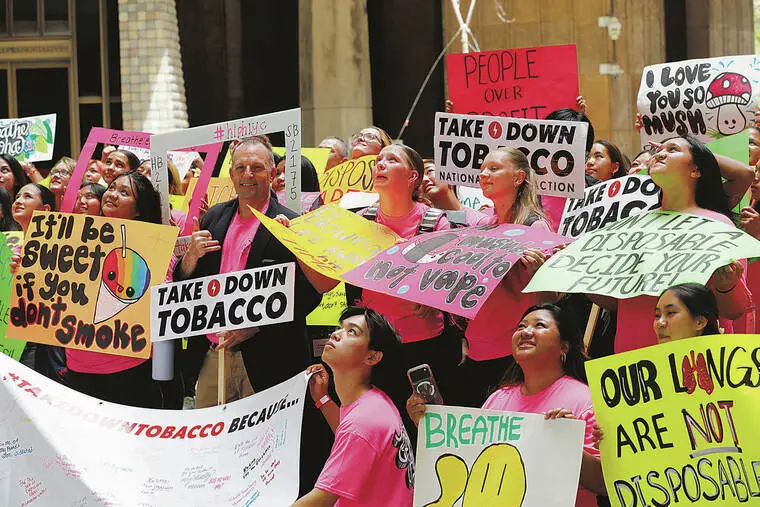
After years of advocacy for bills to curtail e-cigarette use among youth in Hawaii, two bills that address vaping will go to Green for his signature.
Senate Bill 2175 bans the sale of disposable e-cigarettes containing lithium-ion batteries due to their fire risk and harmful impact on the environment, unless they have been federally approved.
Additionally, House Bill 1573 prohibits the sales of vapes unless they are approved for sale by the federal government, which so far has only authorized 45 in the U.S.
Starting in October, manufacturers of vapes and e-liquids must certify to the Hawaii Attorney General annually that they have approval — in the form of a marketing granted order — from the U.S. Food and Drug Administration.
This will apply to all e-smoking devices or e- liquids sold in Hawaii, whether directly or through a dealer, distributor, importer, retailer, wholesales or intermediary.
These bills are considered a win in the battle to keep harmful e-cigarettes from youth in Hawaii, and helping to prevent them from becoming addicted to the products.
“We are very excited with the legislative success that we have had, which essentially makes our state healthier and safer,” said Kailana Hagan, a Coalition for a Tobacco-Free Hawaii Youth Council member.
The youth council advocated to get the toxic products off of shelves, she said, and the bills are meant to protect health and the environment.
Hagan, a Seabury Hall student, added, “It is really cool to see the success that we have had with our policing priorities and how fighting for these action items can actually make change with legislative success here in our state.”
Supporters of HB 1573 said thousands of unapproved products are still available for sale in the U.S., and that the measure would result in better enforcement of these illegal products in Hawaii.
Still, advocates say more stringent measures are needed on flavored vapes targeting youth, particularly in light of the FDA’s recent decision to approve the sales and marketing of fruit-flavored e-cigarettes.
“We are pleased with the passage of these measures to improve public health, but need to go further,” said the Hawaii Department of Health in a statement. “Just last month, the FDA changed course and expanded access to flavored e-cigarettes. A ban on flavored e-cigarettes in Hawaii is increasingly important to protect our youth.”
Pedro Haro, executive director of the American Lung Association in Hawaii, echoed these sentiments.
“We cannot ignore that the Legislature has once again skirted the issue of restricting flavored tobacco once and for all or allowing local communities to do so as has been adopted in several states and numerous localities,” Haro said. “We have to continue to be vigilant against the influence of the tobacco industry on our islands.”
ALA Hawaii condemns the FDA’s recent decision to authorize flavored e-cigarette products, he said, particularly fruit flavors, that clearly appeal to kids.
Medical debt,
insurance
Other bills this year address medical debt and health insurance coverage.
Senate Bill 3025, introduced by state Sen. Chris Lee (D, Kailua-Waimanalo-Hawaii Kai), establishes a medical debt acquisition and forgiveness program within the Office of Wellness and Resilience.
The bill, which would take effect July 1 if approved into law, would appropriate $500,000 in funds to set up the program.
Lee said he has been working on the initiative for three years, and that similar programs have been set up in 27 other states and cities in the U.S. in partnership with a nonprofit, Undue Medical Debt, that has purchased billions of dollars in medical debt for about 0.01% of the overall cost.
Read more Ocean View man accused of Kona road rage incident
When set up, he said, the program potentially would forgive the medical debt of about 50,000 residents in Hawaii totaling about $91.3 million.
“In Hawaii, a surprising number of local residents have unpaid medical debt that they simply can’t afford to address,” said Lee, “despite the fact that we have some of the higher rates of health insurance.”
That includes people stricken with cancer or other illnesses that prevent them from working, he said, and even those who have insurance coverage, but not enough to cover their expenses.
Lee said people don’t choose to have medical emergencies that can bankrupt families.
“Unlike debt that we choose to take on, to buy a car or house or whatever else, people don’t choose medical debt,” he said. “They don’t choose to get sick.”
Erasing medical debt would allow these people to get back on their feet, improve their credit scores and potentially get back to work. Additionally, it could enable them see their doctors for regular checkups and screenings again, and help prevent them from ending up in emergency rooms, which are funded by taxpayer dollars.
Senate Bill 3305, which attempted to set up “Hawaii Care,” a universal, single-payer health care system, never made it to a committee. The system would provide comprehensive healthcare benefits to all Hawaii residents, an idea that has been floated in the state before.
The bill said delivery of healthcare services in Hawaii has approached “crisis levels,” particularly on neighbor isles, as doctors continue leaving the state. The bill was never scheduled for a hearing.
House Bill 2537, which attempted to update Hawaii’s patient’s bill of rights, requiring timely decisions on prior authorizations and regulations on the use of “automated decision support tools” for claims, also failed to get a hearing.
Doctor, nurse shortages
For the Hawaii Healthcare Task Force, the failure to pass House Bill 1965, requiring higher insurance reimbursements for primary care doctors, was a disappointment.
The original bill would have required all health insurers to allocate at least 6% of their total medical expenditures to PCPs next year, and up to 12% by 2029 — boosting it from about 3.6% currently.
Additionally, it required insurers to pay PCPs directly rather than through third-party administrators, and to do so promptly.
The bill morphed into a measure establishing a primary care providers working group, but failed to get to conference committee.
Dr. Esther Yu Smith, the task force’s vice president, said the group plans to return with another bill again next year.
“The task force has basically done all the research that a working group would have done now,” she said. “We have looked at all the legal arguments, we have looked at all the numbers, we have had better access to health care information than we’ve ever had. All we need to do is bring the stakeholders together, fine-tune it, and we’re coming back.”
Hawaii nurses concerned with safe staffing were happy with a resolution requiring the Hawaii State Center for Nursing to create a repository of recommended staffing ratios for the full range of nursing specialties in different healthcare settings, to be made available 20 days prior to the next legislative session.
Senate Bill 847 allows qualified psychologists to prescribe medications under the supervision of a doctor or psychiatrist as part of a three-year pilot program — but only at federally qualified health centers on Kauai and Hawaii Island.
Kauai Mayor Derek Kawakami and Hawaii County Mayor Kimo Alameda supported the bill.
Other bills that passed this legislative session include the approval of $3 million for the Hanai Memory Network to better diagnose and treat Alzheimer’s and other dementias in Hawaii.
The state Legislature also approved bills establishing a $2 million pilot program for in-home health care for frail, elderly residents who do not qualify for government assistance, and to provide colorectal cancer screening for uninsured persons.
Read more Mirra Andreeva claims first Grand Slam title at French Open