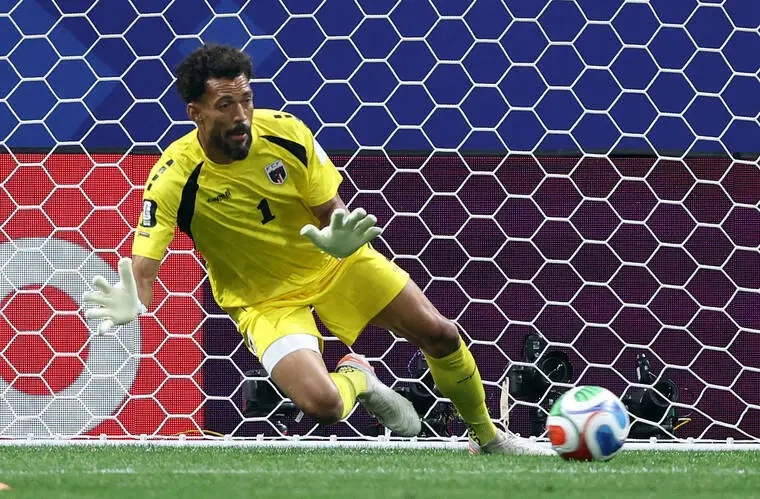
World Cup underdogs Cape Verde stun Spain in goalless stalemate
Rarely has a 0-0 draw at a World Cup been so eagerly anticipated… and then celebrated.
Read more Completion of HVO facility projected for 2027
When the full-time whistle blew in Atlanta on Monday morning it was clear we had all just witnessed something significant. Tournament debutants Cape Verde had held reigning European champions Spain to a goalless draw, a result that — frankly — no-one had seen coming.
It’s a scoreline that immediately places it into the pantheon of World Cup shocks, but is it possible to dig a bit deeper and work out just how much a surprise it is that a team from a small set of Macaronesian islands was able to thwart one of soccer’s leading nations? We gave it a go.
How Cape Verde did it
First of all let’s examine how Pedro Leitao Brito’s side stymied the Spanish, in a game that followed a predictable pattern, as Spain dominated possession and pushed Cape Verde back with relentless passing and pressure. By the end, Luis De La Fuente’s side had completed 400 passes in the attacking third, to their opponent’s… eleven.
But Cape Verde simply did not wilt in a solid, switched-on 4-5-1 defensive shape, compressing space between the lines and defending heroically in their own penalty area to keep the European Champions at bay, and committing only one foul in the process — the fewest ever recorded in a World Cup game.
Given the chasm in individual quality, they had little choice but to drop deeper at times and soak up Spanish attacks. But this was not a completely passive defensive performance from Bubista’s men, looking to spring out of midfield and hassle the ball up the pitch whenever the opportunity arose.
The image below helps to illustrate the general pattern throughout what must have been an exhausting second half. With Spain prepared to commit so many players forward, often leaving six across the front line, they ensured they remained solid in the centre of the pitch, blocking out passes to the dangerous Pedri and Fabian Ruiz in advanced areas and keeping that yellow area as small as possible.
It often left passes out wide to advancing full-backs, but when the ball was floated over, Cape Verde moved as a collective to close down, passing players on and clogging up the flanks to ensure progress was stopped.
On the occasions that Spain did break through, they were able to rely on colossal last-ditch defending from centre-backs Pico Lopes and Diney Borges. Goalkeeper Vozinha, meanwhile, 40 years of age, made seven crucial saves.
As we can see from the visualisation below, both central defenders made at least six clearances in their own penalty area. Lopes notably threw himself in front of a Mikel Oyarzabal volley with just moments to go, a prime example of the back-four’s commitment to defend their goal.
Not only without the ball, their were moments of real quality when Cape Verde recovered possession, zipping the ball around the Spanish pressure and often looking to play their way out with short passes into midfield. With a little more composure and splitting quality on the final pass, they may have made one of their rare forays forward count.
Read more Hawaii climate goals are at risk, advocates warn
But this is a result that Cape Verde will remember for generations, and a performance that will give them confidence that they can compete with Saudi Arabia and Uruguay in what now looks a much more open group.
How big a
shock is it?
How do you objectively assess a World Cup shock, a seismic sporting event that is so reliant on cultural and historic context, as several of The Athletic’s writers illustrated earlier today.
But there are ways of assessing it with cold hard figures, most notably the FIFA world rankings, which began in the 1990s as a way to assess the strength of international teams. Using the historic numbers, we can see that Cape Verde avoiding to defeat to Spain rates as the fourth biggest rankings gap between underdog and favorite.
It’s arguable Cape Verde could be even higher. South Africa defeating France in 2010 was undoubtedly a shock, but they were the host nation, a position that tends to give a nation a few extra percentage points in their favour. Hosting a tournament is also an indication you are not truly a tiny nation — South Africa, despite that win, and their draw with Mexico in the opening game were unfortunate not to get out of the group with four points, but they hosted a 32-team World Cup with relative ease. Will Cape Verde ever host a World Cup? No, they will not.
The example of New Zealand drawing with Italy in 2010 is a better comparison with Cape Verde drawing with Spain. The Italians were the reigning world champions at this point, yet could not defeat the team ranked 78th in the world at the time, leading to outrage in the Italian press. ‘Indigestible Kiwis’ was the headline in the Corriere della Sera.
Perhaps a fairer way is to look at landmass, already a popular metric at the 2026 World Cup thanks to the appearance of several small debutants. And if we do that then Cape Verde have indeed made history, becoming the smallest nation to gain a point at a World Cup, beating Trinidad and Tobago who got a 0-0 draw with Sweden in 2006. Curacao could yet steal this title from Cape Verde this summer, though they will have to defend more effectively than they did in their opening game with Germany, a 7-1 defeat. That many people expected a similar sort of scoreline in Cape Verde’s game with Spain is perhaps the biggest testament to what they achieved on Monday.
What does this mean for the rest
of the tournament?
The Athletic’s projection model still expects Spain to progress, though their chances of winning the group fell from 81 percent to 68 percent after Monday’s draw. More significantly, Cape Verde’s chances of progressing to the round of 32 have gone up from 32 percent to 52 percent — a significant increase.
The main implication for Spain is that they now have an increased chance of facing Argentina in the round of 32.
The South African and New Zealand examples cited above saw both nations exit in the group stages (New Zealand were famously the only team to remain unbeaten at the 2010 World Cup) with points totals — four and three respectively — that almost certainly would have seen them progress in the 2026 format.
Read more Knicks win first NBA championship since 1973, topping Spurs in Game 5
This summer’s romance with Cape Verde may only just be starting.
This article originally appeared in The Athletic.