PUC considers liability cap, recovery fund for future Hawaii wildfires
The state could rule as early as next year on how it will limit catastrophic wildfire liability for electric utilities, with preliminary public input due June 30.
Read more Hawaii County in talks with owner of Punalu‘u Black Sand Beach Park
The state could rule as early as next year on how it will limit catastrophic wildfire liability for electric utilities, with preliminary public input due June 30.
The state Public Utilities Commission wants stakeholders, including ratepayers, to help shape administrative rules governing a wildfire liability cap framework called for under a 2025 Hawaii law.
“This rulemaking intends to help Hawaii address how the state can ensure future wildfire victims are compensated while maintaining the financial stability of utilities responsible for delivering essential public services,” the PUC said in an announcement. “This is a proactive effort to define how responsibility, risk, and recovery are balanced before the next disaster occurs and not after.”
Under the year-old law, Act 258, the three-member commission must establish a monetary liability limit for future catastrophic wildfire damage, not including physical bodily or emotional harm, caused by an electric utility adhering to an approved wildfire mitigation plan.
Such a cap could be a fixed amount per event, or a total that covers a period of time regardless of the number of wildfire disasters.
The PUC also is exploring, as directed by Act 258, whether to recommend that the state Legislature establish a recovery fund for future wildfire disasters potentially financed in whole or part by contributions from ratepayers, utility company shareholders, taxpayers, insurance companies, landowners, tourists and other entities.
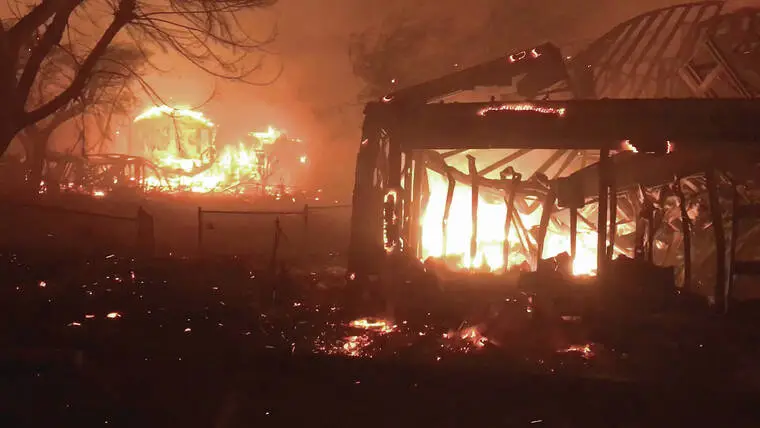
Both initiatives were reactions to the Aug. 8, 2023, Maui wildfire disaster that killed 102 people and caused an estimated $5.7 billion in property damage. The cap and fund are intended to establish a better system to compensate victims of a future wildfire catastrophe without bankrupting either of Hawaii’s two utility companies if they reasonably mitigate wildfire ignition risks.
Hawaii would not be alone in developing a liability cap or recovery fund.
Six other states — Arizona, California, Kansas, Montana, North Dakota and Wyoming — have liability caps, according to a report the PUC submitted to the Legislature in December.
Two states — California and Utah — have recovery funds, which the report said have been more controversial because many consumer advocates see them as shifting wildfire damage costs onto ratepayers.
The PUC report concluded that a Hawaii wildfire recovery fund of some nature is warranted in the future, but not before determining other things that include the liability cap, legal implications and an actuarial study that informs how big the recovery fund should be.
PUC officials say decisions on a liability cap and recovery fund are deeply interconnected, and so the commission is seeking public input on both.
“The definition of the liability cap will have huge impacts on how a recovery fund is ultimately established,” Colin Yost, a PUC commissioner, said during a May 22 informational webinar.
PUC representatives also said both issues involve trade-offs and competing considerations.
Such considerations include utility customer affordability, public safety, disaster recovery, utility stability and utility accountability.
“That’s one reason why community participation and manao (opinion) sharing are such important parts of this process,” Yost said.
Nathan Pollak, a founder and senior adviser at Colorado-based Scidan Consulting Group retained by the PUC to help implement Act 258, said during the webinar that public input will help the commission understand perspectives, trade-offs, questions and concerns from stakeholders that help shape PUC rules for a liability cap.
“This process is intended to help the commission better understand the real world impacts, practical considerations, and differing perspectives associated with liability cap design and implementation,” he said.
Read more Orioles clobber Dodgers, 12-1, to win series behind loud bats, steady start
To submit written public comments, visit puc.hawaii.gov.
The PUC emphasizes that a liability cap would define a maximum amount utilities can pay for real property and personal property damages from a wildfire but would not remove accountability for prudently mitigating wildfire risk under a PUC-approved plan. Both Hawaiian Electric and Kauai Island Utility Cooperative have such plans.
A recovery fund, the commission said, would expedite payouts to claimants with property damage.
The Maui fire resulted in massive litigation settled for $4 billion one year later, but proceeds have still not been paid out largely due to now-resolved disputes with insurers. Distribution of the settlement is to be made in four annual installments, and the first installment payouts are expected to begin in July or August.
Of the total, about $2 billion is coming from Hawaiian Electric, $873 million is from Kamehameha Schools, $808 million is from the state, and about $300 million is from Spectrum Oceanic LLC, Hawaiian Telcom and affiliates of West Maui Land Co.
The PUC report said a Hawaii recovery fund should improve the credit worthiness of utility companies that benefit ratepayers, though efforts to establish funds in other states have faced strong opposition.
California established a $21 billion fund in 2019 after utility Pacific Gas and Electric declared bankruptcy due to a wildfire disaster. Half the funding is from a state loan being repaid over 15 years by ratepayers via a roughly $3 monthly surcharge. The other half is from shareholders of three investor-owned utilities including PG&E.
The fund can be used to pay for damage beyond the greater of $1 billion or maximum insurance proceeds available from a utility.
In 2024, Utah established a $1 billion recovery fund per utility company that was financed by ratepayers. Utah also has damage payment caps of $450,000 for claimants with physical injuries, $100,000 for other non-economic damage and no cap for wrongful death. In both California and Utah, utilities can be held liable beyond the caps if they aren’t prudent with wildfire risk mitigation.
The PUC’s report said the two states have since increased the size of their funds, with up to $18 billion being added in California and $150 million in Utah.
However, consumer groups have been harsh critics of California’s fund, arguing that it over-relies on ratepayer funding and weakens utility mismanagement accountability, according to the PUC report.
One organization, The Utility Reform Network (TURN), and attorneys for California wildfire victims have decried the fund as a bailout.
“Consumer groups are extremely sensitive to California’s high electricity rates, second only to Hawaii nationally,” the PUC report said. “TURN and others argue that ratepayers are paying twice: once to prevent fires and again to cover damages when fires occur.”
Other states, including Oregon and Washington, tried to establish wildfire recovery funds through legislation in 2025 but didn’t succeed, in part due to concerns over ratepayer costs.
“Opponents argued that the bill unfairly shifted costs onto consumers and limited victims’ legal remedies by barring lawsuits against utilities responsible for fires in exchange for compensation from the fund,” the PUC report said about the Oregon legislation.
For Hawaii, the PUC is first working to create rules for a liability cap.
After evaluating preliminary public input, the commission will draft proposed rules and then reengage with stakeholders by holding a public hearing that includes the opportunity for public comment on the draft rules. The state Division of Consumer Advocacy also will be part of the proceeding.
Finalizing rules for a cap also is subject to approval by Hawaii’s governor.
For more information and to submit written public comments on the state’s effort to establish a wildfire liability cap for electric utilities, visit puc.hawaii.gov.
Read more Kona paddlers soar ahead in rankings as Moku season pivots on Wailoa River