Hawaii fast-tracks pilot recruiting efforts as aviator shortage looms
Hawaii’s aviation industry is accelerating efforts to rebuild its pilot pipeline, turning to youth training programs and new community partnerships as retirements mount and global demand for cockpit-ready talent continues to rise.
Read more Resilient Argentina refuses to lose: ‘This is who we are’
Hawaii’s aviation industry is accelerating efforts to rebuild its pilot pipeline, turning to youth training programs and new community partnerships as retirements mount and global demand for cockpit-ready talent continues to rise.
A mandatory retirement age of 65 ensures periodic shortages, even as the commercial sector remains stable for now. Spirit Airlines’ shutdown and a surplus of flight instructors have eased pressure temporarily, but Federal Aviation Administration data shows demand has been continuously rising: passengers flown in 2024 exceeded pre-pandemic averages by 6.5%, and pilot certificates increased 5.2% to 848,770.
Boeing’s long‑range Pilot and Technician Outlook projects the need for 660,000 new commercial pilots worldwide from 2025 to 2044 — including 11,000 in Oceania and 119,000 in North America.
The third annual Hawaii Aviation Expo on Aug. 1 at the Neal S. Blaisdell Center Hawaii Suites will bring Hawaii-based flight schools, airlines and training organizations together for a job fair, workshops and networking — part of a coordinated push to introduce youth to aviation careers earlier.
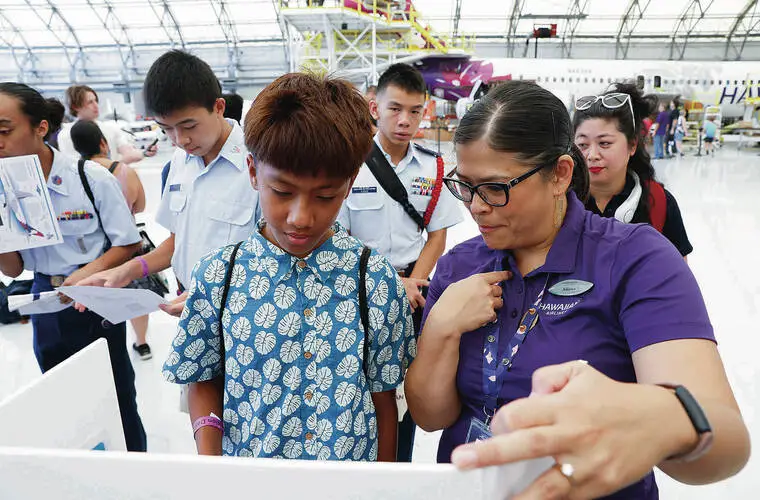
The event builds on Hawaiian Airlines’ inaugural Aviation Day, which was supported by the Aloha Chapter 99s, Soar Hawaii Foundation and Pacific Flight Academy, and drew interest from about 500 Hawaii students.
Alaska Airlines — which has hosted Aviation Day for 18 years — joined Hawaiian Airlines and Horizon Air to welcome nearly 4,400 participants across Honolulu, Portland, San Francisco, Seattle and Anchorage. The events aim to inspire the next generation of aviation professionals with the help of community partners.
Jim Landers, head of Hawaii operations at Hawaiian Airlines, said in a video statement released for Aviation Day, “It’s a really cool thing that we do making these machines fly, taking people to where they want to be and at Hawaiian Airlines connecting people with aloha.”
Expo opportunity
Alex Da Silva, spokesperson for Alaska and Hawaiian airlines, said in an email to the Honolulu Star-Advertiser that the company is sponsoring the Hawaii Aviation Expo for the third year in a row. He said the event provides an opportunity for aspiring pilots and hire-ready pilots to prepare for their careers.
“While we are able to attract and retain pilots to meet our staffing needs today, our goal with our various workforce development efforts is to continue to give Hawaii residents access to rewarding aviation careers here in the islands, and support a strong pipeline to meet projected demand for jobs in our industry,” Da Silva said.
Education sessions will cover flight training basics from the Aloha Chapter 99s, Horizon Air’s development program and resume and interview preparation led by Hawaiian Airlines. Pilots can attend advanced training taught by National Oceanic and Atmospheric Administration experts Robert and Maureen Ballard and Scott Allen of the Honolulu Flight Standards District Office. FAA WINGS credit is available for participants with a FAASTeam account.
Each session attended earns an entry to win discovery flights, swag bags, ground school courses and other prizes.
The events also highlight pilot career perks, including high starting salaries, flexible schedules and family flight benefits. Hawaiian Airlines’ first-year pilot pay starts at $90 per hour and can reach $440.95 per hour for captains, who typically work 12 to 18 days a month. Hawaiian and Alaska airlines are working on a joint collective bargaining agreement.
Aloha Chapter 99s Chair Michelle JoAnn — also executive director of the Hawaii Aviation Expo — said she “saw a need for greater communication and connection” in Hawaii’s largely self-led pilot journey.
The chapter, founded in 1929 by 99 female pilots including Amelia Earhart, is part of an international network of nearly 8,000 women pilots across 44 countries. Funds raised through the expo support pilot training scholarships for women in Hawaii and introductory flight experiences for kamaaina.
“You can pursue this field right here in Hawaii and be successful,” she said. “… If you are willing to put in the work to learn a skill, you are capable and worthy of having that job.”
Broadening access
Hawaiian Airlines’ recent move into the oneworld alliance also carries implications for the state’s pilot pipeline. By joining a global network, the carrier expects increased international connectivity and long‑term growth — factors that could expand demand for pilots and strengthen the case for early training and recruitment. The airline also unveiled a new Airbus A330 design featuring the phrase “Aloha a puni ka honua,” or “Aloha all around the world,” signaling its effort to elevate Hawaii’s presence in global aviation. Company officials say broader access and rising international traffic make sustained workforce development essential, particularly for local students pursuing aviation careers.
Read more Legislation targets data centers in Hawaii County
Hawaii groups are also expanding accessibility efforts aimed at reducing the cost barriers that keep many local youth out of aviation. To help close that gap for students from economically disadvantaged backgrounds, the Soar Hawaii Foundation and Pacific Flight Academy have partnered to create new affordable entry points for aspiring pilots.
James Alaggio, president and founder of the Soar Hawaii Foundation, is building the kind of early access program he didn’t have growing up as a homeless New Jersey youth working at a glider port.
“I had no money. I had no food. I was sometimes on the edge of starvation or freezing to death, and all I wanted to do was, you know, soar in Hawaii,” he said. “… and when I was finally able to make it and became a captain out here, I started to create this foundation back in 2017.”
His volunteer-run program officially launched this past month after about nine years of preparation, with 100% of donations funding equipment, infrastructure and youth training.
About 30 students are currently enrolled. Youth begin learning as early as age 8, solo at 14 and can earn a private glider license at 16 — just as Alaggio did before earning his driver’s license.
He calls Kawaihapai Airfield “the world’s greatest soaring laboratory,” citing four types of lift within five miles of the airfield and roughly 330 days of ideal wind conditions.
He believes gliding should be a learning requirement for all pilots, especially for handling engine-malfunction scenarios.
“Our gliding weather, the soaring — and the beauty of what you can see from soaring — might be one of Hawaii’s best natural resources. You think the big-wave surfing and the water is good? We’re surfing waves that go up to 40,000 feet.”
Tourists can purchase gliding lessons that subsidize affordable flight training for local keiki. Adults pay $10 a day, $50 per hour of flight time and the cost of the glider launch, while prices for keiki ages 8 to 17 cap at $10 per hour.
Babak “Bobby” Nikkhoo, first officer and instructor pilot on the A330 at Hawaiian Airlines, co-founded Pacific Flight Academy, which partners with Soar Hawaii to create a flow-through pathway from gliders to powered aircraft.
Their yearlong program costs $90,000 for students with no flight experience — a major barrier for many aspiring pilots. But the glider pathway dramatically reduces early costs.
“We partner up with James at Soar Hawaii, and that same student can now — instead of going to us — they can go to him … and they can become a commercial glider pilot for a fraction of the cost … I’m talking about like 10% of the cost because gliders don’t burn gas,” Nikkhoo said.
Students who earn a commercial glider certificate and 500-plus hours of teaching time can transition to powered aircraft ratings, making them competitive for commuter airlines like Mokulele Airlines or Lanai Air. Graduates are guaranteed a flight instructor job at Pacific Flight Academy, earning $40 per hour while building the 500 hours needed to reach regional airline eligibility and eventually the 1,500 hours required for an Airline Transport Pilot certificate.
Nikkhoo said the work is rewarding but demanding: “It’s really fun to teach people how to fly … but it’s also very demanding and physically taxing.”
“Our main purpose … is to make sure that the aircraft is handled in as safe of a manner (as possible) if something was to ever go wrong,” he said. “And that’s the experience that you can’t just teach somebody … It is that experience that is earned over years that we get compensated for.”
Hawaii
Aviation Expo
Tickets for the Aug. 1 event are available at the Blaisdell Center Box Office for $40 and online through Ticketmaster with an $11 fee, or for $50 on the day of the event.
Read more First American woman rows solo from California to Hawaii

Related Posts

Remembering Hawaii’s 9/11 victims

World Manta Day returns today
