Blacktip shark ‘nursery’ discovered in Hilo Bay
Research at the University of Hawaii at Hilo has identified the first known blacktip shark nursery habitat in Hawaiian waters, offering new insight into how young sharks use Hilo Bay during their earliest years.
Read more Falcons frustrations: 3 QBs down, Bijan Robinson sitting out and a hole at tackle
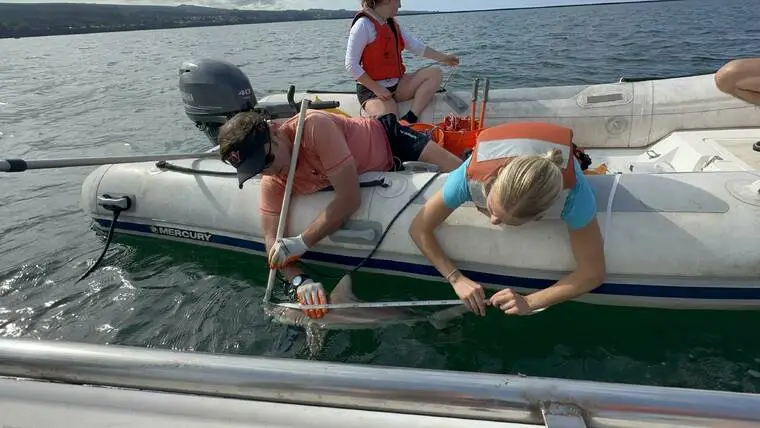
The recently published study found juvenile blacktip sharks live in Hilo Bay year-round, with the highest activity from March through August, according to a UH press release. To track the sharks, researchers tagged juvenile blacktip sharks with acoustic transmitters and monitored their movements throughout Hilo Bay from July 2022 to January 2024.
The study’s results suggest that this population of blacktip sharks reside predominantly within Hilo Bay for the first few years of their life, and highlight the effect that environmental changes can have on this species’ habitat availability and movement patterns.
“Nursery habitats provide food and shelter while these young sharks are growing,” said Jason Turner, an associate professor of marine science at UH Hilo and co-author of the study. “When we think about humans impacting sharks we typically think about overfishing, bycatch or even taking sharks for their fins.
“What we often forget is that impacting their habitat can also be devastating whether that means increased development, maritime traffic, pollution, or the effects of climate change on an area like Hilo Bay.”
The study focused on oceanic blacktip sharks (Carcharhinus limbatus), one of two blacktip shark species found in Hawaii. These blacktip sharks are not considered aggressive toward humans and bites are uncommon, according to the press release.
The research grew out of the thesis of then-UH Hilo graduate student Lauren Moe, who earned a master’s degree in tropical conservation biology and environmental science and is now a doctoral student at the University of Alaska Fairbanks.
Read more Federal review of COVID-19 spending likely after corruption indictment, Case says
Moe co-authored the study with her thesis adviser, Turner, UH Hilo professor Steve Colbert, and Jay Rooker and RJ David Wells at Texas A&M University in Galveston.
According to the press release, the study blended Western science with Native Hawaiian knowledge, reflecting Turner’s commitment to weaving Indigenous practices into marine research.
“In the Hawaiian worldview, setting intention, acknowledging the entities of space and time, asking permission, offering ho‘okupu (ceremonial gifts), and expressing gratitude are rituals required of kanaka (Native Hawaiians) as part of a reciprocal exchange with the elements,” Turner said.
The cultural practices were developed with guidance from UH Hilo marine science alumna Roxane Keli‘ikipikaneokolohaka, executive director of Kia‘i Kanaloa, a network of Native Hawaiian cultural practitioners who care for marine animals.
UH Hilo students received training in Native Hawaiian protocols before working with sharks in the field.
Researchers are now expanding their work to examine 15 years of shark and ray population trends in Hilo Bay.
Read more Rich Paul confirms that LeBron James didn’t consider Philadelphia until after Jaylen Brown trade