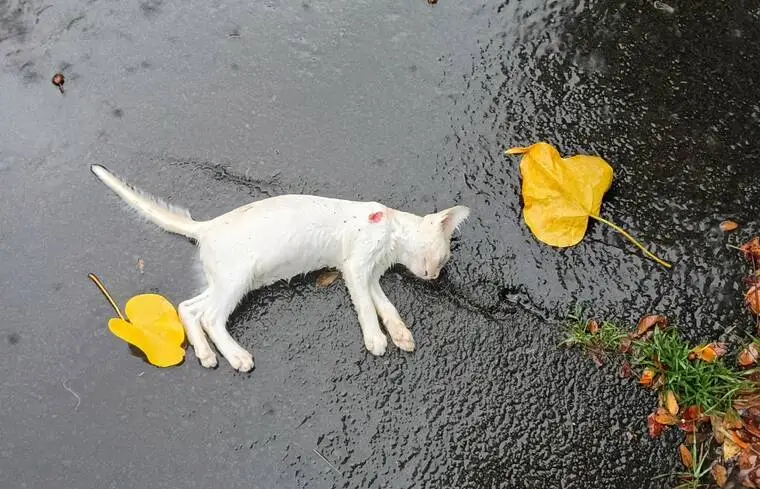
Cats found shot to death on Banyan Drive
A woman who feeds cats on Banyan Drive, despite laws against doing so, said at least two cats — a mother and her kitten — were shot to death in late August, calling it “open season on innocent cats and their caretakers.”
Read more PHOTOS: Vikings handle Ka Makani in 4 sets
“I don’t know who shot them, but I examined the wound. It wasn’t a blast. It was one shot. It was behind the right shoulder on both cats, which I find very unusual that was where both of them were shot. One shot,” Sylvia Dolena told the Tribune-Herald last month. “I’ve been feeding at Lili‘uokalani park, because the feeder was cited and banished from the park and I took over feeding.”
That feeder, Doreen Torres, then 66, was cited May 1, 2024, by the state Department of Land and Natural Resources for allegedly violating state laws that ban the feeding of protected wildlife, because nene could eat the cat food and contract toxoplasmosis, a parasitic infection carried by free-roaming cats.
Torres pleaded not guilty in Environmental Court, and prosecutors dropped the charge against her in January. The dismissal was without prejudice, but the statute of limitations on the misdemeanor charge is two years from the date the offense was allegedly committed, which means Torres won’t be prosecuted again for the same incident.
Dolena thinks the cats were shot either in Lili‘uokalani Gardens or immediately adjacent to it, saying she found them on Banyan Drive between the Ali‘i Ice Factory and the park’s ceremonial Japanese tea house.
“The mom was found on the sidewalk, and the baby was found on the edge of the road, about 30 feet away,” she said. “I usually get to the park while it’s still dark, and the seniors were already walking the park for exercise. They were the ones who told me about it and pointed them out to me.
“I went over and looked at (the cat bodies) and took pictures before I even touched them, and I picked them up and took them with me. I did call the police department and nothing was done. So, that’s where it stands.”
Police told the Tribune-Herald they conducted a search of call records between Aug. 22-30 “for any calls for service in and around the area of Lili‘uokalani Gardens. No calls were located.”
County Council Bill 51, which bans the feeding of feral animals on county property, became law on Jan. 1. Dolena calls it “the cat starvation bill.”
“These are not feral animals. They are abandoned pets and their offspring,” Dolena said. “The colony caretakers, mostly senior women, spend their own limited resources on caring for these animals and provide a valuable service with trap/neuter/return or relocate.”
Dolena said she detected a population drop in the Banyan Drive cat colony and suspects other cats have been shot or moved by unknown individuals.
“All of the cats I was feeding for the past two months are gone, except one that is left,” she said. “I did rescue some, 12 kittens and five adults, that I was able to rescue before they all disappeared. But I had not seen these two particular cats before.”
According to Dolena, despite the county ordinance “people are still dropping off cats” at Lili‘uokalani Gardens.
Read more Warriors’ woes are all fixable, coaches contend
“The kittens that I rescued were new litters of kittens, maybe a month old, a month-and-a-half old,” she said. “And I found four separate litters of kittens dumped in the park.”
Dolena said the passage of Bill 51 created a situation where “animal cruelty is legalized, and compassion is criminalized.”
“The inconvenient truth is that the native bird species are going extinct due to the disease-carrying mosquito, loss of habitat due to over-development and pollution caused by humans, not the cats … ,” she said. “Cats do have toxoplasmosis along with most animals. However, the scientific evidence shows that toxo is very far down on the list of cause of death, approximately less than 10%.”
DLNR spokesman Andrew Laurence said in an email the department didn’t receive a report of the cat shooting. According to Laurence, DLNR’s Division of Conservation and Resources Enforcement officers “continue to monitor feral cat feeding on Hawaii Island.”
“DLNR’s primary concern regarding feral cat feeding is the impact these activities are known to have on Hawaii’s native wildlife, particularly protected species such as the nene (Hawaiian goose) and other threatened or endangered species,” Laurence said.
The nene, Hawaii’s state bird, was downgraded from endangered to threatened status by the federal government in 2020 as a result of decades of captive breeding and conservation programs. It is still listed as endangered by the state.
There is a small nesting population of nene in the park, with three hatchlings reported in May.
“Particular attention is given to situations in which feeding activity is occurring in areas frequented by protected native wildlife or where the activity may be contributing to adverse impacts on those species,” Laurence said. “DOCARE’s enforcement efforts regarding feral cat feeding are generally complaint-driven or based upon violations observed by officers in the course of their duties.”
No arrests have been made for feeding cats, nor have any citations been written since Torres was cited, according to Laurence.
There are two cases in DOCARE records since Torres’ citation. One was closed “as a records-only matter” with no enforcement action taken. The other was a warning issued to a member of the nonprofit spay-neuter organization CatSnip Hawaii.
“When DOCARE officers observe or receive reports that feral cat feeding or associated activities may be negatively affecting protected native species, they investigate the circumstances and take appropriate action consistent with applicable county ordinances, state laws and administrative rules.”
Read more Dave Reardon: Clippers approaching UH training camp as business trip
Email John Burnett at [email protected].