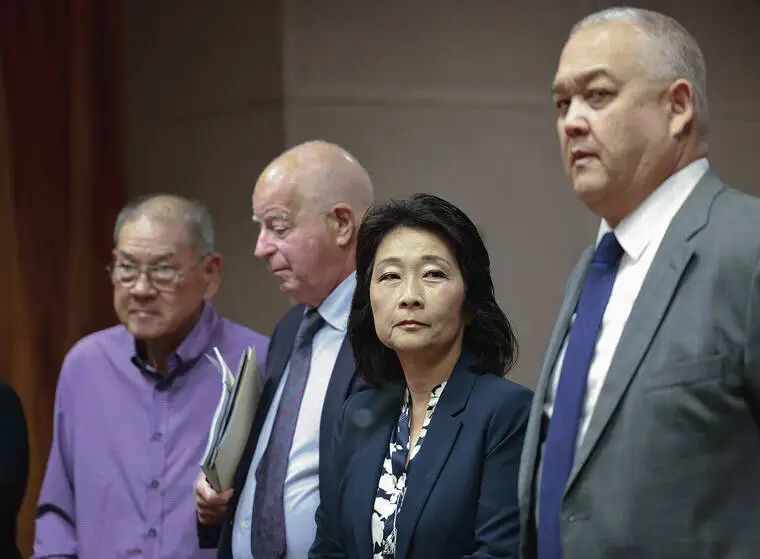
FEMA reviews Hawaii’s COVID funding after Sylvia Luke indictment
The Federal Emergency Management Agency is reviewing FEMA-funded COVID-19 work that has been tied to the public corruption indictment of Hawaii Lt. Gov. Sylvia Luke and four others, and the agency said it may seek repayment or other enforcement actions if it finds improper spending.
Read more Williams sisters reunion: Serena and Venus will play doubles together at Cincinnati Open
The Federal Emergency Management Agency is reviewing FEMA-funded COVID-19 work that has been tied to the public corruption indictment of Hawaii Lt. Gov. Sylvia Luke and four others, and the agency said it may seek repayment or other enforcement actions if it finds improper spending.
In an email to the Honolulu Star-Advertiser on Wednesday, a FEMA spokesperson said, “Under President Trump and Secretary (Markwayne) Mullin, FEMA will not tolerate fraud, waste, or abuse of disaster assistance funds. Consistent with President Trump’s executive order establishing the Task Force to Eliminate Fraud, FEMA will review any information arising from the Hawaii indictment that may relate to FEMA-funded COVID-19 work.”
The spokesperson said FEMA’s Public Assistance program reviews claims for eligibility, documentation, cost reasonableness, duplication of benefits and compliance with program requirements before funding is approved.
However, the FEMA spokesperson noted, “if new facts show that any FEMA-funded costs were ineligible, unsupported, duplicative, improper, or affected by fraud or misconduct, FEMA will pursue all appropriate remedies, including recovery of funds and referral to the appropriate oversight or law enforcement entities.”
Luke, former state Rep. Ryan Yamane, Hawaii Airports Administrator Ford Fuchigami and businessman and lobbyist Tobi Solidum were indicted July 24 over alleged conduct from 2020 to 2022, when Hawaii was under COVID-19 emergency proclamations and lawmakers were seeking funding for testing, vaccinations, contact-tracing and other response efforts. Leo Asuncion Jr., an ex-Luke campaign aide and former Public Utilities Commission chair, was charged with falsifying candidate committee reports, making false statements and obstruction of justice.
A central focus of the indictment is House Bill 2392, introduced by Yamane in January 2022. The measure ultimately appropriated about $170.4 million for COVID-19 response activities after the Hawaii Department of Health told lawmakers it needed emergency funding to continue response operations while awaiting federal reimbursement.
According to the Oahu grand jury indictment, Solidum developed “lucrative financial interests” through the DOH’s contract with the National Kidney Foundation of Hawaii to operate community COVID-19 testing sites. Prosecutors allege funding those operations became a growing concern in 2022 as resources dwindled.
The indictment cites statements by Solidum that he invested about $11 million in the testing effort and that operating 25 community testing sites for a year cost roughly $54 million, excluding tests and labor.
The National Kidney Foundation of Hawaii said its current leadership was not in place during the period under investigation and has hired an independent forensic accounting and investigative firm to review the matter.
Solidum faces four counts of conspiracy to commit bribery and three counts of bribery for allegedly providing Luke and others with campaign contributions, checks and cash. A no-bail warrant has been issued for Solidum, who is believed to have fled to the Philippines.
Luke, who was chair of the state House Finance Committee in 2022, was charged with conspiracy to commit bribery, bribery and falsifying candidate committee reports. Prosecutors allege she accepted $10,000 in campaign contributions from Solidum and agreed to accept up to $70,000 in exchange for using her position to secure funding for community COVID-19 testing.
Luke took an indefinite, unpaid leave from her role as lieutenant governor on April 23 and ended her reelection campaign.
Yamane, who most recently was state Department of Human Services director, was charged with conspiracy to commit bribery and bribery for allegedly accepting money to advance Solidum’s agenda within the Department of Health.
Fuchigami was charged with conspiracy to commit bribery, bribery, making false statements and obstruction of justice for conduct allegedly committed while working for the Senate Ways and Means Committee.
U.S. Rep. Ed Case, a member of the House Appropriations Subcommittee on Homeland Security, which funds FEMA, told the Star-Advertiser in an email Wednesday that he had not received notice of a review from the agency.
Read more Warriors Moala finds a home at guard to help solidify O-line
“But again I wouldn’t be surprised and would expect them to conduct some review under the circumstances,” Case said. “The natural question is whether the funding got to the intended recipients and was used for the intended purposes.”
Case added that his “working assumption” is that the funds were properly used. “I know a lot of very dedicated state employees and community partners worked very hard to get that funding to people in dire need during the crisis,” he said.
Case said he would work with FEMA and the state “wherever needed to answer these questions fully.”
The other members of Hawaii’s all-Democrat congressional delegation — Sens. Mazie Hirono and Brian Schatz, who is a senior member of the Senate Committee on Appropriations, and Rep. Jill Tokuda — did not immediately respond to requests for comment.
Case estimated FEMA has obligated about $312.8 million for Hawaii’s COVID-19 emergency response, including roughly $304 million through its Public Assistance program, which funds testing and response costs. He said he does not know how much of that money has been reimbursed. DOH officials did not provide the Star-Advertiser with a response by deadline.
State Sen. Jarrett Keohokalole (D-Kaneohe-Kailua), who served on the Senate Special Committee on COVID-19 and chaired the Senate Health Committee when HB 2392 moved through the Legislature, said lawmakers viewed the measure as an emergency funding request during a public health crisis.
“Normally in our budget process, appropriations are meant for the future budget cycle and so an emergency appropriation is money that they need right now,” he said, adding that Hawaii was “in a crisis.”
Then-Gov. David Ige urged “expeditious consideration” of the measure, while the state Department of Budget and Finance said the bill would allow the state to pay invoices immediately while seeking FEMA reimbursement. The Hawaii Medical Service Association and the Hawaii Primary Care Association also testified for the bill.
Keohokalole, who is challenging the incumbent Case for the Democratic nomination for urban Honolulu’s congressional seat, said testimony overwhelmingly supported the bill, and so it was “our prerogative to move the measure to Ways and Means so it can undergo a budget review.”
HB 2392, which began with a blank appropriation, ultimately was amended at DOH’s request to include appropriations of roughly $99.4 million for fiscal year 2021-2022 and $71 million for fiscal year 2022-2023 for FEMA-reimbursable COVID-19 service
Keohokalole, who left the Senate Health Committee in 2023, said lawmakers were “trying to get as much testing out there as we could” during the pandemic.
“In hindsight, Hawaii’s performance from a healthcare standpoint during the pandemic was the best in the nation. But that doesn’t mean that we shouldn’t be accounting for fraud where there is evidence of it,” he said.
Keohokalole said accountability drove his support for Senate Bill 2494, signed into law in July, which extends the statute of limitations for bribery cases involving public officials to help ensure defendants cannot “run out the clock” and avoid prosecution.
“The Feds had this case for three years and the (state) attorney general took it over in January because the statute of limitations was going to run out,” he said. “This is now a federal review after a state investigation that took place after a federal investigation that didn’t go anywhere.”
Keohokalole said state lawmakers likely would have conducted their own review sooner if federal investigators had raised concerns about HB 2392 earlier. Given the indictments, he expects the state Legislature to revisit the matter next session. “There will be an audit or some sort of full review,” he said.
Read more Never-say-die Red Sox pull off epic win over White Sox in 13 innings

Related Posts
Lowell leaves Port Allen devastated as boat operators consider next move

Remembering Hawaii’s 9/11 victims
