Governors reflect on U.S.-Hawaii history, look ahead
Hawaii’s current and former governors say the state overall remains patriotic and proud to be part of the United States heading into America’s 250th year, even as its relationship with the federal government has been strained over generations by the 1893 overthrow of the Hawaiian kingdom, cultural suppression, military conflict and modern political clashes.
Read more Paddling: Puna Canoe Club hosts 6th island regatta of 2026
Their experiences — from wartime service in their own families to decades of navigating federal policy — shape how they view Hawaii’s place in the country at this critical juncture.
While some island residents may not celebrate the Fourth of July, “America ought to celebrate 250 years because we’ve survived every challenge — that’s worth celebrating,” said John Waihe‘e III, 80, Hawaii’s fourth governor since statehood and the country’s first Native Hawaiian governor.
David Ige, 69, Hawaii’s eighth governor and the nation’s first of Okinawan descent, said the high rate of military service among isle residents is a reflection of how many people here continue to support the United States.
Both Ige’s father and father‑in‑law volunteered to serve in the all‑Nisei 100th Infantry Battalion, which became known during World War II as “The Purple Heart Battalion.” The unit’s Japanese American soldiers fought in part to prove their loyalty to a country that had forcibly incarcerated 120,000 U.S. citizens and immigrants of Japanese ancestry following the 1941 Japanese attack on Pearl Harbor.
“The percentage of veterans, the number of people who decide to serve in the military to protect the ideals of America, are larger than most other states,” said Ige, who served as governor from 2014 to 2022. “That clearly demonstrates that people are still proud to be Americans.”
Ben Cayetano, 86, Hawaii’s fifth governor and the nation’s first Filipino governor, cited the World War II patriotism of Filipinos, Koreans and Hawaiians, including two Native Hawaiian Medal of Honor recipients, Pfc. Herbert K. Pilila‘au and Pfc. Anthony T. Kaho‘ohanohano. Both stayed behind during separate battles to protect their retreating units until they ran out of ammunition.
“People don’t look at history in its total context,” said Cayetano, governor from 1994 to 2002. “The overwhelming majority of people in Hawaii proved that they were true patriots.”
Ige cited the U.S. Constitution’s guarantee of equal treatment for all, adding: “I really do believe that no other state in the country has been as successful as Hawaii in really living up to those ideals and really implementing them.”
Diverse state
Ige and several of the others pointed to the demographics of all six living governors as proof of Hawaii’s claim as the most ethnically diverse state in America.
Hawaii’s third governor, the late George Ariyoshi, who died April 19, was America’s first Asian American governor.
Gov. Linda Lingle, Hawaii’s sixth governor, was the first Republican to hold the office since William F. Quinn was appointed territorial governor and became Hawaii’s first elected governor after statehood in 1959.
Lingle, now 73, was also the state’s first Jewish governor and female governor, serving from 2002 to 2010. Hawaii’s current leader, Gov. Josh Green, also is Jewish.
Like Gov. Neil Abercrombie — Hawaii’s seventh governor, who celebrated his 88th birthday in his former ceremonial room at the state Capitol on Friday — Lingle and Green also arrived in the islands from different places on the continental U.S. and rose through local political office to become the state’s top elected official.
“Almost any thinking person realizes we’re not a perfect country,” Lingle said. “But generally the people of Hawaii are extremely patriotic and that’s historically been true.”
Hawaii voters overwhelmingly voted for statehood in 1959, with over 94% voting to become America’s 50th state. No other Hawaii election has come close to generating as much support for a single issue or candidate.
Governors gather
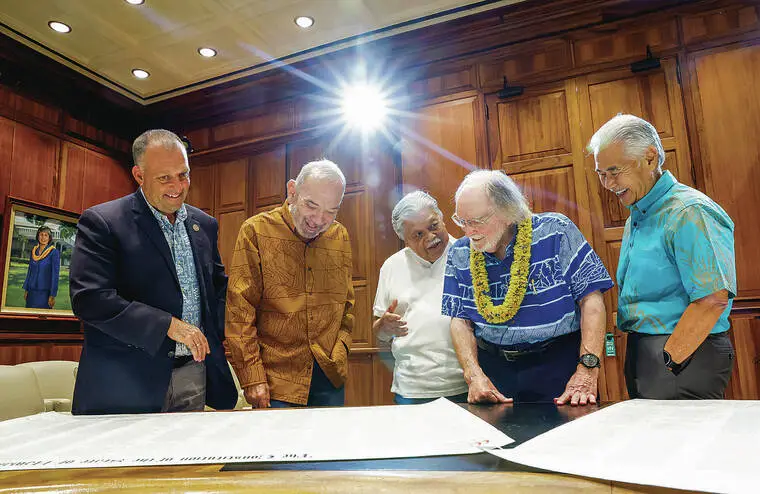
At the request of the Honolulu Star-Advertiser, five of the state’s six living governors gathered in Green’s ceremonial room Friday and reviewed original Hawaii constitutions dating back to the monarchy era. (Lingle was unable to attend, so the five Democrats posed beneath her portrait).
Waihe‘e, who served as governor from 1986 to 1994, was a delegate to the 1978 Constitutional Convention and quickly found his signature on the original constitution drafted that year that remains in force today. The 1978 ConCon established Hawaiian as an official language and created the Office of Hawaiian Affairs.
State Archivist Adam Jansen, who oversees the archives under the state Department of Accounting and General Services, escorted the historic constitutions to the Capitol from the archives, located just steps away.
“This is historic,” Jansen said as the governors reviewed each document going back to the 1800s.
The governors all agree that people in Hawaii are better off being part of the United States of America, despite systematic attacks on Hawaiian culture since the overthrow in 1893.
A century later, in November 1993, the U.S. Congress apologized and acknowledged the overthrow was illegal.
Read more Dembele’s quick-fire treble powers France to 4-1 win over second-string Norway
The apology followed a cultural resurgence sparked by the Hokule‘a voyaging canoe and the illegal occupation of Kahoolawe in the 1970s by the “Kahoolawe Nine,” who protested military bombing and helped launch a movement to protect the land.
Modern generations of Native Hawaiians grew up hearing how their kupuna were beaten in school for dancing hula or speaking Hawaiian.
“Clearly there was an organized attempt to wipe out everything that was Hawaiian,” Lingle said. “The history of our state is a very complicated one that’s unique in America.”
The state Department of Education now requires classes in Hawaiian culture, history and language from kindergarten to the 12th grade, including immersion schools where students speak only Hawaiian.
Historical tensions
January marked the 50th anniversary of when a group of activists climbed aboard a Boston Whaler, evading the U.S. Coast Guard to land on Kahoolawe to bring attention to decades of destruction caused by the Navy, which also left behind tons of unexploded ordnance.
It wasn’t until 1993 that Congress began the process to clean up Kahoolawe and return control to the state, a transfer that took another decade of remediation before the Navy finally relinquished the battered island.
During his tenure, Cayetano worked with a new generation of admirals and generals who, he said, were “more friendly toward local culture” and “more accommodating.”
He recalled how the Marines altered plans for a sea‑assault exercise at Makua Beach on Oahu after public outcry, including threats by activists to launch 1,000 canoes in protest. Instead of risking a confrontation, senior commanders trucked in Marines for a land exercise — a decision Cayetano said reflected “much more sensitive” leadership.
The lessons of Kahoolawe, along with protests over other military uses of state land across Hawaii, remain relevant as the state and U.S. military renegotiate leases of public lands.
Abercrombie, governor from 2010 to 2014, called recent actions by President Donald Trump and his administration an “assault on the very idea of what constitutes being a citizen in the United States of America and in the state of Hawaii today,” adding that policies can change.
“If people had a general idea of progress and fairness and hope and confidence in the future, we would be celebrating (the Fourth of July) in a much, much, much different frame of mind with more positive beliefs,” he said.
The current moment has prompted deeper reflection about the country’s direction, according to Abercrombie.
“Right now millions of people are thinking very, very seriously, particularly as elections come up in this 250th year,” he said. “That’s exactly where we are going as the United States of America. And that, of course, includes Hawaii as literally the last state to enter the union in 1959.”
Pragmatic
governance
Green continues to negotiate military land leases while working with Trump administration officials on issues such rural healthcare, homelessness and federal support for programs that help struggling Americans, including Medicaid and the Supplemental Nutrition Assistance Program, or food stamps.
He contrasted the Trump and Biden administrations’ responses to disasters, noting the Federal Emergency Management Agency under Biden committed aid within hours after the deadly 2023 Maui wildfires, and eventually weeks later under Trump after winter storms on Oahu’s North Shore.
“It’s not easy,” said Green, who is seeking a second term in the 2026 elections. “You play the hand you’re dealt.”
While Hawaii continues to join other so-called blue states in lawsuits against Trump administration policies, Green said he’s chosen a different tack than governors who have “taken the bait and suffered terribly.”
“Of course I would love to vent publicly,” he said. “But I do it at home rather than in the New York Times.”
Green said that even as he listens to Trump administration officials make the case for their policies, “you still have to keep the integrity of your state’s values.”
As Hawaii watches the midterm elections for signs of a possible shift in Congress, Green wants residents to learn from the state’s complicated history with Washington on the eve of America’s 250th year.
“Obviously, I’m wrestling with the federal government,” he said. “My message is, No. 1: We’re going to survive this.”
Read more MLB looks to limit free-agent contract length, dollars in latest labor proposal