Hawaii could face costly scramble to deliver ballots
No matter how the U.S. Supreme Court rules on a U.S. Postal Service plan to regulate mail-in election ballots, Hawaii has no choice but to hold an election on Nov. 3.
Read more BIIF football: Wildcats shut out ‘Riders in crosstown clash; Warriors stay unbeaten in island play
It may not be as convenient for voters to cast their ballots as they have since Hawaii embraced universal mail-in voting in 2020, “but there will be an election,” according to Chief Elections Officer Scott Nago. “There has to be an election by law.”
State Sen. Karl Rhoads worries what the Nov. 3 election would look like if voters lose the ability to receive, then return their ballots through the mail.
It could require Hawaii to spend millions of dollars to hire private companies to deliver ballots to every household where someone is registered to vote. But voters could not use the mail system to return their ballots, so individual voters would have to place them in drop-box locations or at in-person voter service centers.
Rhoads (D, Downtown-Nuuanu-Iwilei) is preparing voters to be ready to vote in person as soon as voter service centers open, to ensure their votes are counted.
Otherwise, if Hawaii tries to hastily ramp up an in-person election system to accommodate thousands of voters, that would require finding enough in-person locations and recruiting enough volunteers to staff them.
“It’s going to be a nightmare,” Rhoads said. “People are going to be standing in line for hours and hours.”
“If it comes to this, I would go to the voter service center the first day it’s open,” he said. “I wouldn’t want to stand in line for hours, so I’m telling people not to wait until the last day.”
President Donald Trump continues to urge the Supreme Court to back his executive order that would require the Postal Service to not deliver mail-in ballots in states that fail to hand over voter data, which critics say is meant to disenfranchise voters, especially those with immigrant backgrounds.
The Postal Service rule would require states to upload voter information into a portal that has yet to be unveiled.
If the Supreme Court rules in favor of Trump and the Postal Service, Rhoads said, “Even if we cooperate with the federal government, the portal’s not ready and ballots (in some states) are already going out. So, I’m actually becoming really concerned.”
States also would have to create new envelopes, but the requirements to comply with new bar code rules also have not been announced, with less than two months to go before the general election.
Hawaii is one of eight states, plus Washington, D.C., that allow all elections to be conducted entirely by mail, according to the National Conference of State Legislatures. The others are California, Colorado, Nevada, Oregon, Utah, Vermont and Washington state.
With no rules in place on how to comply with the Postal Service proposals, states that allow even some form of mail-in voting have yet to come up with an alternative system that would be just as convenient for voters.
“Nobody really has a plan,” Nago said.
So far, lower courts have blocked Trump’s executive order from going into effect, including a three-judge panel of the Boston-based 1st U.S. Circuit Court of Appeals that ruled against it Thursday, saying that states have authority over U.S. elections, not the federal government.
But it’s unclear how the Supreme Court and its six-member majority of conservative justices will ultimately rule on Trump’s emergency application.
Read more Kauai farmers’ plight underscores need for local food production
“We’ve seen unpredictable things,” Nago said.
So Nago and his office are considering the possibility of spending approximately $10 million for a private courier or multiple companies to deliver ballots to hundreds of thousands of addresses across the islands, including rural, remote communities. However, unlike the Postal Service, private companies will not deliver to P.O. boxes.
Even if that comes to pass, voters would not be able to mail their ballots back in order to be counted, as they do now.
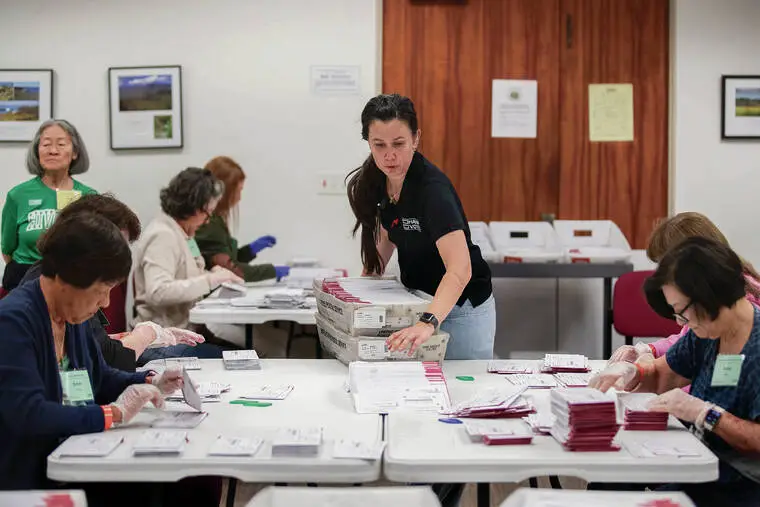
In the Aug. 8 party primary elections, 281,214 people voted — 274,865 of them by mail.
The largest number of mail-in ballots were cast in 2020, the first year of the COVID-19 pandemic, when 551,036 island voters submitted their ballots by mail. By comparison, only 28,748 people voted in person.
It was also the same year that Trump lost his reelection bid to Joe Biden, a defeat Trump still maintains was the result of “rigged” or “stolen” ballots despite no evidence or court rulings.
Rhoads noted the president’s hypocrisy in issuing his executive order giving control of mail-in ballots to the Postal Service, since Trump himself votes by mail.
“The real problem is Trump’s frustration” with his 2020 election loss, he said. “What they’re trying to do is clearly unconstitutional … because the states are the ones who run elections, not the feds. They’re demanding that we turn over all of our voter records, which we’re under no legal obligation to do. And they’re trying to rig the elections to keep away people who vote by mail, which a majority are Democrats.”
Rhoads chairs the Senate Judiciary Committee that held an informational briefing with the House Committee on Judiciary and Hawaiian Affairs in July that included a discussion with Nago about how Hawaii will respond if the Supreme Court agrees with Trump’s executive order.
It would be up to each county, which manages their own elections, to decide if they want to open more in-person voter service centers and recruit more volunteers.
But when Rhoads introduced a bill during the last legislative session that would have funded more county voter service centers, but all four county clerks rejected the proposal.
“They said, ‘We have no interest in opening more,’ so we killed the bill,” Rhoads said.
Colin Moore, who teaches public policy at the University of Hawaii, agreed that a Supreme Court ruling in Trump’s favor would be expensive and inconvenient for voters in Hawaii, and would further discourage voter participation.
No matter how the court rules, Moore said, even the dispute is likely to sow mistrust in the security of America’s voting system.
“The administration’s motivation is to just introduce a lot of uncertainty and potentially chaos into the election that then could later be used to question the results,” Moore said. “If you’re just casually listening to these stories, you would be led to believe that there are very serious concerns about ballot security that warrant this level of scrutiny and controversy that, frankly, shouldn’t exist.
“We have a lot of problems in this country, but election security isn’t one of them.”
Read more How the UH and New Mexico State football teams match up