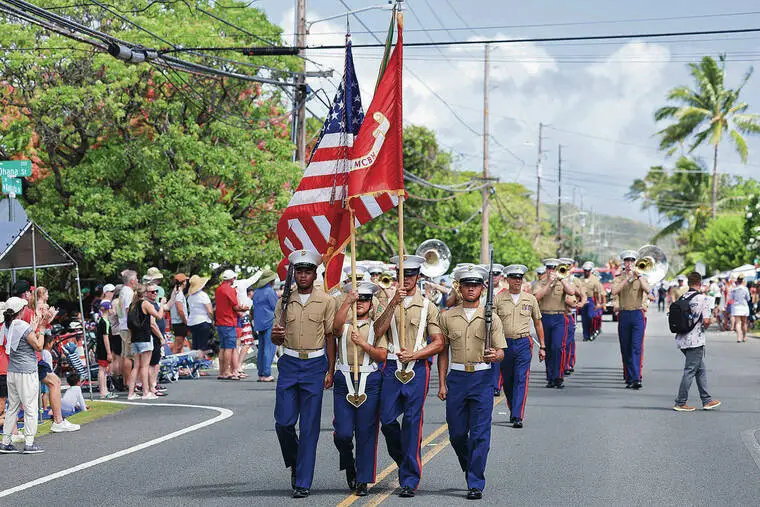
Hawaii veterans reflect on their service as America marks a milestone
Sterling Kanoa Beair served as an Army combat medic in Iraq. He excelled in the military, attaining the rank of staff sergeant and earning accolades from his comrades and superiors.
Read more UH baseball reloads roster with transfers, prep grads
But he also carried demons from his wartime experiences as he struggled to reintegrate into civilian life, wrestling with post-traumatic stress and substance abuse, eventually finding himself homeless and living in a tent near Kaena Point.
“Combat changed me,” said Beair, 43. “It taught me discipline and taught me courage, sacrifice, but it left a lot of wounds and damage that aren’t visible always. Healing from those wounds has come less from military training and more from reconnecting with my culture.”
Beair now lives on Molokai, where he is a counselor with the Lili‘uokalani Trust, working with youth, and has been farming the land with his family.
“It brings me tears of joy whenever I think about my brothers and sisters in arms,” he said. “At the same time, returning home led me to reflect a little bit more deeply on my identity as a Native Hawaiian because our history includes the overthrow of our kingdom, the loss of our national sovereignty, and even the continued military presence throughout our islands can sometimes be a lot of weight on our native community.”
As the United States celebrates 250 years since its founding, the role of the military — older than the nation itself — and those who served in it has taken center stage in commemorations.
People from Hawaii have served in the U.S. military and fought in America’s wars since well before the annexation of the islands in 1898. The first person from Hawaii known to have done so was Humehume, the son of Kauai’s King Kaumuali‘i, who enlisted in the Marine Corps and served aboard the USS Wasp during the War of 1812 and later reenlisted and fought in the Second Barbary War.
Though the Kingdom of Hawaii declared neutrality during the American Civil War, both Native Hawaiians and other Hawaii-born men fought in the conflict, including the children of American missionaries and whalers.
In 2014, researchers identified 119 documented people from the islands who served in the war, though exact numbers remain unclear due to spotty records and the fact that many Hawaiians opted to enlist and serve under Americanized names. One of them, J.R. Kealoha, is buried at O‘ahu Cemetery in Nuuanu.
But after annexation, Hawaii became a strategic hub for the U.S. military, with each branch establishing major bases. Generations of isle residents have since been shaped both by service abroad and the military’s presence here.
Love of country
After the Dec. 7, 1941, surprise attack on Pearl Harbor drew the U.S. into World War II, Japanese Americans immediately came under suspicion and soon faced persecution. They were reclassified as “enemy aliens” and thousands were rounded up and placed in internment camps.
But many young nisei — second-generation Japanese Americans — insisted on serving despite stiff resistance from many senior political and military leaders.
Thousands of nisei from Hawaii would ultimately serve in Europe fighting the Nazis with the 100th Infantry Battalion and later the 442nd Regimental Combat Team, which is still regarded as the most highly decorated combat unit in U.S. Army history.
Others served in Asia and the Pacific in the Military Intelligence Service, listening in on Japanese radio chatter, interrogating prisoners and translating captured documents.
Local filmmaker Steve Sue researched the legacy of the 100th Battalion both at war and after for his recent film “The 100th: Seeds of Aloha.”
“What I found was a very clear theme of using the aloha spirit, both in terms of during the war and for 80 years after in the rebuilding of the world,” Sue said. “It’s really important to understand what makes the country great, and how great these soldiers were. They were part of the Greatest Generation, and perhaps they were even the greatest of the Greatest Generation.”
But few of the nisei who fought in World War II remain to tell their stories. Willy Toda, an MIS veteran who worked with Japanese prisoners of war at Schofield Barracks and later served in the occupation of Japan, died June 22 at the age of 99.
“They all wanted to go, they all wanted to serve their country,” said Toda’s daughter, Linda Austin.
“Two of his brothers weren’t able to go. One was too old and the other one was married with a child,” she said. “They were kind of sad that they couldn’t go, they felt left out. They were very loyal to the country — it’s amazing.”
Difficult
questions
Nisei veterans, including the late U.S. Sen. Daniel Inouye and Gov. George Ariyoshi, would come to shape life and politics in Hawaii. But while the nisei fought to prove their worth as Americans, some Native Hawaiians came home from war with very different feelings.
“We’re not America, we’re not Americans,” said Sparky Rodrigues, 77, who served in Vietnam as a Navy combat engineer. “This is Polynesia.”
Rodrigues is a prominent activist and a co-founder of Malama Makua, an organization that seeks to ultimately see the Army leave its controversial training area in Makua Valley on the Waianae Coast, a site regarded as sacred by many Hawaiian cultural practitioners.
Read more Norway shock Brazil, make history on Erling Haaland’s heroic brace
“Going to Vietnam gave me a perspective of confusion initially, because I grew up American in school,” Rodrigues said. “You do the Pledge of Allegiance to the flag — there’s a patriotism and loyalty that’s instilled in you since elementary school.”
The violence of war shattered his perceptions of what he believed about the United States and haunted him when he returned to Hawaii.
“There’s no decompression to help get back into society,” Rodrigues explained. “So I brought the war back with my family, with my kids, with my community, and it took decades for that to resolve. I still deal with it, but I’m able to deal with it now — not so much back then, because I didn’t understand.”
Beair said that for a time, he struggled with reconciling his U.S. military service and his reconnection with his Hawaiian roots, but that “I no longer see these identities as opposites, I see them as just responsibilities. My military service taught me to protect people. My Hawaiian identity teaches me what I am protecting: our people, our culture, our aina.”
“I can deeply respect the men and women who serve while also asking difficult questions about the role of the military in Hawaii, and even throughout the world,” he said. “I feel like having fought and bled for the flag allows me to ask those questions. Those questions are not rooted in anger toward any service member, they come from a desire to understand how we can protect both people and places with wisdom and integrity and aloha.”
The costs of war
Allen Hoe was drafted into the Army at age 19 and fought in Vietnam with an elite reconnaissance unit. Raised on stories of ancient Hawaiian warriors, his life has been deeply shaped by war and his ties to the military.
He recalled that during his tour of duty, his main memory of Independence Day was “instead of watching at night, instead of watching sporadic firefights, it seems like, although we had been warned against it, everybody in the bush was firing off tracer rounds to celebrate Fourth of July, and it probably confused or puzzled the enemy to no end.”
Near the end of the Vietnam War — amid mounting protests across the nation — the U.S. military ended the draft in 1973 and has since relied on an all-volunteer force, which increasingly has drawn from a diminishing pool of multigenerational military families.
A study of 2003 recruiting data by the conservative Heritage Foundation found that Pacific Islanders, including Hawaiians, joined the U.S. Army at a rate 249% higher than other ethnic groups. Among them were Hoe’s two sons. His eldest, 1st Lt. Nainoa Hoe, was killed by a sniper in 2005 in the Iraqi city of Mosul.
Hoe, 79, a respected attorney, former state judge and community leader who has served on numerous nonprofit and government boards, said he’s concerned that American leaders now find it all too easy to send other people’s children to war, and “that those who shoulder the burden have become lesser and lesser in numbers and lesser and lesser in terms of value or political capital.”
Matthew Griffin, 47, served in the Army’s elite 2nd Ranger Battalion in Iraq and Afghanistan. A West Point graduate hailing from Iowa, he married into a family from Hawaii and now lives near Hilo with his wife. He said he shares fears that Americans have become deeply disconnected from the realities of military service and war.
“They have these glorious movies that get put in front of the media, and that’s about the extent that they’re willing to reach into what our military does,” he said. “They just don’t understand, they just couldn’t, they’re just so insulated from it … so I wouldn’t say it’s their fault, they’re just not aware.”
Beair said he believes “America often honors the image of the soldier more than the actual person … . I’m not saying that people don’t care. I’m saying the country often does not understand the full weight of what it asks.”
“Soldiers are asked to carry things that most citizens will never ever have to see, do or remember,” he said. “We’re asked to leave our families, suppress our fears, just follow orders, survive violence, sometimes participate in things that go against our spirit, our humanity. And then we come home and we’re expected to, like, return to a normal life like nothing happened, and it’s not realistic, right? It’s not fair.”
A power
for good
As America marks the 250th anniversary of its founding, military forces from around the world have gathered in Hawaii for the Navy’s massive biennial exercise Rim of the Pacific.
As Rodrigues watched RIMPAC unfold from shore, he said he was struck by its scale.
“If all we do is train for war, we will never have peace, and unless we start training for peace, that might be a way to stop having more war,” he said. “But like Sun Tzu said, ‘When you’re at peace, prepare for war,’ and the U.S. is really good at that part. So, the majority of our budget, the trillions of dollars a year, goes to making war, not peace.”
Rodrigues added that for many years he was angry at the military. But today, he said, “I’m not anti-American, I’m not anti-military, I’m pro-Hawaiian and pro-aina.”
“I want them to be our friend, I want them to be our ally,” he said. “I want them to be our family that’s behaving better, not only for our community but for the world. So that’s my solution to the confusion.”
Griffin said that during his military service, he saw both the best and worst aspects of America’s role in the world. It made him reflect on both the possibilities and limits of U.S. power.
“It makes me recognize the impact we can have as Americans; it could either be good or bad,” he said. “It’s really just going to be which direction we, as a citizenry, want to go or we allow our elected leaders to go. As a nation, we can move a lot of people to do a lot of good in the world, or we can do some not so good in the world.”
Read more England hang on to beat battling Mexico 3-2 in last-16 thriller

Related Posts

Remembering Hawaii’s 9/11 victims

World Manta Day returns today
