How to improve the HI-5 recycling program?
State lawmakers are seeking ways to improve the HI-5 recycling program, which has shown a steady decline in recovery rates over the past 10 years.
Read more ‘We’re representing more than ourselves’: Resilient Trojans making most of ‘26 season
State lawmakers are seeking ways to improve the HI-5 recycling program, which has shown a steady decline in recovery rates over the past 10 years.
Launched in 2005 by the Department of Health, the Deposit Beverage Container program, or HI-5, aimed to incentivize recycling by providing a 5-cent refund to consumers who returned eligible cans, bottles and other containers to collection sites.
At an informational hearing last week, members of the state House Committee on Energy and Environmental Protection, chaired by Kona Rep. Nicole Lowen, heard an update on the program from the DOH Solid Waste Division.
“In fiscal year 2025, we recycled 515 million containers,” said DOH SWD staff member Lane Otsu during the hearing. “And as far as numbers of certified redemption centers, we currently have 51 sites, and we have 294 beverage distributors registered with us.”
Currently, he said, all of the collected containers are sent to out-of-state facilities for recycling. He said the department is working on incorporating recommendations from the most recent audit report on the program and expanding its capacity, which has proven challenging.
“It’s just difficult for CRCs to secure land that can accommodate a full certified redemption center,” he said. “The issue that we know all of the CRCs encounter is that sort of difficulty in maintaining staff.”
Of the existing redemption centers, there are 14 on Hawaii Island, 23 on Oahu, seven on Maui, five on Kauai, one on Molokai and one on Lanai.
Otsu said the department is working with Hawaii County to put out a request for proposals for a space to host an additional redemption center on the Big Island.
Read more Naalehu cemetery recovery continues after Lala flooding
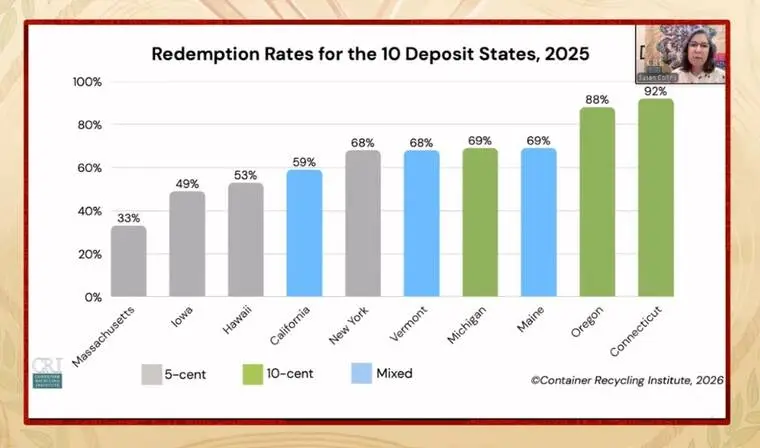
Members of the committee also heard from Susan Collins, the president of the Container Recycling Institute, who presented data showing Hawaii’s container redemption rates through the HI-5 program over the last 10 years. The data showed a drop in the redemption rate from 66% in 2016 to 52% in 2025. She said this has been a broader trend among states that offer similar refund rates.
“The ones that still have a 5-cent deposit have been seeing a steady decline, not a huge decline, but just year by year a little bit of erosion,” she said.
However, Collins said, states that offer a larger refund for containers have held steady at higher rates.
“Something that we know about container deposit laws is that the incentive is a very powerful motivating force to get people to return their containers and not litter their containers, or to pick up litter, because it has a value, and it therefore is logically true that a larger incentive has a larger effect,” she said. “So, it’s not a surprise that the states that have a 10-cent deposit instead of a 5-cent deposit have some of the highest redemption rates in the country.”
Cindy Coutts, president and CEO of Encorp Pacific, the nonprofit agency that runs the Return It program for British Columbia, Canada, also presented on the province’s recycling initiative, which has yielded positive results. A key part of that success, Coutts said, was establishing a regulatory framework surrounding recycling which places responsibility with the producers of containers.
“It’s a results-based regulation,” she said. “It sets out a number of very key results, and then turns the obligation to meet those results over to the producers or the brand owners of the beverage containers.”
Lowen asked the DOH if this type of approach, referred to as Extended Producer Responsibility, had been considered for Hawaii. Otsu responded that it had and that the department was continuing to evaluate the possibility.
“We began looking at EPR as a real possibility for our current system to transition to with (House Bill) 1928 from this past session, and we’ve continued research on that,” he said. “Today’s input is great because some of those areas we’ve identified as things that we need to address … we’re just continuing research on that with the goal of, yeah, putting together at least a solid outline of what issues would need to be addressed to switch to EPR.”
Read more Enrique Hernandez belts tiebreaking HR as Dodgers knock off Giants
The full hearing can be viewed at www.youtube.com/watch?v=z6JhtfWMgJc.
Email Grace Inez Adams at [email protected].