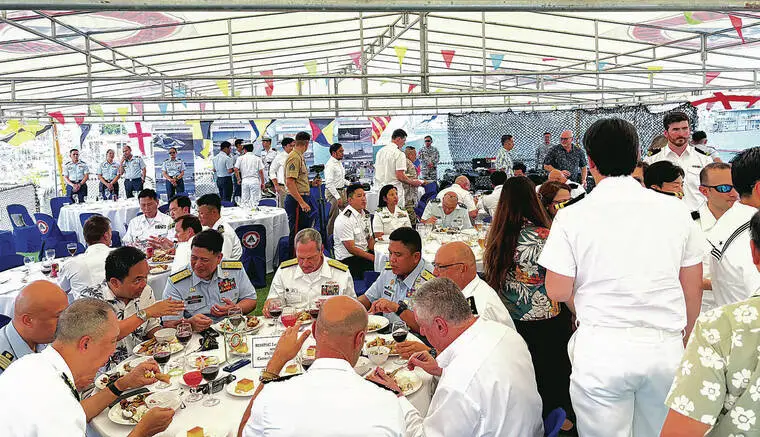
International forces work across cultures for biennial RIMPAC
As the biennial Rim of the Pacific Exercise gets underway, participants are holding meetings and getting set up for operations across Hawaii.
Read more LeBron James leaving Lakers, to play with another team
“The area of operations encompasses the entire Hawaiian operating area,” said Lt. Cmdr. Benn Van Balen, an Australian navy officer serving as RIMPAC’s exercise coordinator for the 30th iteration of the biennial naval warfare exercise.
This year 30 countries are participating, including first-time participants Poland, Spain, Guatemala, Greece and Fiji. Getting them all ready for operations is a challenge.
“With 30 nations, you always have challenges in information transfer and communications challenges,” said Van Balen as he stood outside the K. Mark Takai Pacific Warfighting Center on Ford Island on Friday addressing a small group of reporters.
The Pacific Warfighting Center will be the hub for coordinating and directing operations as the exercise gets into full swing. As media toured the building it was mostly empty, but in coming weeks there will be a hive of activity as service members from across the world sit in front of hundreds of computers and screens, monitoring ship, aircraft and troop movements.
In Pearl Harbor, between planning meetings and classroom instruction, participating ships have begun holding receptions, inviting both exercise participants and local dignitaries aboard to serve food from their countries. On Saturday, many of the ships opened for tours to military families and others with base access.
But on the Windward side, troops participating in the ground combat portion of the exercise already have begun hitting the dirt, practicing shooting and infantry tactics at Marine Corps Base Hawaii and at Marine Corps Training Area Bellows.
“Our concept of success in the infantry is that we must continue to sustain and grow into the basics,” said Lt. Col. Colin Elsasser, commander of the Twenty-Nine Palms-based 7th Marine Regiment’s 2nd Battalion as marines from South Korea, Mexico and Tonga trained at the firing range at MCBH on the Mokapu Peninsula on Saturday.
“Really the most violent place on earth for an infantrymen is kind of those last 100 yards on his objective, where all these skills you’re seeing out here today are absolutely essential,” he said.
But he said that as the exercise moves on, the operations will get more complex. RIMPAC’s combat is simulated, but on real-world battlefields in Ukraine and the Middle East, technology and tactics have rapidly changed with the proliferation of low-cost drones, satellite communications and surveillance systems and other tools.
Elsasser explained that “as the character of war evolves, we absolutely have to look at how do we continue to maintain brilliance in the basics in infantry skills … but also continue to adapt new and emerging capabilities, things such as small (drones) and operating on the electromagnetic spectrum, all of which are capabilities that war and certainly the Marine Corps and our partners here have the ability to train to.”
“A lot of the partner nations that are participating in RIMPAC this year have started to shift focus towards more bespoke technical designs,” Van Balen said. “There is a growing focus on things like unmanned systems within not just RIMPAC, but any exercise across the globe. I think as we start to see some of these systems develop across many of our partner nations, they’ll be interested in sharing that information and using RIMPAC as an opportunity to build interoperability.”
Read more Residents blast STVRs legislation; commission defers action
Col. Robb McDonald, commanding officer of the U.S. 15th Marine Expeditionary Unit, said that while American forces are the hosts, he expects his Marines will be learning as much as they will be sharing with participating forces.
“Sometimes there’s obstacles to overcome, such as language barriers and those sorts of things, but I think that we’ve done it enough to where you come to something like RIMPAC, it’s something that we can actually showcase rather than overcome any barriers in training,” McDonald said. “I’d use the word ‘opportunities,’ so we learn different TTPs — tactics, techniques and procedures — from other countries, just as they learn from us.”
RIMPAC involves ground, air and sea forces all working together across the Hawaiian Islands and its surrounding waters.
“This exercise itself, it is a combined exercise, meaning that it is multinational, it is joint, so we have all spheres of military activity, but it is centered in the maritime domain,” Van Balen said. “So the Combined Forces Maritime Component Commander really is the head figure for RIMPAC, he is the supported commander, and all other joint-force elements will be supporting that central activity.”
That year that role is being filled by South Korean navy Rear Adm. Kim In-Ho, the first time a South Korean officer has filled that role. South Korea has sent its largest participating contingent yet to the exercise.
Van Balen said “that’s a pretty auspicious challenge for Korea, and also a significant milestone within their journey for RIMAC.”
South Korea has emerged as one of the world’s most important shipbuilding nations for both commercial and military vessels. Once reliant on hand-me-down American vessels, as South Korea’s economy and global standing have grown, Seoul has ambitious plans for its navy.
Thursday marked the 76th anniversary of the beginning of the Korean War. Kim stepped away from the exercise to attend a ceremony at the National Memorial Cemetery of the Pacific in Punchbowl crater along with dozens of South Korean sailors and marines in their dress uniforms.
At the ceremony, during remarks delivered by South Korea’s newly appointed Honolulu Consul General Nam Sangmin, he noted that on the day the Korean War broke out, Vice Adm. Sohn Won-il, South Korea’s first chief of naval operations, was in Honolulu.
Sohn was learning about the U.S. Navy’s shipyards and vessel repair operations as he worked to build and run his young nation’s fledgling navy.
“He came here on the 24th June, 1950, (before) making his way back to Korea with the three warships transferred from the United States,” Nam said. “At the moment, those three vessels represented nearly the entirety of the Korean navy. Within two days, additional weapon systems were installed in Hawaii, and then Adm. Sohn departed at once for Korea. The small fleet was the seed of what has grown into one of the most capable navies in the world today.”
Read more Haaland the hero again as Norway edge Ivory Coast to advance at World Cup

Related Posts

Remembering Hawaii’s 9/11 victims

World Manta Day returns today
