Rules to limit CRB spread passed on Big Island and Maui
The coconut rhinoceros beetle’s hold across the Hawaiian Islands has grown in recent months, prompting the state Board of Agriculture and Biosecurity to expand restrictions on transporting potential host material between infested islands and areas.
The coconut rhinoceros beetle’s hold across the Hawaiian Islands has grown in recent months, prompting the state Board of Agriculture and Biosecurity to expand restrictions on transporting potential host material between infested islands and areas.
The invasive beetle, known as CRB, has decimated thousands of coconut trees on Oahu since it was first detected in 2013, especially on the Leeward Coast and North Shore. After more than a decade, the pest has now been detected on every main Hawaiian island. It was detected on Kauai and Hawaii Island in 2023, with the invasion on Hawaii Island focused on the Kona side until its first detection in Hilo earlier this month.
Maui also had a single detection at the airport in 2023, but did not have another detection until last month. The pest was detected for the first time on Lanai in August 2025 and again in May, while it was found on Molokai this past April.
On Tuesday, the Board of Agriculture and Biosecurity approved a request to expand the designated infested area in West Hawaii to include the area between Henry Street, Palani Road and Queen Kaahumanu Highway.
The designation is an attempt to help mitigate the spread of the beetle, as a rule passed in March restricts the transportation of CRB host material from the designated infested area to other areas on island and in the state without a permit.
Read more County names new Animal Control administrator
Those issued a permit also have to sign a compliance agreement that they will follow strategies to slow and prevent the spread of CRB. Trainings for the agreement can be coordinated at biisc.org/crb-compliance-trainings.
Also on Tuesday, the board approved a similar rule that restricted transportation of CRB host material from any other island in the state to Maui and Lanai unless it has been treated to kill the pest at all life stage, transported in a CRB resistant container and inspected by the Department of Agriculture and Biosecurity Plan Quarantine Branch. A similar rule for interisland shipments of CRB host material was passed on Molokai in October.
CRB host material includes compost and live plants of any size with roots in organic material such as soil or mulch. CRB eggs resemble small white balls similar to fertilizer, then hatch into large white grubs that grow up to 4 inches long.
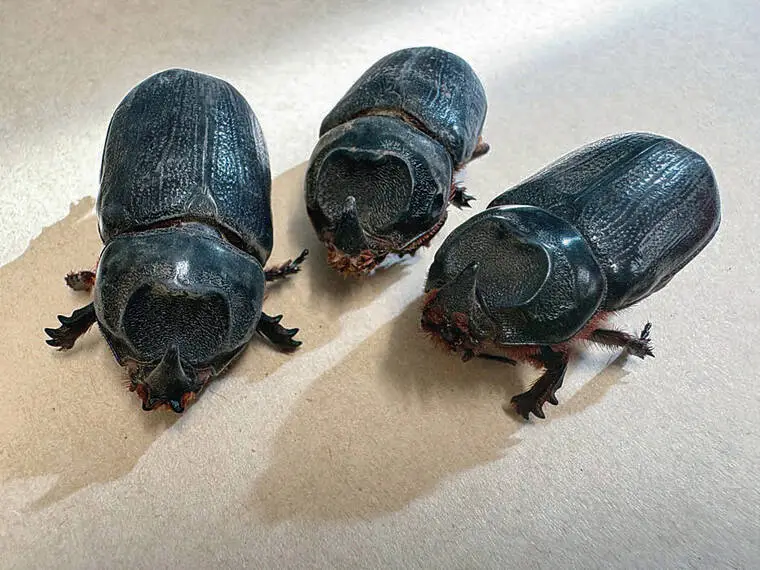
The grubs live in host material for three to five months before they eventually becomes adult beetles up to 2-1/2 inches long with a hard black exoskeleton and horn. The adults can fly up to 2 miles at a time and eat the hearts of coconut palms and other similar plants.
Infested palms typically have drooping fronds with a triangular or diamond pattern on the leaves. Infestations can be fatal for trees, and there are few options to fight the beetle. The University of Hawaii is currently researching a virus that targets the beetles and could mitigate their impact to the state.
Read more Police: Hilo man with nearly 2 pounds of cocaine nabbed at public park