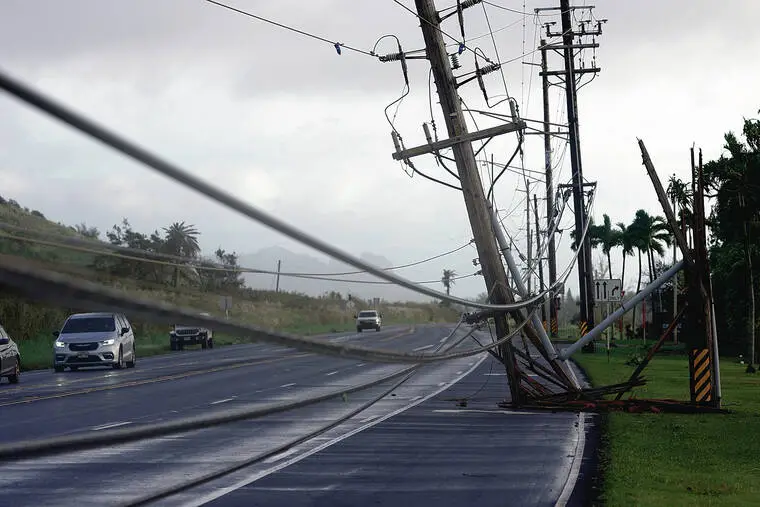
Storms sink economic forecast for Hawaii
Natural disasters in Hawaii this year are contributing to a big drain on the state economy, where growth is now projected to be its weakest since a 2020 contraction due to COVID-19.
Read more New Wahine basketball coach Mitchell approaches season with fresh perspective
Natural disasters in Hawaii this year are contributing to a big drain on the state economy, where growth is now projected to be its weakest since a 2020 contraction due to COVID-19.
University of Hawaii researchers forecast that Hawaii’s economy, after factoring inflation, will grow by a scant 0.6% this year, down from 3.3% last year.
The difference represents a nearly $1 billion reduction in the value of all goods and services produced in the state adjusted for inflation, also known as real gross domestic product.
The University of Hawaii Economic Research Organization made the forecast in a report being released publicly today, and said the dramatic slowdown also is being driven by high inflation mostly in energy costs that spiked due to the war in Iran started by the United States and Israel.
“Hawaii continues to feel the effects of the weather and the war,” the report states.
The parade of storms this year began with a pair of Kona-low systems in March that were followed by Hurricane Lala in August and then Hurricane Lowell earlier this month. There also was a magnitude-6.0 earthquake on Hawaii island in May that caused major damage.
All told, the disasters have disrupted tourism, interrupted local businesses and schools, and inflicted damage on roads, utility systems and more than 1,000 homes. On Wednesday, Gov. Josh Green said a preliminary estimate for damage repair costs was $686 million for all the disasters this year.
That cost, and perhaps a further ding to state economic growth, is poised to expand based on the projected track of Tropical Storm Nolo, which is expected to pass south of Hawaii island as a major hurricane on Saturday and deliver enough rain to cause potentially catastrophic flooding.
Carl Bonham, UHERO’s executive director, said on Thursday during a media briefing that so many storms have battered Hawaii this year that it is starting to get hard to keep track of them. He also said that would-be visitors to the state have been discouraged from making scheduled trips and that others may not even want to come later this year.
“Imagine you’re someone who lives on the West Coast and you were thinking (about) a quick trip to Hawaii in October or for Thanksgiving,” Bonham said. “You might have second thoughts about it right now. I mean, how do you know there’s not going to be another storm in October that’s going to completely disrupt your travel plans. And so each of these (storm) events has had an impact, but cumulatively there’s a decent chance that this is going to make the shoulder season even weaker than it would have been, and even weaker than if you just add up the individual impacts.”
Read more Nolo strengthens as it nears Big Island; County to open five more shelters this morning
UHERO’s report projects that Hurricane Lowell’s damaging brush with Kauai on Sept. 7 will bring down visitor arrivals on the Garden Isle by more than 6% this year.
The report also forecasts a 0.7% drop in Hawaii visitor arrivals for 2026, representing 65,600 tourists, in part because of all the storms so far, high fuel costs stemming from the Iran war, and the U.S. trade war with Canada.
Tourism is the state’s biggest economic driver and private-sector employer. So the industry’s softness is contributing to what UHERO said is a weakened Hawaii labor market where job growth has stalled. The state unemployment rate was 2.7% in August, up from 2.2% in January. UHERO forecasts 2.5% for the year, which is relatively low but up from 2.3% last year.
Another drag on the local economy is inflation. UHERO’s report said federal data for Oahu shows an inflation rate of 5.6% over the 12 months through July mainly driven by higher costs for energy and housing, the latter of which includes rental rates and insurance.
“Higher energy prices act as a tax on businesses, consumers, and the traveling public,” the report said. “That force exerts some drag on the local economy.”
UHERO expects that Oahu’s inflation rate this year will average 4.8% and then ease to 3.3% in 2027.
One strong and steady sector of Hawaii’s economy continues to be construction, where major local and federal government projects are ongoing along with private-sector condominium development.
UHERO’s report said the industry represents about 6% of the state economy, and is being sustained by large federal military projects, expansion of Honolulu’s Skyline rail system, a new shipping container terminal at Honolulu Harbor, and several high-rise condos being built in urban Honolulu.
Next year, state economic growth is projected by UHERO to rebound to 1.6%, though the organization said there is considerable uncertainty with that outlook.
“We think gradual relief from energy prices and from macro uncertainty will occur, although recent war developments make this impossible to call,” the report said. “Uncertainty about the prospects for the ongoing Iran war, oil prices, and therefore the likely course of the Hawaii economy remains considerable.”
Read more Draft EA clears the way for improvements to Isaac Hale Beach Park