UH Forest Stewards program celebrates milestone
Over 100,000 acres of forest on Hawaii Island are located on private land. Since 2012, a program through the University of Hawaii’ has been working to educate and equip the owners of this land with the tools and knowledge necessary to sustainably care for these forests.
Read more MLB Roundup: Dodgers jump ahead early, hold off Mets to win fourth straight
Over 100,000 acres of forest on Hawaii Island are located on private land. Since 2012, a program through the University of Hawaii’ has been working to educate and equip the owners of this land with the tools and knowledge necessary to sustainably care for these forests.
Housed in the College of Tropical Agriculture and Human Resilience, the Forest Stewards program, led by Hilo-based UH extension forester J.B. Friday, recently graduated its 10th cohort.
“The goals are to get out to forest landowners best practices for managing their forests,” Friday said. “Especially on the Big Island, we have thousands and thousands — I even think there’s tens of thousands — of forest landowners all through Puna, and some in Ka‘u and some in Kona.”
He said the program is designed to encourage participants to share what they learn with their neighbors and communities, broadening its reach.
“I’m only one guy teaching people on a one-to-one basis, but if I teach ten people, they each teach ten more people, the knowledge grows through that,” Friday said. “I’ve seen the graduates of this program doing all kinds of great things, so I think it’s a real way of building capacity.”
The program is offered at no charge to participants, but they are asked to commit at least 30 hours to sharing what they learned and developing a project to promote forest stewardship. Past projects have included native plant sales and workshops and one participant who worked with Hawaii County to expand property tax incentives for native plant and reforestation projects.
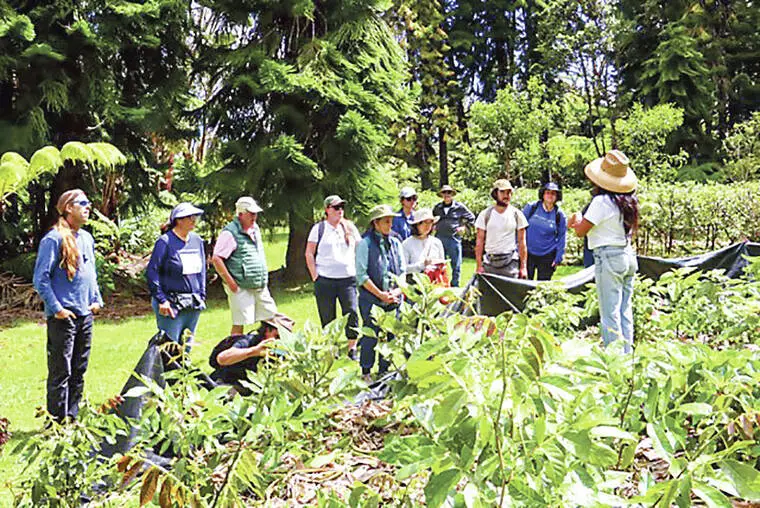
The most recent cohort of participants spent three days this summer in the Pahoa area, attending workshops, listening to presentations from various forestry-related organizations, and going on field trips, including visits with previous participants to see their work first-hand.
“I want them to see, oh, this person’s like me, and they’ve been able to do this with the same sort of resources I can get,” Friday said.
One of these participants, Liana Katase, a landowner in Volcano who has a background in conservation, said she found the experience incredibly valuable.
“It was great to review the different topics that they went over, even though I’ve worked in this field,” she said. “They cover everything from forest health to soil science, fire, wildfires, protecting your home from fire and Hawaiian culture – there were a lot of presentations just reviewing all that information, a top to bottom overview on forest health in general and stewardship.”
Read more Council hopefuls share top priorities
In addition, she said the program provided access to resources and support for forest landowners as well as forming a community around stewardship.
“I don’t think people realize that private landowners manage a good portion of our native forests, and that we can find ways to steward our properties, and there are resources out there to do that … ,” she said. “Everyone was very open to sharing. I feel like we connected really well … and so we’ve kind of formed this like cohort or little community to stay in touch.”
Fellow landowner and a member of the 2025 forest stewards cohort Aliza Gebin said the program gave her the confidence to take a more proactive approach in conserving the ohia trees on her property in the South Kona area.
“We have a large ohia canopy, and I’ve felt a little hesitant to even do conservation work in the forest because I’m fearful that any sort of disruption to what’s happening may increase the risk of rapid ohia death … ,” she said. “My takeaway was it’s also really important just to do what we know is scientifically and evidence based proof of what we do know about ROD and how to still maintain the forest.”
While there have been participants from other islands, Friday said the program’s main focus is on Hawaii Island.
“Especially on Hawaii Island, there are so many private landowners with small acreages of forest, but it adds up to a lot of forest, and so the private landowners, how they manage their forest really has an impact overall on our forest.
Gebin echoed this sentiment.
“We have so much land here that has, on one hand, been degraded and deforested and not taken care of,” Gebin said. “But we also have a lot of land that is still able to be maintained or restored in some way, like thousands of thousands of acres, in a way that I don’t think every other island has. And so just the amount of space that we can preserve, it’s like really important for us to do that.”
While Friday said the future and timing of the program is dependent on funding, he intends to continue running it in years to come and encourages landowners from all different backgrounds to apply.
“This isn’t to make people professional foresters, but it’s to make people aware of what things they should be doing, what things they should not be doing, and what help there is out there to get help in managing their land,” he said.
Those interested in learning more and applying for the program can contact Friday by email at [email protected].
Read more Chris McBride joins Vulcans sports medicine staff
Email Grace Inez Adams at [email protected].