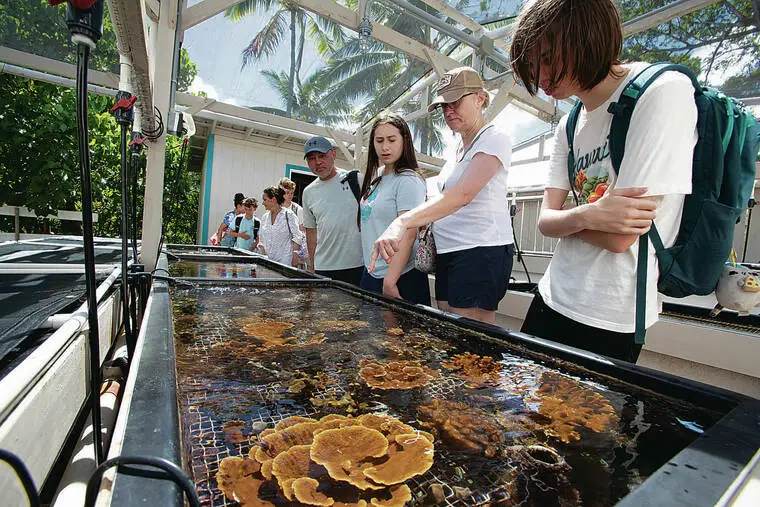
After storm damage, Hawaii’s reefs brace for another blow from El Nino
When back-to-back Kona lows hit the state in March, Alika Garcia got ready to dive.
As executive director of Kuleana Coral, a coral restoration group on Oahu, he and his team worked under an emergency permit to survey and restore the affected coral colonies in Maunalua Bay as soon as ocean conditions were safe.
During their first survey, around two weeks after the storms, Garcia’s team identified “easily 1,000 broken corals” in a 10,000 square foot area they typically work in. Branching corals had broken tips, bouldering corals were flipped over and buried in sand, and other corals were broken off completely.
The team had to work fast, Garcia said. In his experience, it could take two to three weeks of being buried before all the tissues in a coral colony die. Plus, large broken corals can act like “bowling balls” against healthy nearby colonies if not reattached to the reef.
Garcia and his team worked to identify “corals of opportunity,” or corals that appeared more resilient, and reattached more than 400 of them to the reef using eco-friendly cement and epoxy. So far only four have been identified as having since been dislodged. Garcia added he hasn’t checked their progress since large swells smashed the south shore over the past month.
For now, his focus is on preparing coral for its next threat: El Nino.
The latest forecast for this year’s El Nino cycle has an 81% chance of being “very strong” from October to December and could be one of the strongest cycles on record since 1950. Characterized by warming surface waters and lessening tradewinds in the equatorial Pacific Ocean, NOAA’s Coral Reef Watch predicts Hawaii could reach a coral bleaching heat stress warning by August and at an Alert Level 1 by October.
If Hawaii’s waters do reach a warning level, the state Department of Land and Natural Resources’ Division of Aquatic Resources will place a moratorium on most coral restoration activities, according to DAR Rapid Response Coordinator Eric Dilley. The timeline has made Garcia and his team prioritize planting coral from their nurseries, installing temperature loggers at restoration sites and taking photos to monitor how the reefs may change as the ocean heat wave rolls in.
• • •
The impacts from the Kona-low storms have made the reefs even more vulnerable. In reefs off Pupukea on Oahu’s North Shore, coral colonies are already bleaching.
“Bleaching of corals at a time of year when temperature is not the issue … (is) suggestive of something else going on,” Dilley said, adding that corals also are sensitive to changes in salinity, sediment and nutrients that come from freshwater and storm runoff.
A DAR survey team last month observed 75% of coral cover having signs of bleaching at depth greater than 40 feet, Dilley said, which could be from higher levels of freshwater seeping through submarine groundwater discharges following the storms.
Keisha Bahr, Texas A&M associate professor of marine biology and a former University of Hawaii professor, authored one of the only studies that recorded how freshwater flooding followed by heat stress affects coral reefs. The study documented coral colonies in Kaneohe Bay in July 2014, when the area experienced a localized influx of flooding. That event alone, she and her students recorded, reduced coral cover by 22.5%.
“It’s a very fast mortality that will happen with corals, because they only have a tolerance in terms of their salinity to about 15 parts per 1000 for no more than 24 hours,” Bahr said. “It was also very traumatic when we did see it, because it wasn’t only that we saw extensive mortality or death of the corals, but also of some octopus and eel and crab — so the cryptic animals that are associated with reef as well.”
In the days following the freshwater flooding, Bahr said she and her students witnessed coral tissue “sloughing off” like how human skin peels after a bad sunburn. She added that it was hard to say whether it was salinity alone affecting the corals or if increased nutrients, sediment or rapid temperature cooling from the flooding also contributed.
“With temperature, it’s a slower process of the coral bleaching, and if it’s bleached for a certain period of time then it will die,” Bahr said. “This was like immediate destruction of the coral’s tissue, and then the animal was killed.”
• • •
As that year’s El Nino event took hold beginning in September 2014, which eventually became known as Hawaii’s worst recorded bleaching event as it lasted through 2015, Bahr and her students recorded further reduced coral in the “freshwater kill area” by 60%. Several corals that survived the freshwater event didn’t have time to recover by the time the heat hit, she said.
Bahr compared coral stress to human stress.
“When we have one stressful thing we’re anxious about, that’s a lot easier to deal with versus having multiple stressors or anxieties,” she said.
The 2014-2015 bleaching event was “catastrophic,” according the Hawaii Coral Bleaching Collaborative, which Dilley also coordinates. The west coast of Hawaii island saw up to a 71% loss in coral cover and there was close to a 50% loss in Kaneohe and Hanauma bays on Oahu.
And it’s not just coral that can be impacted by El Nino cycles. Bowdoin College marine biology professor and former UH professor David Carlon recorded how reef fish were affected during El Nino thermal heat waves in Hawaii from 2007 to 2017 and found larval fish production and survival fell during El Nino years but increased during neutral and La Nina years.
Larval fish, which are microscopic baby fish that grow to be around 10 mm before settling on the reef, feed on phytoplankton in the water, Carlon said. Warmer temperatures cause the baby fish to be under stress and in need of more food, but those high temperatures also kill the plankton, making less food available.
Plankton availability is also a key stressor for corals that also use it as a food source, Carlon added.
Read more BI athlete’s corner: Eleban flying high in martial arts, wins bronze in Muay Thai championships
The heat waves also had long-term impacts on reproduction, he said, with less “fish recruitment,” or fish transitioning to adulthood, following El Nino cycles.
“Just in our plankton samples you can see a decline,” Carlon said. “The highest abundances we got were in the first few years of the study, and then it just kind of tails off. We never got those abundances again.”
• • •
At UH’s Coral Resilience Lab on Moku o Loe, also known as Coconut Island, in Kaneohe Bay, researchers are preparing for the worst but hoping for the best.
The lab has been testing and breeding for heat-resilient corals, according to lab senior scientist Carlo Caruso, and planted some in different areas around Oahu in tandem with coral restoration partners.
“We’ve planted corals that we think are more thermally tolerant,” he said. “This is the opportunity to see in the real world the performance of that strategy.”
The results could inform better coral restoration strategies, Caruso said, and so far conditions for heat have mostly been tested in the lab.
Eva Majerova, a coral molecular biologist with the lab, said she is also working on something similar to a DNA fingerprinting kit for coral to help trace which genes may impact a coral’s resilience to heat.
But, she added, most biological advantages come with trade-offs. For example, corals that are heat resilient may reproduce more slowly and vice versa, which can affect the reef’s overall ecosystem. She added that the trade-offs different corals exhibit are still being studied but that finger coral, or porites porites, appears to be both heat resilient and slower at reproducing but not slow enough to “decimate the entire population.”
Doctorate student Alyssa Varela also has set up some experiments in anticipation of El Nino. The lab helped selectively breed thermally tolerant corals following the 2014-2015 bleaching event and she’s planted colonies in different areas that have different environmental variables, such as salinity, temperature and light.
She plans to monitor the corals throughout this year’s El Nino.
“No one is hoping for any (coral) mortality,” Majerova said, “but we are a little excited about having the possibility to test all our hypotheses in a real-life bleaching event.”
• • •
But all hope isn’t lost, several researchers added, and there are ways to help coral reefs at a local level.
“Global stressors, like ocean acidification and, particularly, ocean warming are hard to mitigate at the local level … because they’re global issues,” UH assistant professor Andrea Kealoha said. “But what our managers locally are really trying to focus on is, if you reduce the local stressors, it increases the coral reef resilience to climate-change stressors.”
Kealoha said studying which areas have specific local stressors and addressing them is imperative to reducing stress on the reefs. For example, she said, areas that have a high sediment problem during storms could be addressed through better land management and planting while areas with high nutrients could be helped by converting cesspools or better wastewater management.
Dilley agreed local stressors can be reduced through land management.
“Native Hawaiians had this figured out,” he said. “They’ve known for thousands of years that the top of the mountain is connected to the ocean in a very kind of direct way.”
The bleaching at Pupukea following the Kona lows is “a perfect example” of how important land management is, according to Dilley. The area has a high rate of unconverted cesspools and experienced extreme flooding and sediment during the storms.
And on the hyper-local level, he added, community members can play an integral part in tracking coral health. He encouraged anyone who uses the ocean to document and record coral observations through DAR’s “Eyes on the Reef” portal at eorhawaii.org. The program is a “direct line of communication” with DAR and helps the agency make decisions on surveys, intervention and restoration.
“It’s really a way for the public at-large to be able to do something that’s really important and valuable to DAR and helpful for coral reef management,” he said.
Documenting the Pupukea bleaching is a “success story” of the program, he said, because community reports prompted DAR to conduct more surveys.
“It gets to a point of, what can the public do?” Dilley said, adding it’s easy to feel helpless when trying to save the reefs. “They can do this. This is really important.”
Read more UH quarterback Alejado ready to rise and shine for Warriors

Related Posts

Remembering Hawaii’s 9/11 victims

World Manta Day returns today
