BLNR moves to settle $45,000 fine against men who took 4,000 opihi
After three men were caught taking more than 4,000 opihi from a protected area on Hawaii Island, the Board of Land and Natural Resources moved to settle the case in lieu of a more than $45,000 fine after considering both cultural impacts for both the environment and the violators.
Read more 5 Dodgers whose under-the-radar contributions helped spark MLB-best first half
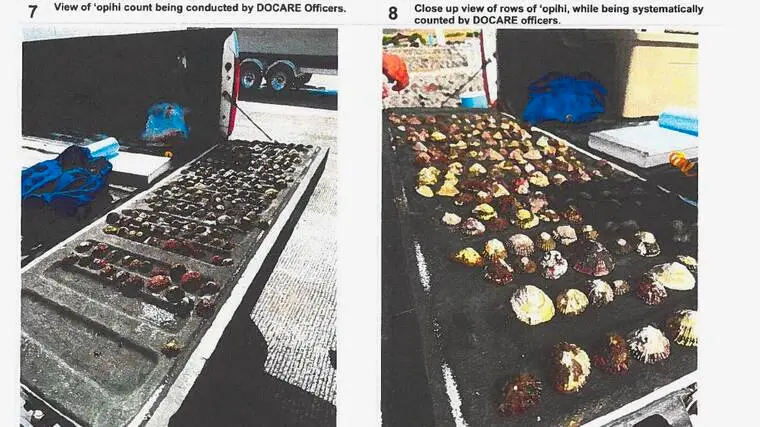
The decision came during a Department of Land and Natural Resources meeting last month, where Charlie Taylor, with the Division of Aquatic Resources, said the men were caught with 4,068 opihi gathered from Kaupulehu Marine Reserve in September. The reserve is a “no-take” zone, meaning no fishing or harvesting of aquatic life is allowed.
Brandon Carvalho, Kaipo Botehlo-Matthey and Keaupililani Solomon-Lewis told Division of Conservation and Resources Enforcement officers that they were catching the opihi for a family celebrations. Carvalho told officers he thought the no-take rule had expired, Botehlo-Matthey acknowledged the trio had entered a no-take zone while Solomon-Lewis declined to speak to officers.
DAR staff told the Honolulu Star-Advertiser that there is no regulation on the daily bag limit on opihi, but that any sort of fishing in no-take zones is prohibited. Legally caught opihi need to be at least 1-1/4 inches in diameter, but the agency did not measure the opihi caught by the men since they were illegally caught.
Criminal charges against the men were dropped because the Hawaii County Prosecuting Attorney’s Office “mistakenly thought there were no available criminal penalties for the violations,” DAR records show.
“This was a learning opportunity for all involved and now there are clear lines of communication between that office, DOCARE, DLNR’s legal fellows and the Department of the Attorney General’s Land Division,” the agency said.
Violations of the no-take policy at Kaupulehu Marine Reserve, or any violation of rules in the West Hawaii Fishery Management Area, is a petty misdemeanor. The reserve’s no-take policy will not expire until DAR finishes the rule-making process for a comprehensive fisheries management plan, the agency said.
Taylor said the maximum fine the men could have received was $4 million — $1,000 per opihi — but said it was “a little ridiculous.” Instead, the agency determined the men should be fined $10 per opihi based on internal guidelines the agency is creating to evaluate fines.
“We feel like this is a pretty standard number for the value, especially taken from a protected area,” he said.
In total, the men faced $46,186.23 in fines, including administrative fees and costs. DAR opted to split the fine evenly three ways, with each facing $15,395.41 for their share of the fine.
Carvalho, Botehlo- Matthey and Solomon-Lewis said in a joint statement at the meeting, which was read by someone else, that they have “great respect for Hawaii’s natural resources and the laws intended to protect them.”
“We were born and raised locally and understand the importance of preserving our marine resources for future generations,” the statement said. “At no time did we intentionally violate any law or regulation.”
The men said they did not realize they were within the no-take zone because they entered the area by boat and did not see any clear signs. They added that the dismissed criminal charges “supports the position that this matter does not warrant the substantial penalties being sought,” calling the recommended fine “a little excessive in light of the circumstances.”
“This was not a deliberate act of disregard for the law but rather an honest mistake resulting from a lack of clear notice and our awareness that we had entered a restricted area,” the statement said, adding that the men were gathering food for their families in a long-standing cultural practice.
Local resident Malia Kipapa supported the fine in written testimony, and added that the case should set a precedent to deter future violations.
“If we fail to hold individuals accountable for actions of this magnitude, it sends the message that violations within protected areas will be tolerated,” Kipapa said. “Strong enforcement is necessary to demonstrate that there are real consequences for poaching and the illegal take of resources from marine reserves.”
Read more Two Paauilo men charged in shooting
Janine Dumaguin, the marine watch volunteer who reported the men and a member of Hui Kahuwai, a nonprofit with the mission to implement stewardship strategies for Kaupulehu Marine Reserve, said she was appreciative of the responding DOCARE officers who “demonstrated the importance of timely enforcement.”
She did not advocate for what kind of accountability the men should face, but rather that it considered that community stewardship recognizes that these types of situations are complex.
“We are talking about people who have families, relationships, and ties to the same islands we all call home. That reality does not change what happened, but it does remind us that accountability and community are not separate from one another,” she said. “My hope is not simply that accountability occurs. My hope is also that there is understanding. The individuals involved do not have to agree with my actions, but I hope they understand why I made the decisions I did that day.”
Land board member Kaiwi Yoon said he took issue with the men’s statement not containing an apology.
“This is a kanawai that was broken,” he said. “When you come at us … without any accountability or remorse, it bothers me, culturally speaking.”
“I’m super sorry,” Botehlo-Matthey responded, this time speaking himself. “I’m all about the Hawaiian culture. My daughter goes to Kamehameha Schools and everything. I feel really bad. I try to provide, not take. … I feel awful about this.”
Hui Kahuwai Executive Director Rebecca Most testified that while the opihi were returned to the reserve area, most of them did not survive when members checked a few days later.
“For us, it was really an example of how much can be taken and how quickly, and it’s precisely the kind of event that shows us how fragile the recovery is that we’ve been working so hard on this past decade,” Most said. “The gains of a decade can be like wiped out when people who don’t know or respect this place treat the resource like an ATM.”
Several community members testified in support of the recommended fines, including Sharde Freitas, a public policy advocate with the Office of Hawaiian Affairs and ocean advocate Mike Nakachi.
Lifelong Hawaii Island resident Bobby Camara, however, said that while he believes there should be a ban on taking opihi in the whole state, the proposed fine seemed “poho,” or a waste of time.
“I would kind of be leaning towards some sort of … rigidly controlled community service and education,” he said.
Yoon told the men, who are also Hawaiian, that Hawaiians have been fighting for decades to preserve and preserve the virtues and mana of Hawaiian culture.
“These type of actions, boys, demonstrate our inability as a lahui (race) to love and preserve and protect our fragile cultural resources,” Yoon said. “I’m not upset, boys, I’m disappointed, and I’m hurt. I’m hurt because we fought all these years for you guys, this next generation, and to claim ignorance is not acceptable.”
The board ultimately decided to move to settlement talks, which could result in reduced fines, community service, education or a combination of the three. The Division of Aquatic Resources is expected to provide an update on the settlement this September.
Read more Hilo woman killed in Kona traffic crash

Related Posts

Remembering Hawaii’s 9/11 victims

World Manta Day returns today
