Hawaii enacts AI laws to protect children
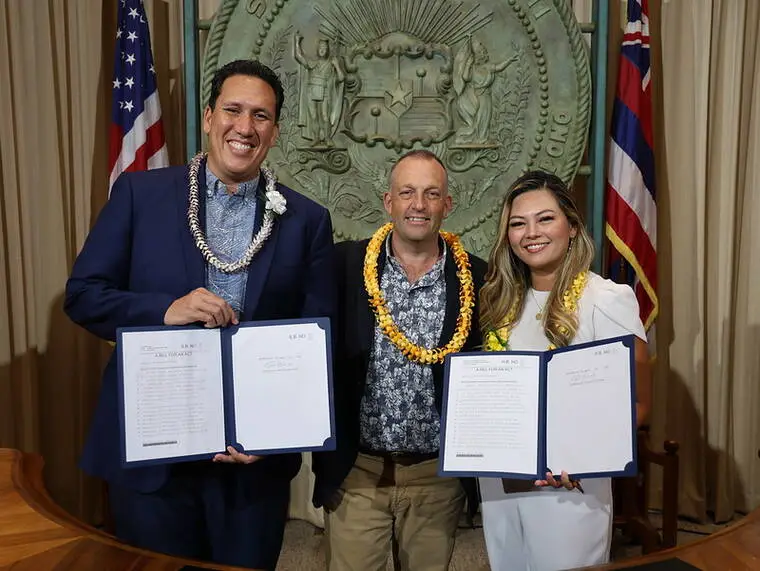
Hawaii took a major step into regulating artificial intelligence this week as Gov. Josh Green signed two bills establishing some of the state’s first guardrails for AI chatbots and AI-generated deepfakes, citing growing concerns over child safety, fraud and mental health.
Read more Messi leads Argentina rally, extends England’s decades of disappointment
Hawaii took a major step into regulating artificial intelligence this week as Gov. Josh Green signed two bills establishing some of the state’s first guardrails for AI chatbots and AI-generated deepfakes, citing growing concerns over child safety, fraud and mental health.
The measures — Senate Bill 3001, the Artificial Intelligence Disclosure and Safety Act, and House Bill 2137, which creates new civil protections against harmful AI-generated digital imitations — are designed to address what lawmakers say are emerging risks posed by rapidly advancing AI technologies.
“This emerging field is consequential because it’s going very rapidly through society,” Green said Tuesday during the bill signing ceremony. “There are undoubtedly going to be benefits of AI… but will it be the right information? Will it be thoughtful? … Will it be safe information? These are the questions that have arisen.”
SB 3001 requires conversational AI services to clearly disclose that users are interacting with artificial intelligence rather than a human whenever a reasonable person could mistake the chatbot for a real person.
The law places additional protections on minors, requiring AI companies that know or reasonably believe a user is under 18 to prominently disclose that they are interacting with AI. Those disclosures must either remain visible throughout the conversation or appear at the beginning of each session and at least every three hours during extended chats, reminding users to take breaks and that the conversation is artificially generated.
The legislation also prohibits chatbot operators from programming AI to present itself as a licensed mental health professional and requires systems to direct users expressing suicidal thoughts or self-harm toward crisis intervention resources such as suicide hotlines or crisis text lines.
For minors, the bill goes further by banning features intended to increase emotional dependence on AI companions, including unpredictable reward systems, simulated romantic or sexual relationships, manipulative engagement techniques designed to prolong conversations, and sexually explicit content. Companies must also provide privacy controls for minors and, where appropriate, their parents or guardians.
Violations would be considered unfair or deceptive business practices enforceable by the state Department of Attorney General or the Office of Consumer Protection. Companies could face civil penalties of up to $1,000 per violation, capped at $1 million per operator.
Beginning in 2028, operators will also be required to submit annual reports detailing how often they referred users to crisis services and describing their suicide prevention protocols.
Green said the measure was inspired in part by reports of young people receiving dangerous advice from AI chatbots.
“There have been stories where individuals, young people, received advice that was tragic from an AI-generated algorithm,” Green said. “I have two teenagers, and I can only imagine what would happen if they thought they were getting comprehensive, competent advice from a psychiatrist or psychologist, and instead an algorithm set them down a path where they felt desperate and hurt themselves.”
The governor described AI as “a public health consideration” and said the state worked closely with the attorney general, state Department of Health and harm reduction experts while developing the legislation.
Read more Tropical Storm Elida is expected to become the Pacific’s first hurricane of 2026
State Sen. Jarrett Keohokalole (D, Kaneohe-Kailua), who introduced the legislation, said lawmakers wanted to establish safeguards before more people are harmed.
“This effort is an attempt for us to put reasonable and obvious guardrails on new revolutionary technology a little bit faster than that, so that less people, especially children, will be harmed along the way,” he said.
Keohokalole said legislators heard testimony earlier this year about Hawaii children being negatively affected by AI companion chatbots. While acknowledging that Congress may eventually create national AI standards, Keohokalole said lawmakers chose not to wait.
“We didn’t want to wait when it came to kids, when it came to instances of self-harm and suicidal ideation,” he said.
Introduced by state Rep. Trish La Chica (D, Waipio-Mililani), Green also signed HB 2137, which creates new civil protections against harmful AI-generated “deepfakes” — highly realistic digital imitations of a person’s face, voice or likeness.
Under the law, it will be illegal to knowingly publish a realistic AI-generated imitation of someone without their consent if it is used in advertising, causes harm, or is used to commit fraud, defamation, harassment or other criminal acts.
Victims — or their estates for up to 10 years after death — may seek court orders requiring removal of the content, recover actual damages or up to $25,000 per advertisement, pursue punitive damages when malice is proven, and recover attorneys’ fees and court costs.
The legislation includes exemptions for parody, satire, commentary, criticism, scholarship, educational or political expression, news reporting, documentaries and historical works, aiming to preserve First Amendment protections.
La Chica said the deepfake bill gives people legal protections when AI-generated versions of their face, voice or likeness are used without consent to cause harm, while the chatbot measure addresses AI companion systems designed to keep children engaged and foster emotional attachment. She noted that similar technologies have been linked to tragic cases nationwide in which children turned to AI instead of trusted adults during moments of emotional distress.
Green said increasingly sophisticated deepfake technology can be used to deceive people, damage reputations and cause significant emotional harm, particularly when fake images or videos falsely depict someone engaging in conduct that never occurred or target young people in exploitative or humiliating ways.
He also warned that older adults may be especially vulnerable to scams involving AI-generated voices or videos impersonating trusted figures such as bankers or public officials.
La Chica said lawmakers chose to “lead instead of reacting and waiting” as AI technology continues to evolve. Together, the two new laws represent Hawaii’s most comprehensive effort yet to regulate artificial intelligence, seeking to balance the technology’s potential benefits with new protections aimed at reducing risks to consumers, particularly children.
Read more Life as a Super Bowl-winning coach is good for the Seahawks’ Mike Macdonald

Related Posts

Remembering Hawaii’s 9/11 victims

World Manta Day returns today
