Revamping Hawaii Volcanoes National Park
Eight years after the 2018 eruption of the Kilauea volcano sent ash spewing into the air, streams of lava snaking toward the coast, and set off thousands of earthquakes over the course of just a few months, Hawaii Volcanoes National Park is nearing the end of a $36 million disaster recovery project.
Read more Friendship over fear: How USMNT’s long-held brotherhood is antidote to World Cup nerves
Eight years after the 2018 eruption of the Kilauea volcano sent ash spewing into the air, streams of lava snaking toward the coast, and set off thousands of earthquakes over the course of just a few months, Hawaii Volcanoes National Park is nearing the end of a $36 million disaster recovery project.
While some park infrastructure, including part of the road that once circled the Kilauea summit — which collapsed into the volcanic crater during the eruption — was beyond repair, other features and facilities have begun to reopen. The majority of the remaining work is scheduled to be completed by the end of this year.
Expanded
viewing area
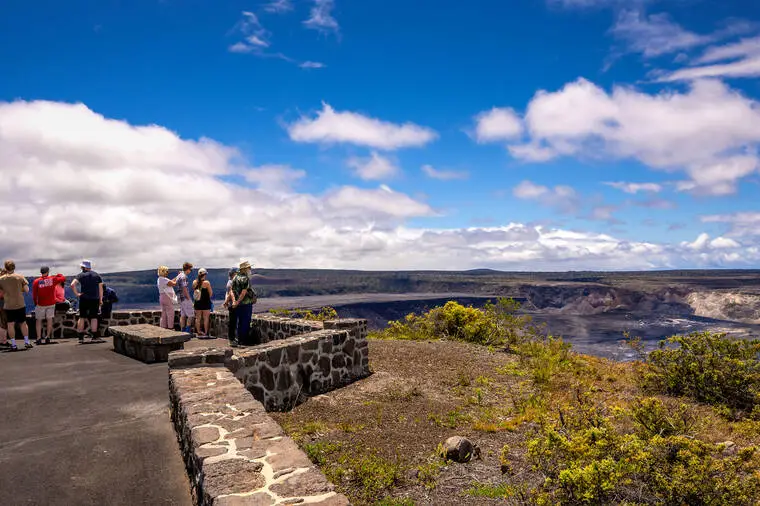
On a recent Thursday afternoon, Danielle Foster, the park’s construction manager for the project, and HVNP public affairs specialist Jessica Ferracane stood at the site of the former Jaggar Museum on the Uekahuna observation deck on the rim of the Kilauea caldera.
The museum, which previously housed exhibits on volcanology, history and culture, was severely damaged during the eruption and the National Park Service ultimately decided not to rebuild it.
Instead, following an extensive planning and public input process, NPS opted to create an expanded platform at the site which is a popular spot for viewing Kilauea and the surrounding landscape. The observation deck reopened to the public in May of last year.
“This outdoor area is so much more expanded now,” Ferracane said. “The Jaggar Museum would close at night, and people couldn’t go in, so you’d have all the people (in front of the building), especially during eruptions and nice glows. There was not enough room for people, so now we have a nice expansive space, and you can see so much from here. It’s a really phenomenal viewing point.”
Foster said NPS made a concerted effort to pay homage to the Jaggar Museum through the design of the expanded viewing platform.
“The Jaggar Museum is historic. It was built in the ’20s, and so in order to protect that historic function, we couldn’t protect the structure itself, but we can commemorate it, and so this concrete outline with the stone corners, that is where Jaggar Museum sat,” she said, adding that the seven benches now scattered across the platform were also made using stones from the building.
In addition to the historical value, Foster said reusing the building material had environmental benefits as well.
“We live on an island, so it’s really important to consider the environment. We didn’t want the whole building to go into the landfill,” she said. “So we made it a deconstruction contract, so they were supposed to reuse, recycle as much of it as they could, so 99% of those buildings was recycled or reused.”
While she said some of the material was shipped off for use on other islands, some of it went toward construction projects within the park, including the renovation of the Kilauea Visitor Center — another element of the disaster recovery project.
“We decided that we were gonna renovate the visitor center, remove a lot of the offices that are in the back, and instead expand the visitor space to make up that difference that we lost by taking away Jaggar,” Foster said. “And also providing more park store space for the Hawaii Pacific Parks Association, because they were out here, and they had a really big space in Jaggar.”
A renovated
visitor center
When plans were first discussed to make changes to the Kilauea Visitor Center, Ferracane said the initial idea was to construct a new, larger building to the east of the current location, which would have involved clearing some of the forest.
But when the project entered the public input phase, there was pushback, she said.
“In the beginning, we really wanted to have a new … facility and have this be a lot bigger and build that way more and move some of the forest,” she said, motioning toward the trees. “And our feedback was overwhelmingly like, ‘no, don’t do that … .’ And so the decision was made — which I give the park management a lot of credit for — to just renovate here and make it work within the existing footprint, more or less.”
Among the additions being made to the visitor center are a comfort station with new bathrooms and changing areas, a new open-air halau and an expanded educational space within the main building.
“Most of this side was all staff, and now it’s going to be visitor space,” Foster said during a recent visit to the construction site. “When we shifted, pivoted, from doing a new visitor center to a renovation, we had to figure out how we’re going to accommodate that and not just give them the same small space, which we knew was already undersized.”
She said staff offices were relocated to other buildings to open up the space and allow for more exhibits, which are in the process of being developed.
There will also be more educational and event space at the new halau, a covered outdoor structure that will be accessible to visitors at all hours. It’s an addition that Foster said will improve the visitor experience, especially for those coming to the park at night.
Read more El Nino officially arrives — with warning
“It’s really important because our park is a 24/7 park. People come here any time of day or night, and we want them to understand where they are, what they need to know to be safe, and what they need to know for being where they are.”
She said the front two-thirds of the 5,000-square-foot halau will be used for wayfinding and orientation displays, and the back third will be reserved for educational and cultural programming and other events. It will also serve as a meeting and gathering point for schools and other large groups.
The architecture of the structure differs from that of the visitor center building, which was constructed in the 1940s. Foster said that this was an intentional decision.
“The visitor center is a very western looking building,” she said. “Between our architect working with us and the State Historic Preservation office, as well as our kupuna consultation group and other consulting parties like Historic Hawaii Foundation, we all worked together to come up with what this would look like, and it was distinctly wanted to be different than the visitor center.”
Work on the visitor center is over 75% done, and it is on track to reopen later this year, according to HVNP. In the meantime, the temporary visitor center that has been set up down the road at the Kilauea Military Camp will remain open.
In addition to the new viewing platform and renovated visitor center, Foster said the disaster recovery project also made it possible to improve safety and accessibility throughout the park.
She said it also provided an opportunity to address a feature that had long been a source of complaints and safety concerns: the park entrance.
Traffic and safety improvements
Prior to the 2018 eruption, the entrance to the park was a two-lane road that ended in a “T” shortly after the entrance booths.
“So, the people turning left could only turn left from the left entrance booth, and then the right entrance booth, they couldn’t, so they would go down and then do a U-turn, an illegal U-turn in the middle of the road,” Foster said. “So, it was a lot of safety issues that we were concerned about, and it was also very confusing for the visitors.”
The solution they came up with was to create a roundabout just past the booths.Foster said the idea initially faced some resistance, but after it was completed in October 2025, people quickly came around.
“Once it went in, we got several comments that were like, ‘I was skeptical, and it is great,’” Foster said.
They also added a designated lane for staff and contractors to prevent congestion and traffic, as well as a designated parking lot and crosswalk for staff to be able to access the entrance booths more safely.
‘Everybody’s park’
With the project nearing its end, Ferracane said that she said that she is grateful to the community and visitors for their patience, feedback and support.
“Our local community, especially here in Volcano, really feel like this is their park, and of course it is — it’s everybody’s park,” she said. “Everybody’s been really patient, and for the most part, really positive and supportive of the changes.”
Foster said that while it has been a long process, involving many different elements and stakeholders, she is pleased with the work and its outcomes.
“I think it’s been a really good collaborative project. We worked with a lot of different people in the planning, design and construction, and I think it’s been really great. … I’ve been really happy to see what we can do to help improve the park for our public.”
Overall, Foster and Ferracane said they believe the improvements are helping to shape a better, more sustainable future for the park, especially at the Kilauea summit region.
“The whole project really helps fulfill the park mission, which is to provide safe access to active volcanism,” Ferracane said. “This is safe access, because we’re far enough away from the rim. We’re providing orientation, we’re providing cultural information — which is also part of the park mission — and we’re meeting visitors where they want to be the most, which is right here at the summit of Kilauea.”
Read more The Knicks, one win from NBA championship, really look like a team of destiny
Email Grace Inez Adams at [email protected].

Related Posts

Green signs executive order to preserve 2026 renewable energy tax credit
Hilo Harbor project hits snag