Hilo Harbor project hits snag
A $62 million planned expansion of Hilo Harbor will include traffic-flow improvements along Kalanianaole Street, promising relief to beach-goers, school commuters and residents of Keaukaha fed up with frequent gridlocks caused by cargo trucks entering and exiting the port.
Read more 2026 KTA Roy Fujimoto Scholarship awarded to 4 Big Island high school seniors
A $62 million planned expansion of Hilo Harbor will include traffic-flow improvements along Kalanianaole Street, promising relief to beach-goers, school commuters and residents of Keaukaha fed up with frequent gridlocks caused by cargo trucks entering and exiting the port.
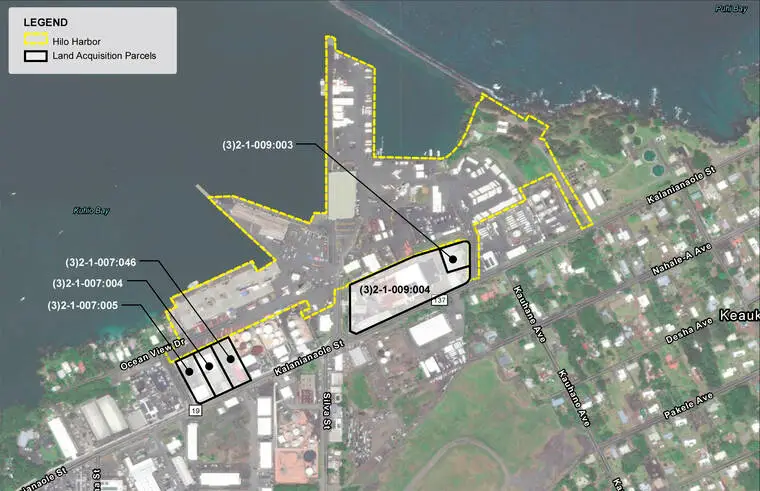
But the project’s timetable continues to be pushed back by breakdowns in negotiations over five privately owned properties adjacent to the port which the state needs to acquire before work can begin. This has prompted some state Department of Transportation officials to describe the ongoing impasse as nearing a “tipping point” where the state could consider resorting to eminent domain.
Regardless of whether the handful of parcels making up a combined 9.38 acres are acquired through voluntary sale or forced seizure, the project will compel the relocation of more than a dozen businesses and a church.
These include AirGas Gaspro, Ocean Front Kitchen, Service Rentals and Supplies, Hilo Auto Sales and Rentals, Maika‘i Auto Body amd Paint, Ho‘ola Farms, Keoki’s Auto Repair, Conen’s Freight Transportation Inc., Westside Audio Hilo, Ambrosio’s Auto Glass, Surplus Plus, Automotive Solutions Hawaii and Car Rentals LLC and Zion’s House of Praise Holiness Church.
The properties in question have three owners: Parcel 1 is owned by AirGas Gaspro, which operates a gas plant and retail store selling gas, welding equipment and industrial safety supplies on the corner of Kalanianaole Street and Kumau Street. Parcels 2 and 3 along Kalanianaole Street are owned by 595K LLC, while Parcels 4 and 5 along Kalanianaole Street are owned by Sparks and Boschetti LLC.
Parcel 4 is the largest of the bunch at 5.56 acres, with roughly 11 businesses operating out of its buildings and warehouses comprising the Kuhio Industrial Park.
DOT officials have contended that the lack of landowner cooperation has bumped the project’s shovel-ready date back by at least a few years. According to the project’s final environmental assessment published in October 2024, the process to acquire the five properties in question was anticipated to be completed by the end of 2025. Now, half a year past the estimated acquisition completion date, the process has barely even begun.
The state has yet to complete its “Phase 2” environmental site assessment for the parcels to evaluate the presence of contamination in their soil and groundwater.
“That original timeline in the EA was strictly based on cooperative landowners — we’re not there,” DOT Deputy Director for Harbors Dreana Kalili told the Tribune-Herald. “Cooperation with the landowners at this point in time is just for us to have access to the property so we can finish our Phase 2 as well as our appraisal. We can’t even get on (site) to do a proper appraisal, so we know what we’re dealing with in terms of the acquisition cost. So, I think we’re approaching a point — the tipping point and the decision point — where we will need to make a decision about whether we keep asking politely or whether we proceed with eminent domain.”
Under the Fifth Amendment to the U.S. Constitution, federal, state and local governments can use eminent domain to seize private property as long as it’s for “public use” and owners are provided “just compensation.” Legal experts generally agree that expanding a harbor is a valid use of the power because it involves improving infrastructure used to benefit the general public.
In what Kalili described as a “bottleneck” in the project’s progress, the property owners’ refusal to grant access has made it impossible for the state to come up with offers or settle on an accurate budget because the extent of hazardous materials contamination — and its resulting remediation costs — are still unknown. According to the EA, between $15 million and $17 million of the project’s total price tag will be spent on land acquisition.
The document spells out a long list of potential pollution issues documented by state officials during preliminary site inspections, including petroleum products “in contact with bare soil,” metal residues from “unpermitted automobile salvage activities,” abandoned underground storage tanks used to store diesel, hydraulic fluid and used oil, piles of large appliances, unlabeled barrels and buckets, “rusting/leaking salvage vehicles,” countless used tires and various other types of municipal waste.
This is in addition to contamination stemming from the properties’ historical uses, including pesticide and fertilizer manufacturing, storage and distribution.
“We know the history of the owners and the land and what businesses operated there — that’s not a secret,” Kalili said. “But because we haven’t been able to gain access to the land to complete our Phase 2, we don’t know the extent. And so we could be pleasantly surprised and be like, ‘oh, it’s all clean’, or it could be much worse. That’s why the work with the landowners is so important to the process and we just haven’t been successful there.”
Community benefit
The state’s acquisition of the contested parcels will allow for the widening of Kalanianaole Street to include a minimum 350-foot-long dedicated left-turn lane in front of the harbor which could accommodate up to four semi-trailers, according to the EA. This would reduce traffic congestion along the coastal thoroughfare by maintaining a “clearer through lane.”
The project also involves using parts of Parcels 4 and 5 to build a 450-foot-long “stacking” zone for semi-trailers leading up to the harbor entrance, which the new left-turn lane would funnel trucks into. This stacking zone would be approximately 70 feet wide, allowing for up to three lanes that could potentially accommodate between five and six trucks each, or around 16 total. Existing buildings on these parcels would need to be demolished to build the stacking area.
Read more Revamping Hawaii Volcanoes National Park
“There are a lot of benefits, but I think the community is really going to see and touch and feel the one which is that stacking and storage turn lane into the main port gate,” Kalili said.
Enabling trucks to queue up right outside the harbor entrance without blocking through traffic, she said, will be a welcome relief to drivers. According to the EA, DOT has observed vehicles routinely backing up for over a quarter mile along Kalanianaole Street in either direction of the harbor, causing traffic jams that can last up to an hour during peak activity periods. “There is going to be another lane so that motorists who need to get beyond that choke point at the port gate can move past it safely and seamlessly,” she said. “That’s going to be the big benefit.”
This, she said, will be a boon to road safety along the streets leading up to the harbor.
“Generally speaking, when you have a planned and dedicated (turn lane) for these very heavy vehicles — they’re trucks that are carrying loaded usually 40 to 45-foot containers — it separates them from everyone else driving on the road,” she said. “And that separation, even if it’s just for a couple hundred feet, is going to be helpful in improving safety.”
The majority of the public, she said, probably won’t notice the effect of the project’s “operational efficiencies” until they go shopping.
“We’re going to see some reductions in timing for cargo delivery, but, of course, the public right outside — unless you’re a longshoreman or you do a lot of regular business at the port — you don’t see those adjustments,” she said. “But you would feel them when you go to the store and the shelves are empty.”
Disembarking cruise ship passengers also stand to benefit from the improvements. Currently, passengers on foot and the ground transportation vehicles entering the port to pick them up and drop them off can conflict with cargo loading and unloading operations, causing delays and safety threats to all parties.
“It will allow for additional separation between cruise passengers and the cargo moves,” Kalili said of the expansion project. “The cruise passenger terminal is like smack in the middle between two cargo yards, so with the additional space we’ll be able to carve out some very safe and protected pedestrian pathways from the terminal for those who want to explore Hilo on their own.”
The EA echoes this, stating the project will allow DOT to “implement improvements separating access into and out of the harbor’s facility benefiting both passenger service and cargo operations by providing safer and dedicated access into the harbor for each activity.”
Improved safety
Matson Navigation Company, Pasha Hawaii Transport Lines and Young Brothers Limited are the harbor’s main users transporting and processing cargo. They use around 31 acres of the 46-acre facility as cargo handling and storage areas. Containing semi-trucks in the proposed external stacking area would free up more cargo yard space, giving loading operators a wider berth to safely maneuver.
“Having more space and having that congestion mitigated inside the terminal gate makes it more safe for the personnel and labor that operate in the terminal,” she said.
Other safety upgrades called for by the expansion plans include replacing worn asphalt surfaces with hardened concrete and siting brighter, more efficient light poles — which were originally constructed half a century ago.
“You can imagine the improvements in lighting technology since the ’70s,” she said. “This means that we can effectively light more areas of the terminal with fewer fixtures.”
Reducing the number of obstacles like light poles in the cargo yard for operators to navigate around might seem insignificant, she said, but it can quickly add up.
“If we don’t need to have as many pedestals, there’s just more area and open space for those who are operating the cargo handling equipment to move around,” she said. “It’s small things like this that are going to improve aspects of safety for those who work in the terminal.”
AirGas Gaspro, 595K LLC and Sparks and Boschetti LLC did not immediately respond to email inquiries.
Read more Friendship over fear: How USMNT’s long-held brotherhood is antidote to World Cup nerves
Email Stefan Verbano at [email protected].

Related Posts
Green signs executive order to preserve 2026 renewable energy tax credit
Revamping Hawaii Volcanoes National Park