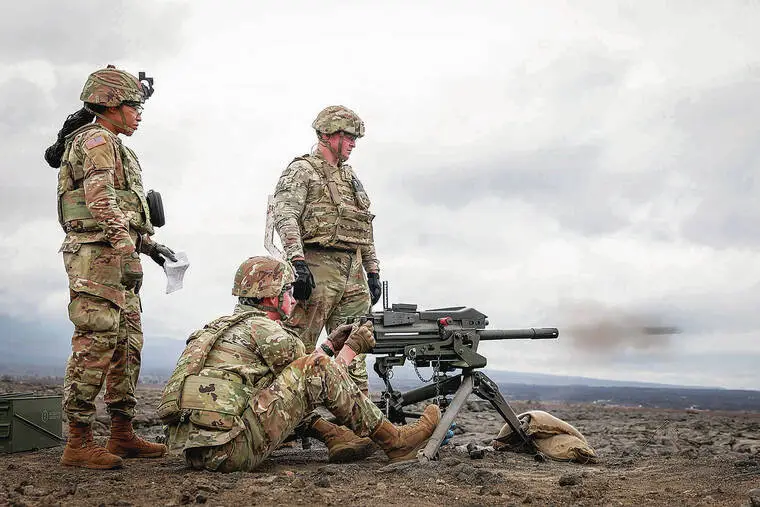
Draft bill in Congress calls for negotiation on Army land leases in Hawaii
A draft of Congress’s annual military spending bill approved by the Senate Armed Services Committee contains language that would limit the Army’s ability to seize land in Hawaii through eminent domain.
Read more Netherlands rout Sweden 5-1; Japan blanks Tunisia 4-0
The National Defense Authorization Act for the 2027 fiscal year calls on Army Secretary Dan Driscoll to negotiate “on terms acceptable to both the Department of the Army and the State of Hawaii” as the service seeks to potentially renew leases on state owned parcels of land — specifically 19,700 acres at Pohakuloa Training Area on Hawaii Island and 450 acres at Kahuku Training Area on Oahu.
It would also require the Army to resubmit new versions of its environmental impact statements on proposed lease renewals that were rejected by the state Board of Land and Natural Resources last year “that responds to and addresses any deficiencies identified by the Hawaii Department of Land and Natural Resources,” within 30 days of the bill’s approval.
The draft also calls on the Army to provide Congress a report within 60 days of its passage “describing the specific steps and proposals the Secretary has made to promote lease renewals.”
The NDAA is expected to go the U.S. Senate floor at the end of July for a final vote and would require President Donald Trump’s signature to become law.
Office of Hawaiian Affairs Chair Kai Kahele, who led a delegation this year to Washington, D.C., to consult with lawmakers on military land leases and other issues, said in a statement Friday that the inclusion of the provisions in the NDAA “reflects meaningful progress in acknowledging Hawaii’s unique legal and cultural context.”
“The removal of condemnation as an option and the requirement for renewed environmental review are consistent with what OHA has long advocated — that these lands must not be permanently alienated and that Hawaii’s concerns must be fully addressed in good faith,” Kahele said. “Congress appears willing to respect Hawaii’s laws and institutions. The opportunity before us now is to fully embrace the responsibilities and authorities those laws entrust to us.”
The Army’s leased lands in Hawaii include 1,150 acres at Kahuku Training Area, 4,390 acres at Kawailoa-Poamoho Training Area and 782 acres at Makua Military Reservation on Oahu; and 22,750 acres at the Pohakuloa Training Area on Hawaii island.
It obtained all those lands for a mere $1 in 1964. The leases are set to expire in 2029.
Read more County eyes Kona Kmart for events center
Last year, the Army stated that after the current leases expire, on Oahu it only wants to retain 450 acres at Kahuku and not pursue renewing leases on any other state lands — a roughly 93% reduction.
The Army is focusing much more on Pohakuloa, which is the service’s largest live-fire training area in the Pacific Basin. Commanders argue PTA is a critical training and testing ground for American troops and their allies as they prepare for potential conflict in the region.
The BLNR voted to reject the Army’s environmental impact statements for both Oahu and Hawaii island citing criticisms by DLNR staff that said the study used outdated environmental data and information on traditional burial grounds, and that the Army did not properly consult the Hawaii State Aha Moku Advisory Committee, which was formed to protect, conserve and manage Hawaii’s natural, cultural and historic resources.
After the rejection of the EIS’s, Driscoll told the Honolulu Star-Advertiser in August that he wanted to “figure out how can we, with the constraints that we all have — whether it’s a swap, land exchange or through a much more aggressive model — how can we push through these changes in a way that both respects the Hawaiian people … while also acknowledging the battlefield reality that we must have this training land because it is so critically important to us.”
He suggested a 60-day timeline to resolve the lease, but that soon softened to an end of year goal. However, Gov. Josh Green told local media outlets several times that Pentagon officials had suggested to his staff that they were exploring taking the land by eminent domain on national security grounds if they could not reach an agreement with the state that satisfied them.
Last year, Congress passed an NDAA that also called on military officials to negotiate with the state on lands, and a bipartisan conference committee wrote that it wanted military leaders to understand that eminent domain should only be considered if all other options had been completely exhausted.
In April, as Kahele led the OHA delegation in Washington, U.S. Sen. Mazie Hirono (D, Hawaii) and U.S. Rep. Jill Tokuda (D, Hawaii) questioned Adm. Samuel Paparo, who leads all U.S. forces in the Pacific from Camp Smith, about his thoughts on the prospect of using eminent domain to seize the land.
When asked by Tokuda if such a seizure should be “taken off the table” for negotiations, Paparo said: “I think finding a consensus solution is important, and it’s above my pay grade, these terms.” He added that “our relationships within Hawaii are really critical for the operation of the joint force, and it’s our home.”
Read more South Africa salvages draw with late penalty after Czechs take early lead

Related Posts
Hawaii voter registration going from opt-in to opt-out
From South Kohala, to Antarctica, to UH board