Hawaii voter registration going from opt-in to opt-out
Hawaii residents will have less work to do to register or renew their registration to vote under a recently enacted state law, but the changes won’t take effect until after elections in August and November.
Read more From South Kohala, to Antarctica, to UH board
The new law, Act 67 enacted by Gov. Josh Green on May 29, takes effect Jan. 1 and will automatically register residents to vote when they apply for or renew a Hawaii driver’s license or state identification card, unless they choose to opt out for reasons that include not being eligible to vote.
Act 67, which stemmed from Senate Bill 2239, also automatically updates records of those already registered to vote if they update their address through driver’s license or state ID renewals.
Previously, residents were required to affirmatively check a box on a driver’s license or state ID application if they wanted to also register to vote.
The state Department of the Attorney General raised concerns that an early draft of the bill did not address compliance with a state and federal law requiring people who register to vote to attest under penalty of perjury that that they meet qualifications to vote, which include being a U.S. citizen and a resident of the state where registering to vote.
The previous opt-in system satisfied the requirement to attest being eligible, unlike the proposed opt-out requirement.
To address the issue, a final draft of SB 2239 added language to prevent new voter registration or updated registration unless an applicant presents a document when applying for or renewing their driver’s license or state ID that demonstrates proof of U.S. citizenship, or if licensing records conclusively indicate that an applicant provided documentation as part of a previous transaction.
The passage of SB 2239 this year followed over a decade of unsuccessful attempts at the Legislature to institute automatic voter registration, or AVR.
Read more USMNT beats Australia, soars into World Cup knockout stage; How’d they do it without Pulisic?
In 2021, a bill similar to the one that just became law was introduced in the Senate and received wide support from good-government organizations, labor unions and other government action groups. But that measure, SB 159, ran into opposition in the House. As a compromise, the House and Senate passed an amended version of the bill that allowed applicants for driver’s licenses or state IDs to affirmatively choose to also be registered to vote.
Sen. Stanley Chang (D, Hawaii Kai-Kahala-Diamond Head) introduced both the 2021 and 2026 bills. In a statement, he said, “It may seem like a small change, but AVR will help modernize our election system, reduce administrative costs, improve the accuracy of voter rolls, and make it easier for residents to participate in the democratic process. When more people have access to voting, our democracy is stronger.”
It remains to be seen whether the change will result in higher registered voter turnout.
Hawaii has some of the worst turnouts for elections in the country. Only 32.3% of all Hawaii registered voters bothered to vote in the 2024 primary election, which represented a record low since widespread mail-in voting began in 2020. Mail-in voting was expected to boost turnout, as was the option created in 2021 to register to vote when getting a driver’s license or state ID.
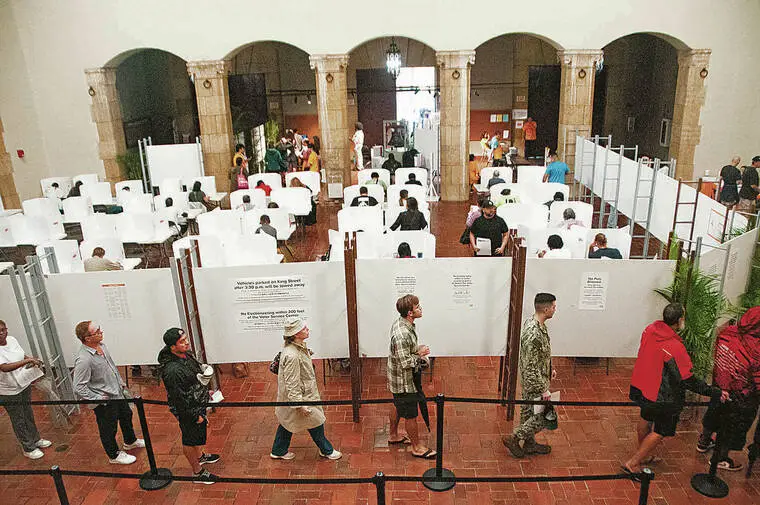
One positive effect the new law may generate is reducing long voter lines on the last day to vote, starting in 2028. The relatively few places around the state to vote in person — after mail-in voting became the dramatically predominant way Hawaii residents vote — allow people to register at the same time, which slows down the procession of people waiting to just vote.
“Voter turnout in our state is dismal,” Beth Anderson said in written testimony on SB 2239 in March. “We need to do everything we can to make it easier to vote, and to be registered to vote.”
Read more Hilo chef and restaurauteur Miyo Harumi dies at 82