CRB battle ramps up: More weapons available for those fighting invasive bug
As Hawaii Island ecologists continue to expand their arsenal in the fight to slow coconut rhinoceros beetle’s spread — including protective netting, chemical treatments, pheromone traps and even scent-detection dogs — they are now trying out a simple, cost-effective prevention measure: green waste bins.
Read more Charlotte Hornets trading LaMelo Ball to Minnesota Timberwolves
As Hawaii Island ecologists continue to expand their arsenal in the fight to slow coconut rhinoceros beetle’s spread — including protective netting, chemical treatments, pheromone traps and even scent-detection dogs — they are now trying out a simple, cost-effective prevention measure: green waste bins.
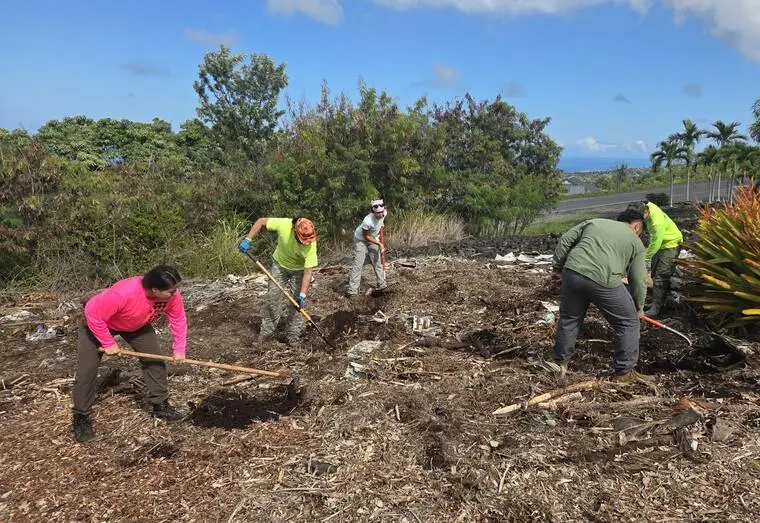
Starting today and continuing through Saturday, residents in the Kona Palisades neighborhood are being offered free green waste disposal services as part of a multi-agency partnership to cut down on the beetle’s breeding habitat. Bins will be available at Lokahi Makai Park located off of Maheu Circle.
According to a Big Island Invasive Species Committee press release, “limited assistance could be available” for residents looking to remove large or difficult-to-move slash piles on their properties.
CRB is an invasive insect responsible for causing extensive damage to palms and other plants across the Hawaiian Islands, where it threatens native species like hala and the endangered loulu (native fan palm).
The large armored bugs also attack food crops like taro, banana, breadfruit, papaya, pineapple, date palms and sugarcane, with reports of hungry adult beetles in heavily infested areas even going after mango trees.
Native to South Asia, CRB has killed or damaged more than 1,000 coconut palms across Oahu in the past decade.
It was first found on Hawaii Island in the Waikoloa area in October 2023 and — after almost two years of little to no detection — the number of adult and larval beetles tallied in north and central Kailua-Kona began to tick up significantly starting in mid-2025.
An on-site inspection of Keahole Agricultural Park by several different agencies last July uncovered two active breeding sites at a landscape nursery, discovering 110 late-state larvae and three adult beetles. Since then, officials had been steadily finding an average of roughly 20 adult beetles per month along with varying numbers of larvae.
This weekend’s green waste removal effort along Kaiminani Drive is a push to remove the beetle’s “host material” that provides ideal conditions for female specimens to lay eggs and for larvae to grow.
This specific neighborhood was chosen due to its proximity to the agricultural park, according to BIISC Program Manager Franny Brewer. The committee is a University of Hawaii partnership working to protect the island from harmful invasive plants and animals.
“That’s ground zero, right there at the base of Kaiminani (Drive),” Brewer told the Tribune-Herald about Keahole Agricultural Park. “That’s where this (infestation) has been radiating out from, so what this is based on is really that location being right up the mountain, basically, directly above the area where we know the beetles are breeding and they are flying uphill.”
That makes Kona Palisades the next logical area for the beetles to spread to based on their behavior, she said.
“Basically we’re going uphill from the breeding spot where we know we’re catching beetles, where we’re seeing breeding populations starting to pop up, so it’s really just based on that,” she said.
When asked whether she thinks the mulch pile removal tactic will pay off, she said it’s too soon to tell.
Read more Hawaii among worst states with SNAP payment errors
“We don’t know — no one’s done it before,” she said. “This is sort of an experimental attempt to see, like, what can we do? We know that green waste is how they spread. They fly, so it’s like they’re flying to these places where there’s green waste. If we can reduce the amount of green waste on the landscape … we’re really hoping that we can, at the very least, do some significant population reduction.”
BIISC stated in its press release that acceptable types of waste include tree branches and limbs, shrubs and hedge clippings, weeds and other yard plants. Household trash, bagged yard waste, construction debris, appliances, electronics and hazardous waste cannot be accepted.
The collected organic materials will be fumigated, finely ground and then heated to ensure all adult beetles, larvae and eggs are destroyed, with the resulting material to be used as mulch.
“There’s going to be three levels of beetle destruction,” Brewer said gleefully.
Although efforts to promote composting and the production of mulch from green waste have seen great success on Hawaii Island, she said the proliferation of CRB in recent years has complicated these well-meaning initiatives.
“That’s something that’s always really difficult,” she said. “Because when a new invasive species comes in, it changes the landscape literally and figuratively, right? So, things that you may have done forever, for years, it’s not that — oh, that action is wrong — it’s that now that might become a risk where it never was before, and so you have to be conscious of that.”
Some assistance in the beetle battle has come in the form of legislation like House Bill 2207, which was signed into law on June 5 by Gov. Josh Green. HB 2207 allows for the sale and distribution of fine mesh mono-filament nets to protect trees and plants from CRB infiltration — a cheap, poison-free control for homeowners and small-scale farmers wary of using insecticides.
While one bill from this year’s legislative session did make it into law, several others were deferred or stalled, including measures that would have established a CRB “bounty” program, created mandatory host material handling and storage rules, and funded “best practices” trainings for tree trimmers, arborists and landscapers.
“I’m glad we got anything, so that was very exciting,” Brewer said about HB 2207. “We’ve very happy about that because now we can actively share these nets and do that community program. Now, we can be more open with our education.”
Other help has come from county and state-level rules, like a voluntary compliance order put in place by Hawaii County on June 25, 2025, that asked residents and businesses to avoid transporting CRB host materials within the affected zone of West Hawaii. This order was intended to give the Hawaii Department of Agriculture and Biosecurity (DAB) time to draft interim rules for Hawaii Island.
These rules were approved by the state Board of Agriculture and Biosecurity on March 24 and restrict the movement of host materials like mulch, trimmings, wood chips, stumps, compost and plant propagation media. BIISC hosted one-hour training sessions in late-April to teach stakeholders about safe transportation and handling practices, resulting in “compliance agreements.”
DAB documents spelling out the restrictions contend that without “effective rules,” CRB’s spread on Hawaii Island would be “so dangerous to the ecological health of flora or fauna present in the state and … so immediate in nature as to constitute an emergency.”
Penalties for breaking these new mandates include misdemeanor charges and fines between $100 and $10,000. Subsequent violations within five years of a prior conviction incur the cost of cleanup and decontamination fees, along with fines up to $25,000.
The CRB-infested area in West Hawaii delineated by the board’s rules is bound by Waikoloa Road from Highway 190 to the coast and continues south to Laaloa Avenue along Ali‘i Drive, and from the coast to its intersection with Highway 11 to the east.
Read more Turkey beats altered US lineup with last-minute goal in group finale
Email Stefan Verbano at [email protected].