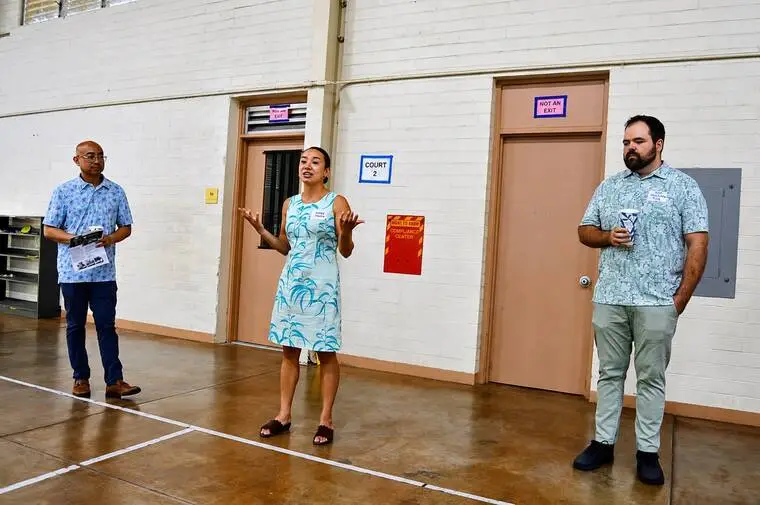
Hawaii Island lawmakers share priorities, concerns at town hall
KEAAU — Three state lawmakers outlined priorities and Puna community members voiced concerns at a June 28 town hall in the Keaau Armory, with the overarching issue being the state’s budget and its effect on one of Hawaii’s most impoverished areas.
KEAAU — Three state lawmakers outlined priorities and Puna community members voiced concerns at a June 28 town hall in the Keaau Armory, with the overarching issue being the state’s budget and its effect on one of Hawaii’s most impoverished areas.
About three dozen audience members engaged with Democratic Reps. Greggor Ilagan, who represents lower Puna, Jeanne Kapela, whose district straddles the southern and southeast coasts of the island from South Kona through Ka‘u north to Kurtistown, and Chris Todd, who represents portions of Hilo and Puna.
“Right before we entered our session, our Council on Revenues — which is a combination of our state economists and some very, very bright people — their projection was that we were going to have about a $1.5 billion budget deficit by the end of our six-year financial plan, which is not a good thing,” said Todd, who chairs the House Finance Committee. “Going back about a year before, it was a $4 billion to $5 billion surplus.
“Much of that difference, a $6 billion to $7 billion difference, was a direct result of two things. One is that they failed to adequately predict the revenue reduction from us passing a very substantial income tax cut in 2024. The second is that we have massive levels of federal uncertainty. And where there is certainty, there is direct cost to the state.”
Todd used as an example additional costs incurred by the state Department of Human Services because of federal laws increasing the state’s cost share for programs including Medicaid and the Supplemental Nutrition Assistance Program, or SNAP. He said the imposition of additional eligibility verification requirements “means we either have to contract those services out or get the staff help at the Department of Human Services to meet this federal obligation,” which he estimated at $70 million yearly.
“That $70 million per year over the course of the financial plan is over $400 million. But that doesn’t even scrape the surface of what could be coming our way, because they put in very punitive measures around SNAP that’ll cut across all 50 states,” Todd explained. “It has to do with what’s called the SNAP error rate. This isn’t, you know, food stamp fraud. This is more a paperwork thing. It’s, like, minor details, right?
“But depending on where you are on the SNAP error rate, the potential cost to the state in penalties is over $100 million. So that’s just the Department of Human Services, and we’re talking about a potential of $200 million per year towards state government. And that’s just touching the state budget, not the theft from everyday working-class folks.
“In a perfect world, we’d pay nothing,” Todd posited. “The number of states that currently fall under the threshold of that 6% error rate threshold — it’s a handful.”
Hawaii’s error rate rose to 10.92% in the 2025 federal fiscal year from 6.68% the year prior after falling from around 21% in each of the two preceding years. It was the 17th-highest error rate, slightly above the weighted national average of 10.62%.
Kapela told the gathering what she is “really excited about is the $50 million we raised for the Keaau outpatient care facility” — the Keaau Benioff Health Center, a 40,000-square-foot facility currently in planning with a projected price tag of $90 million and an expected completion date by the end of 2028.
“So much of that (funding) has come from the state, because we know the importance of building healthcare into our rural communities,” Kapela said. “When we talk about healthcare, we have funding that’s going to Ka‘u Hospital, as well. And in the last couple of years, what we tried to do is assist with their wastewater issues.”
Kapela said a priority for her is helping rural residents with access to improved healthcare, “including potential dialysis.” She added that state funding for a mobile healthcare unit currently operating in Ocean View could be a model for other rural communities, such as Volcano.
“It’s essentially emergency care, critical care for individuals who are in the community,” she said. “We’re looking at trying to replicate that, because these mobile units are much better, faster and easier to utilize. And we can get them on the ground much quicker than a traditional brick-and-mortar. We’re looking at trying to get something like that in Volcano, as well.”
Read more Runnin’ with Rani: Kona Marathon kicks off 4th of July with a bang
Ilagan outlined five priorities, two of which involved improving daily commutes for Puna residents, many of whom sit in highway logjams during peak traffic hours.
“We’ve been trying to push for expanding the Ainaloa roundabout and the installation of two roundabouts to make Makuu and Orchidland safer,” said Ilagan, adding that state Sen. Joy San Buenaventura of Puna “has really pushed for the acceleration/deceleration/right turn (lanes) at Keaau Transfer Station, so that will have another lane to safely go into that transfer station.”
He said the Department of Transportation’s peak-hour contraflow traffic lanes “have been very effective and working very well as we use that as our temporary fix.”
“We would like to see that move into four lanes in the future, but it’s going to take a lot of work to figure out how that’s going to happen.”
With congested Highway 130 the only major highway servicing lower Puna — a major headache should emergency evacuation occur — Ilagan said the push for alternate routes continues, with Todd and Kapela advocating for the Puna Mauka Alternate Route and Ilagan for the Puna Makai Alternate Route.
Wilson Okamoto Corp. is conducting an ongoing feasibility and alignment study on route alternatives, although the final report — originally expected in December — likely is delayed until late next year. Ilagan secured $1 million in state funding with the county ponying up another million.
Ilagan also said $1 million is going toward the design of a pair of protective jetties in Pohoiki Bay.
A $5.4 million dredging project by the Department of Land and Natural Resources to reopen the bay’s boat ramp — which was rendered unusable by sedimentation caused by the 2018 eruption of Kilauea volcano — was unsuccessful as sediment returned quickly to close off boat channels.
“That didn’t go so well with the dredging, but now we’re moving toward a more permanent solution,” said Ilagan, who has publicly taken accountability for convincing colleagues to fund the unsuccessful project.
A man in the audience confronted Ilagan about the failed dredging, pointing out an environmental assessment noted the project could fail.
“Why should we trust you now?” the man asked, rhetorically.
Ilagan tried to reply that the dredging was urged by the community, while the man repeatedly interrupted, mentioning the EA.
Other issues discussed at the town hall included the limited availability and high cost of homeowners’ insurance for residents in lava zones 1 and 2, funding for culture and the arts, creating better legislation on attacks by vicious dogs, water catchment legislation, a perceived land-zoning loophole that’s led to two large residences on numerous Hawaiian Paradise Parks lots, and visa legislation intended to bolster legal rights for certain resident immigrants.
Read more In surprise, Coco Gauff bends the Wimbledon lawn to her will
Email John Burnett at [email protected].

Related Posts

Remembering Hawaii’s 9/11 victims

World Manta Day returns today
