Council committee postpones vote on Waikoloa development
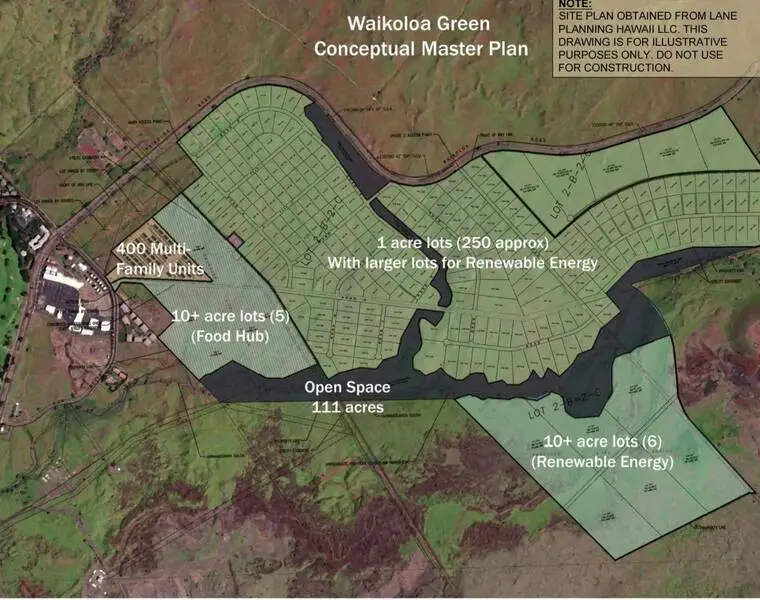
The County Council’s Committee on Legislative Approvals and Acquisitions last week voted 9-0 to postpone until its Oct. 6 meeting a pair of bills seeking approval for a project that would build some 400 apartments and 300 single-family homes on just over 700 acres in Waikoloa.
Read more No. 8 Ole Miss gets late TD, INT to send Lane Kiffin, No. 7 LSU home unhappy
The County Council’s Committee on Legislative Approvals and Acquisitions last week voted 9-0 to postpone until its Oct. 6 meeting a pair of bills seeking approval for a project that would build some 400 apartments and 300 single-family homes on just over 700 acres in Waikoloa.
The Leeward Planning Commission voted 5-0 in June with one excused absence to forward a favorable recommendation for the proposal by Waikoloa Green LLC for its project, which would also include a solar-energy panel field, food hub, community garden and open space with trails.
The land, 711 acres of former Parker Ranch land south of Waikoloa Road near the Paniolo Avenue intersection, was bought for $4 million in 2022 from landowner Waikoloa Highlands by Waikoloa Green LLC, a partnership between New Jersey developer Daniel Popkin and former state senator and Honolulu city councilman Jon Yoshimura, an attorney.
Last Tuesday’s testimony on Bills 186 and 187 — zoning changes needed for the project — was mostly in opposition, with testifiers citing lack of infrastructure to support the growth. Questions included water sufficiency in the windy, arid location, insufficiency of evacuation routes in case of wildfire or other disaster and whether Waikoloa Elementary School could handle the influx of students the housing would bring.
Yoshimura and Popkin said they received a letter from a private water company stating there is sufficient water for the project. The applicants originally estimated the development would require 1.29 million gallons of water a day, but came into the meeting with a reduced estimate of 362,000 gallons daily.
A 2019 estimate by CWRM of a 16-million-gallon a day sustainable yield from the Waimea Aquifer was used as a baseline statistic to justify water sufficiency to build.
Don Thomas, a University of Hawaii geochemist and hydrologist testified “the current conceptual model for groundwater and how groundwater is stored and how it moves through the island is very incomplete” and the state Commission for Water Resource Management derives its sustainable yield statistics “based on that model.”
“This is all by saying we really need to go back and reevaluate … sustainable yields as well as our supposed aquifer boundaries, because they really have no meaning scientifically in where the water is or what quantities of water are there that can be withdrawn,” Thomas testified.
Waikoloa resident Michelle Stefanik asked for the project to be shelved until a second evacuation route is opened, questioning if the entire community can be evacuated safely in case of a disaster.
“Before allowing a change, the county needs to demonstrate that the infrastructure can protect both the people already living here and those who will be moving in to this new development,” Stefanik said. “The county’s 2008 South Kohala Community Development Plan identified a second access road for Waikoloa Village as a, quote, very high priority.
“Eighteen years later, we’re still asking for that same, permanent second road. During the 2021 Mana Road fire evacuation, residents were waiting more than an hour in traffic. That experience demonstrates the difficulty evacuating the community we already have. Please consider the combined evacuation needs for our existing residents and everyone who would be added” with several new housing developments on the books.
“On Aug. 25, the (Hawaii Housing Finance and Development Corp.) withdrew the environmental review exemption for the separate Waikoloa Affordable Apartments project following concerns about evacuation safety. That action reinforces the importance of examining the combined impact for growth before approving it,” she said.
Matt Chalker, executive director of Wildfire Safety Advocates, also noted the withdrawal of the exemption for the project, which in his words is “less than half the size” of the Waikoloa Green proposal. Chalker said his organization wrote HHFDC in July, requesting the environmental exemption be rescinded.
Read more BIIF football: Warriors, Wildcats shut out opponents
“If they want to proceed, they’re going to have to go back and re-do the environmental review, and we don’t see how that ends with anything other than an environmental assessment, and likely an (Environmental Impact Statement) after that.” Chalker testified. “Our understanding is that they came to that decision after conferring with both local state legislators and directly with the governor, personally.
“We know that wasn’t an easy decision. It is slowing down housing that is desperately needed, but it is also doing something more. It is an acknowledgement that barreling ahead without concern for the consequences is dangerous. It’s a state agency agreeing our concerns are valid and they are doing something about it. These are the exact same concerns we’re raising with you on a project that is twice the … size, sharing the same road — and I urge you to follow the state’s lead.”
Chalker said he wanted to emphasize that he and his group are “not opposed to housing,” calling it “a vital human right.”
“But putting people, especially families with young children, in a dangerous situation is not helpful. It is simply setting the state for a tragedy of immense proportions. And I urge this committee to take action today to prevent that future tragedy.”
Rancher Alexander Lancaster testified in strong support of the development.
“As kanaka and Pacific Islanders, we look carefully at large corporations coming into our ‘aina, especially when their development offers little development to the local community. But this project is different,” Lancaster said. “Waikoloa Green brings together housing, agriculture, local employment, food security… . We cannot call housing a crisis while delaying meaningful housing projects. This is not a luxury retreat. These approximately 400 multi-family homes are intended for local people — kupuna and working families. This project will give 400 local families an opportunity for safe, stable housing.
“Water is our most precious resource and must be managed responsibly. But providing water to 400 local families is not wasting water. These families already live on our island and need water every day. This development will use water for one of its most important purposes, supporting the health and stability of our people.”
Yoshimura touted the reduced water consumption estimate, which he said was for “full build-out” of the project.
“This adjustment and new conservation measures that we’re agreeing to will ensure that Waikoloa Green’s impact to the Waimea aquifer is within applicable standards,” Yoshimura said.
Council members had pointed questions for Yoshimura and Popkin about how agriculture and a local food hub were going to be accomplished on bone-dry land unsuitable for planting crops, with the developers replying agriculture will be largely hydroponics and aquaponics.
Puna Councilwoman Ashley Kierkiewicz said she wanted information from CWRM concerning the water situation.
“A lot of checks have been written, but we don’t know if the banks will be able to cash it, right?,” Kierkiewicz said. “I think it’s really important to know if this project being brought to us for our consideration and water commitments already being provided by the private water service — just wanting to do our due diligence making sure there is carrying capacity for the area to support what we all agree to be a very worthwhile project.”
Puna Councilman Matt Kaneali‘i-Kleinfelder said he wanted more information, saying “a lot of question marks out there” amount to a “difficult decision for me.”
“I’ve heard ag. I’ve heard renewable energy. What I heard was ‘a beautiful project.’ I think as we suss out more of the details, there’s a beautiful project on paper — and then there’s the reality of what we’re going to build. … I’d say sharpen up your pencils and come back to us with the project you actually plan to build. Renewable energy, ag, 10-acre lots, food hubs — those things take a lot of water, especially a food hub,” Kaneali‘i-Kleinfelder said.
Read more Kade Anderson delivers best start of career as Mariners stave off elimination
Email John Burnett at [email protected].