Worrisome trend of shorter Hawaii vacations reaches into June
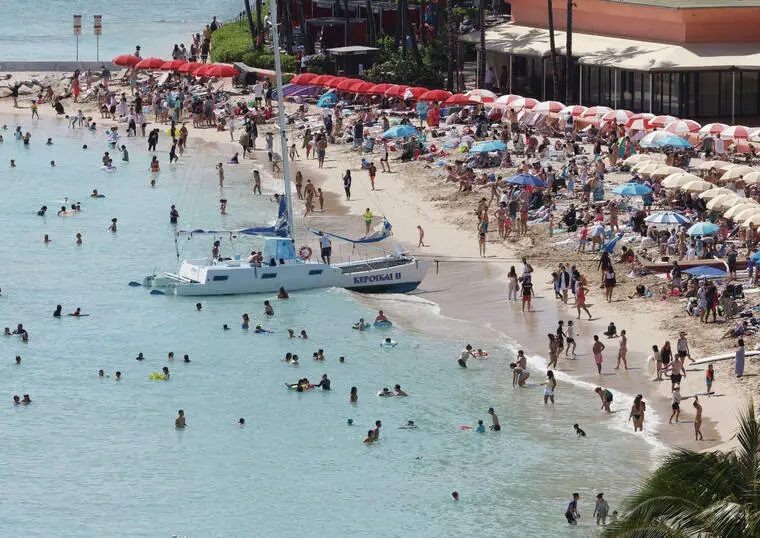
Tourists in Hawaii spent less time here on average in June, representing the third straight month of contraction now solidified as a trend the visitor industry hopes to reverse.
Read more Robbie Ray’s quality start propels Giants past Padres
Yet because slightly more visitors came and spent significantly more per day on average in June, total spending in the state’s biggest industry rose a bit to offset negative impacts of shorter stays.
The latest monthly data on Hawaii’s tourism industry was released Friday by the state Department of Business, Economic Development and Tourism, and is an increasing concern among industry stakeholders.
“That’s very concerning because we want the opposite,” said Keith Vieira, a local hotel industry veteran and principal of KV &Associates Hospitality Consulting. “I’m happy that people are coming, but it’s a (length-of-stay) trend that we have to turn around. You want ideally less arrivals and longer stays. People tend to spend more that way.”
On average, Hawaii visitors spent 7.9 days in the state in June, down from 8.9 days in the same month last year.
Over the first half of this year, the average stay is 8.2 days — the shortest average since at least 2019. The average stay over the first six months of last year was 8.8 days.
Spending less time on a vacation means visitors have less time for dining, shopping and activities. Hotel room revenue also has been negatively impacted.
However, visitors who came in June spent more per day on average: $293 per person versus $259 a year earlier, according to DBEDT’s preliminary data.
The 13.2% jump in average daily spending per visitor helped push up total visitor spending for all of June by 0.6% to almost $1.97 billion from a little more than $1.96 billion in the same month last year, representing a gain of $11 million.
The total number of visitors in June edged up 0.2% to 858,577 from 857,102 a year earlier.
Vieira said he can’t understand where visitors are spending more money because the feedback he has gotten is that hotel room rates and revenue for restaurants and activities are down.
Toni Marie Davis, executive director of the Activities &Attractions Association of Hawai‘i, also questions DBEDT’s preliminary spending data and suspects that tourists could be paying more for parking and resort fees at hotels while revenue is falling for other parts of the visitor industry.
Davis added that visitors may be shortening trips to offset higher prices for things in general driven by inflation and the cost of airfare that isn’t included in visitor spending.
“I think the whole trip is costing more,” she said. “So they have to cut somewhere, and so they cut the number of days.”
Read more Gianni Infantino nixes unpopular proposal to sell stakes in World Cup
DBEDT Director James Tokioka said part of the state’s marketing strategy for tourism coordinated in part by the Hawai’i Tourism Authority is encouraging longer stays by promoting multi‑island travel and visits during shoulder seasons.
“HTA and its marketing partners are also putting greater emphasis on the visitor experience and fostering a deeper connection to Hawaii’s culture and place, as reflected in the Hawai‘i Stays With You campaign,” he said in a statement.
The overall slight gain in Hawaii visitor arrivals in June was produced by more visitors from the mainland — a 9.4% gain from the U.S. East market and a 0.7% gain from the U.S. West market. Those increases offset international visitor decreases of 4.2% from Japan, 15% from Canada and 21.3% from all other parts of the world.
The cruise ship industry also was weaker.
There were no visits from out-of-state ships in June compared with three small vessels that visited a year earlier bringing 1,371 visitors. The locally homeported Pride of America cruise ship in June took on 9,328 passengers who came to the state by plane, down 5.9% from 9,913 visiting passengers a year ago.
One thing that helped sustain visitor arrivals in June was flight capacity form airlines.
There were 5,416 trans-Pacific flights with 1.16 million seats in June, up 8.7% and 4.4%, respectively, from 4,981 flights with 1.11 million seats a year earlier, according to DBEDT.
By island, Oahu and Maui generally had a better June than Kauai and Hawaii island compared with the same month last year.
For Oahu, visitor arrivals edged up 0.5% to 514,992 and spending rose 2.1% to $935 million. Average length of stay on Oahu fell by a half day to 6.7 days.
On Maui, arrivals rose 1% to 229,197 along with a 1% gain in spending to $516 million. Maui’s average length of stay fell by a little over a day to 6.5 days.
Kauai suffered a 4.9% decline in arrivals to 128,883 though spending rose 1.8% to $271 million. The island also had the shortest average length of stay at 6.4 days, which was down by a day.
Hawaii Island was the only island in DBEDT’s report with declines for arrivals, spending and length of stay. Arrivals slipped 0.2% to 154,835.
Spending slid 2.3% to $254 million, and average length of stay contracted by just short of a day to 6.5 days.
Read more Picking 76ers, James seeks chance to prove he’s the greatest