Underwater fiber cable project clears hurdle
Plans are underway to improve internet access across the state by connecting the islands via a new underwater fiber optic cable by next year.
Plans are underway to improve internet access across the state by connecting the islands via a new underwater fiber optic cable by next year.
The Hawaii Islands Fiber Link project is part of the state’s Connect Kakou initiative to increase broadband infrastructure and accessibility. The state has over $400 million available in federal funding for the effort, a portion of which has been allocated toward the estimated $140 it will cost to install the HIFL cable, with the remainder being made up through private sector partnerships.
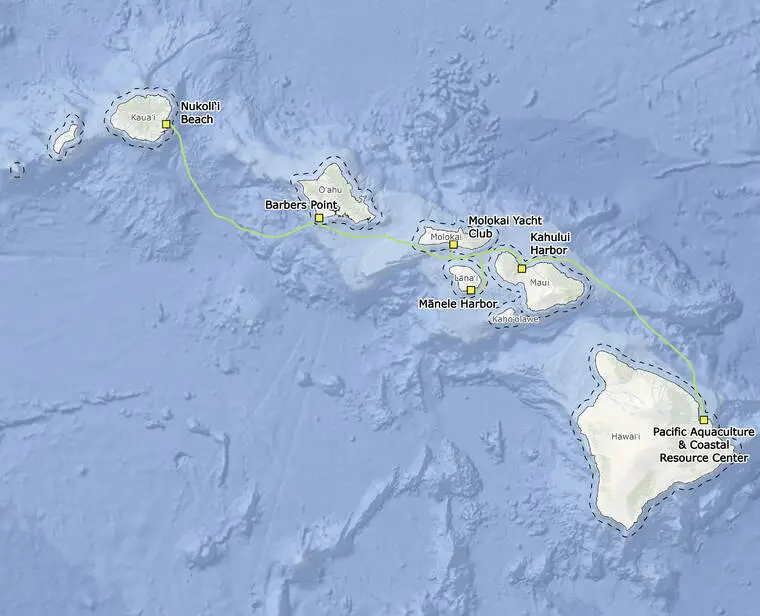
The cable will run from Nukoli‘i beach on Kauai to Barber’s Point on Oahu, the Molokai Yacht Club, Manele Harbor on Lanai and Kahului Harbor on Maui before reaching Hawaii Island, where it will land at the Pacific Aquaculture and Coastal Resources Center, just adjacent to Keaukaha Beach Park.
Garret Yoshimi, who is in charge of public sector broadband projects for the University of Hawaii — which is overseeing the project on behalf of the state — said the landing sites were chosen based on several factors including accessibility and proximity to existing systems. The HIFL cable will be the first to connect to the Hilo side of the island, which Yoshimi said was also a strategic decision.
“We were primarily looking for sites that were public lands, were public-controlled lands, public-controlled facilities, and then also that coincided with the existing carrier infrastructure,” he said.
“The cable will come in on the east side and give us some geographic resilience … so locations were chosen also based on making sure it’s separated from the existing landing stations.”
He said the PACRC site, which is a UH Hilo facility, fit the bill. However, there has been concern from some members of the community about the cable’s route, which will run through a hole drilled beneath Puhi Bay, home to fragile coral reef ecosystems.
Cliff Miyake, chief operating officer of Ocean Networks, the contractor in charge of installing and overseeing the cable, said that the company altered the original plans in response to this feedback so that the drilling will occur farther from the reef.
“The original spot where we were going to pop the conduit up from the sea bottom was a bit too close to shore, I believe, when we originally engineered it,” he said. “So, in meetings with the community and listening to what they wanted to see happen, we decided to move it out. We moved it about 1,500 feet farther out, found a sandy area to pop out, and looked for sand channels to navigate through the coral to get out to the deeper water.”
The cable will also pass under a small portion of Department of Hawaiian Home Lands land, triggering the need for beneficiary consultation. Several community meetings on the matter were held last year, with DHHL ultimately approving a right of entry for to cable to pass through the land.
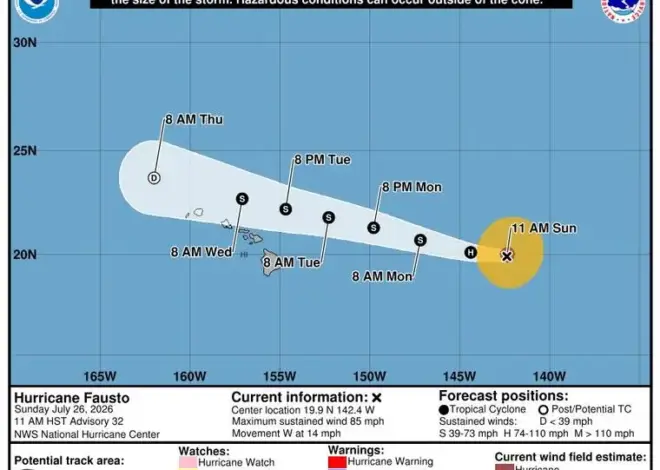
Read more Fausto in Central Pacific, continues toward Hawaii
Yoshimi said that the impact of construction to install the cable will be limited, with no disruption in access to the beach park.
“Aside from, you know, digging a hole where it comes up on the beach and then covering it up, that’s actually the evidence that most people will notice,” he said.
A draft environmental assessment for the project was submitted earlier this year, and the final is expected to be completed in the coming months. While the project was initially slated to be finished in 2026, Yoshimi said it will now likely be sometime in 2027.
“The time frame is still tight, because we do have to go through a bunch of other permitting activities before we actually drop the cable in the water,” he said. “There is a lot of work remaining to do, but we do hope to get the system online and operational next year.”
He said that while the incorporation of feedback is part of what pushed the timeline for the project out, he views it as a necessary and valuable part of the process.
“Doing all the outreach and making sure that we fully can have those conversations, make sure folks understand what we’re actually doing, that’s important,” he said. “That overrides the, ‘yeah we want to get it done quickly.’”
When it does come on line, Yoshimi said the cable will significantly strengthen the state’s existing internet infrastructure, much of which is past its prime.
“These submarine cable systems have a design life of 25 years. … There are three existing systems in the water connecting the islands together. Two of them are actually past that 25 year lifetime. They’re still operational, but they’re past that lifetime,” he said. “This system, the one that we’re building now, not only provides capacity but provides something that’s new, so there’s a new lifetime span.”
Miyake said another takeaway from community engagement was that people wanted better internet connectivity, which he said the cable will help provide.
“I know there’s a lot of folks who we’ve talked to in the communities that have said the internet, you know, it could be better, could be a lot better, and we think this new cable will do much to improve that,” he said.
Read more Gilbert Kahele park closed Tuesday morning for vector control
For more information about the HIFL project, visit: www.hifl.llc/.
Email Grace Inez Adams at [email protected].